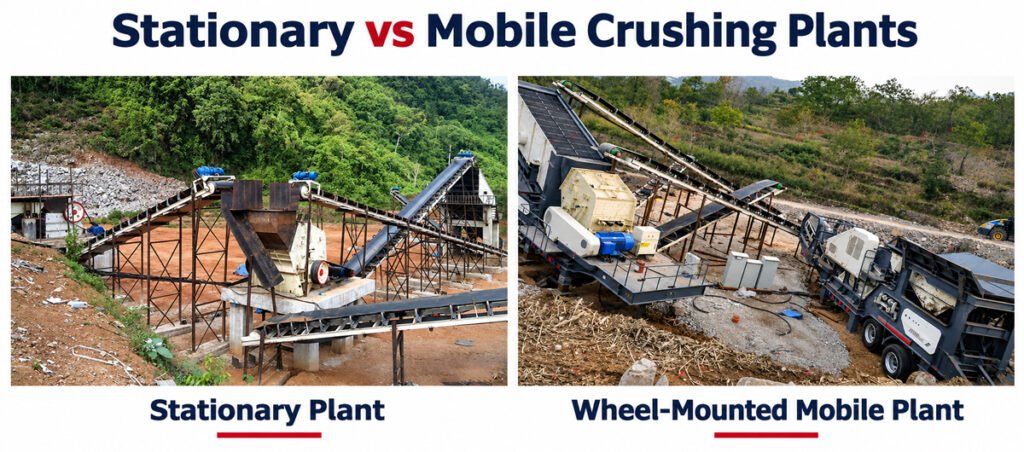
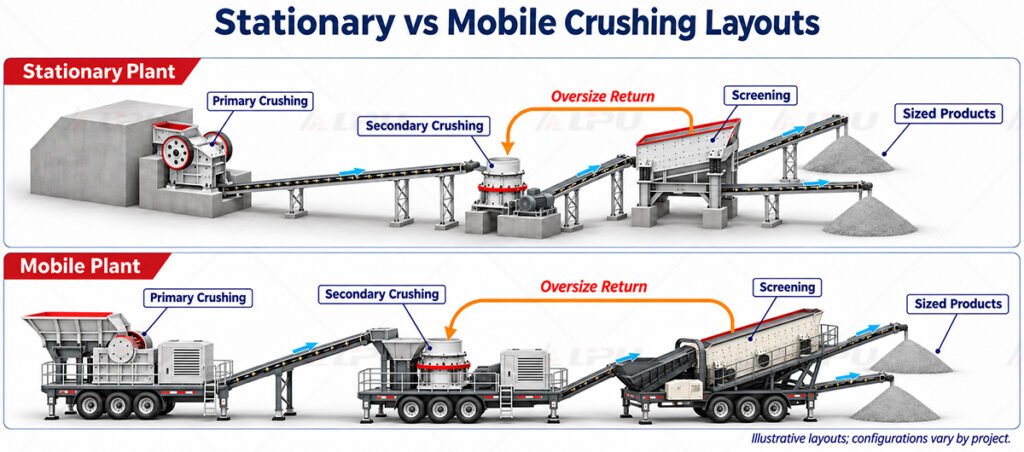
A stationary crushing plant installs crushers, screens and conveyors in a planned fixed arrangement. A mobile crushing plant mounts selected equipment on tracked or wheeled chassis for easier repositioning or transport.
Both can produce suitable crushed material when correctly configured. The better choice depends on the equipment duty, site conditions and how the project will operate.
Before comparing prices, establish what each proposal includes: a primary crushing unit, a combined crushing-and-screening unit, or a complete multi-stage plant.
The main difference is how the equipment is supported, connected and moved.
A stationary plant normally uses separately installed machines connected by conveyors, chutes and supporting structures. A mobile unit integrates selected equipment onto a transportable chassis.
Feature
Stationary Plant
Mobile Plant
Equipment support
Foundations and engineered supporting structures
Tracked or wheeled chassis with model-specific supports
Machine arrangement
Planned around the site and process
Limited by individual unit layouts and connections
Material transfer
Fixed conveyors and chutes
Onboard and inter-unit conveyors
Relocation
Requires planned dismantling and transport
Designed for relocation, with preparation still required
Expansion
Additional equipment can be incorporated into the layout
Additional units can be considered if interfaces are compatible
Site preparation
Designed for the permanent installation
Still requires suitable ground, access and operating space
A mobile plant is not necessarily a complete production line on one chassis. Multiple crushing and screening units may be needed.
Which Machines Can Be Included?
Both arrangements can use jaw crushers, cone crushers, impact crushers and vibrating screens.
Select the crushing mechanism according to the material and required product before deciding how it should be mounted.
For example:
A primary jaw unit may prepare large feed for secondary crushing.
A cone-crushing stage may be evaluated for hard, abrasive material.
An impact-crushing stage may suit appropriate less-abrasive material or recycling duties.
A screening stage separates the required product fractions.
The proposed equipment list should identify each unit’s duty rather than describe every mobile arrangement simply as a “mobile crusher.”
When Is a Stationary Plant Worth Considering?
A stationary arrangement deserves evaluation where production will remain in one location and the project benefits from a purpose-designed layout.
Separately positioned equipment can provide flexibility for feed storage, screening, product conveyors and maintenance access. However, these benefits depend on the actual engineering and available space.
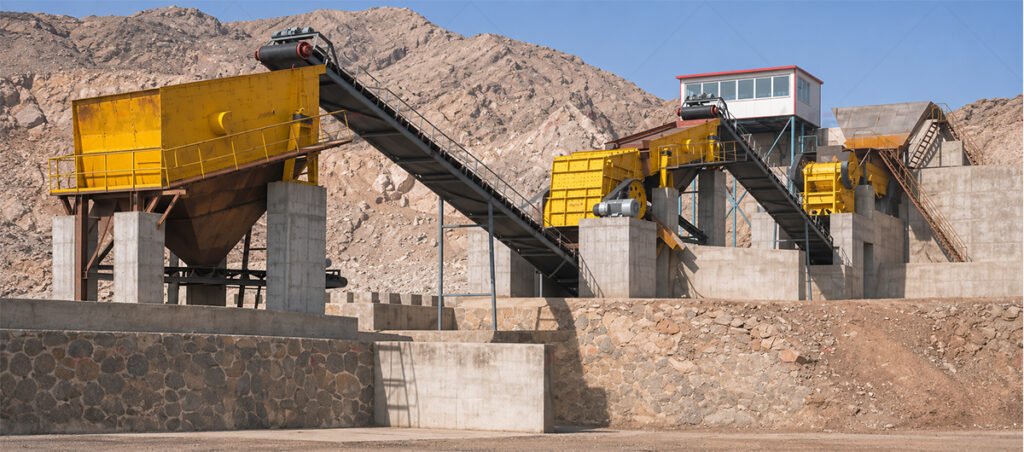
Stationary crushing equipment installed on concrete foundations
Consider a stationary plant when:
The operating location is expected to remain stable.
Several crushing or screening stages are required.
Feed storage and controlled inter-stage transfer are important.
Multiple finished-product stockpiles must be accommodated.
Long-term maintenance and expansion need planned access.
Project duration is relevant, but there is no universal number of years that makes a stationary plant the correct choice.
When Does a Mobile Plant Make More Sense?
Mobile equipment deserves consideration where repositioning or relocation provides a practical operating benefit.
It may allow crushing closer to the material source, support work across several sites, or reduce the need to dismantle separately installed equipment.
However, mobility should solve an identifiable problem. A unit that remains in the same position throughout its working life should still be compared with stationary alternatives.
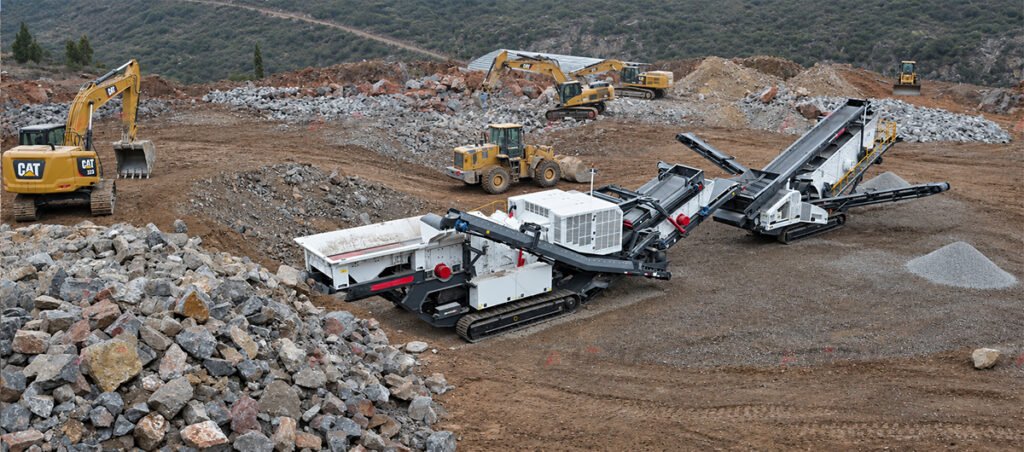
Tracked mobile units combine crushing and screening at the quarry
Consider:
How often the equipment will move.
Whether moves occur within one site or between sites.
Which machines and conveyors must move together.
How material will be loaded and stockpiled.
What preparation is needed before production restarts.
Include relocation downtime in the comparison. Transportable equipment still needs inspection, positioning and operational checks after a move.
What Should You Check on a Mobile Crushing Unit?
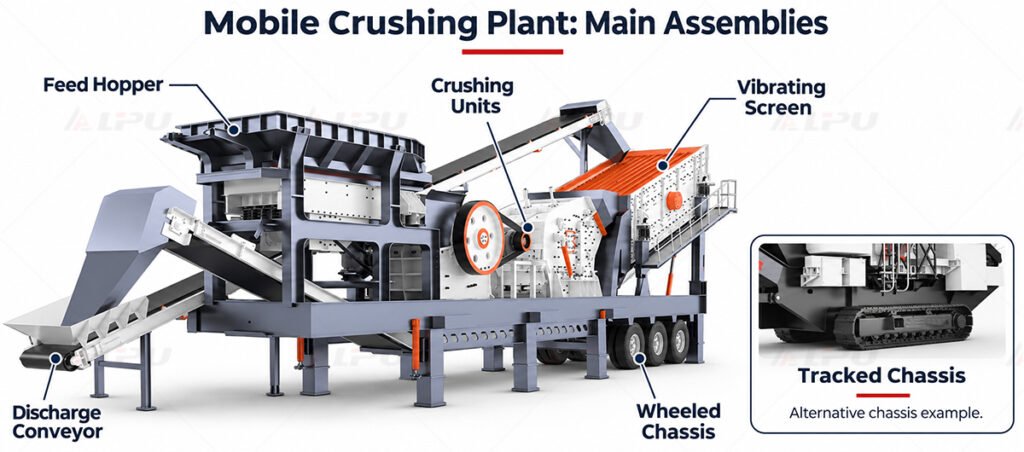
Inspect the complete machine rather than focusing only on its crusher.
Check the complete mobile unit and its service access
Assembly
What to Review
Hopper and feeder
Loading access, feed limits and available pre-screening
Crusher
Type, chamber configuration and operating requirements
Screen, where fitted
Deck arrangement, openings and product outlets
Conveyors
Discharge height, transfer position and transport preparation
Chassis and supports
Operating-ground requirements and positioning method
Power system
Supply arrangement and auxiliary requirements
Controls
Local controls, interlocks and protection functions
Service access
Wear-part replacement, lifting access and inspection space
Onboard equipment varies by model. Confirm whether the screen, return conveyor, magnet or other accessories shown in promotional images are included.
Should You Choose Tracked or Wheeled Equipment?
If mobility is justified, the next decision is how the equipment will move.
Tracked units can reposition under their own travel system within suitable site conditions. Wheeled units are arranged for towing or transport using appropriate vehicles.
Neither should be selected without checking operating and transport requirements.
For an initial comparison, establish:
Ground conditions and access routes.
Expected repositioning distance.
Transport dimensions and weight.
Required transport vehicles.
Conveyor folding or removal requirements.
Positioning, support and connection procedures.
Do not assume tracked equipment can operate on any ground or that wheeled equipment is automatically ready for unrestricted road transport.
How Do You Configure a Complete Crushing Line?
The required material transformation remains the starting point for either arrangement.
For stationary plants, check the fixed transfer arrangements and supporting structures.
For mobile plants, check the interfaces between units. The discharge conveyor must deliver material to the next hopper at a suitable position and rate.
Both arrangements must match the complete crushing duty
Compare the complete line using:
Fresh-feed capacity.
Feed acceptance at each stage.
Required product fractions.
Screen capacity.
Returning oversize load.
Conveyor and stockpile requirements.
Adding several machines with matching catalogue capacities does not automatically produce a balanced plant.
Which Arrangement Costs Less?
There is no universal price advantage. Compare equivalent production duties and clearly defined equipment packages.
Cost Area
Include in the Comparison
Equipment
Crushers, screens, feeders, conveyors and accessories
Installation
Foundations, supports, assembly and commissioning
Utilities
Power connections and required auxiliary systems
Material handling
Loading, haulage, transfer and stockpiling
Relocation
Preparation, transport, reassembly and production interruption
Maintenance
Wear parts, service access, lifting equipment and downtime
A lower crusher purchase price may not represent a lower installed plant cost. Likewise, savings in foundations or material haulage should not be assumed without evaluating the actual layout.
Ask suppliers to price the same feed, products and operating requirements.
What Should Be Included in the Quotation?
A useful quotation identifies the equipment and the boundaries of supply.
Confirm:
Machine models and quantities.
Crusher configuration and wear-part specification.
Screens, decks and supplied screen media.
Feeders, conveyors and return systems.
Drives, controls and electrical equipment.
Supporting structures, platforms and guards.
Installation responsibilities and drawings.
Commissioning support and recommended spares.
For mobile equipment, include transport configuration, operating dimensions and any items that must be removed before relocation.
For stationary equipment, clarify responsibility for foundations, structural engineering and interconnecting equipment.
What Information Should You Send LIPU?
Provide the material type, maximum feed dimensions, required throughput and finished-product specifications.
Add site photographs or a layout, available power information and the expected movement plan. Explain whether you need one machine, an additional stage or a complete plant.
LIPU can evaluate stationary equipment and mobile crushing configurations against these requirements. A clear enquiry helps establish a comparable equipment scope before model and price discussions.
Frequently Asked Questions
Can a mobile plant process hard rock?
Yes, with suitable crushing equipment and configuration. Chassis type does not replace the need to assess feed properties and crusher duty.
Does one mobile crusher produce several finished sizes?
Only if the arrangement includes suitable screening and product handling. A primary crushing unit alone should not be assumed to provide several screened products.
Does mobile equipment eliminate site preparation?
No. Suitable ground, access, operating space and required connections still need to be established.
Is a stationary plant always cheaper over the long term?
No. Installation, material transport, utilization, maintenance and relocation requirements affect the comparison.
Can more mobile units be added later?
Possibly, provided feed acceptance, capacity, conveyor interfaces and controls are compatible.
Should fixed and mobile proposals use the same capacity target?
Yes. Compare equivalent feed and finished-product requirements, including screening and return loads where applicable.


We will reply to you within 24 hours