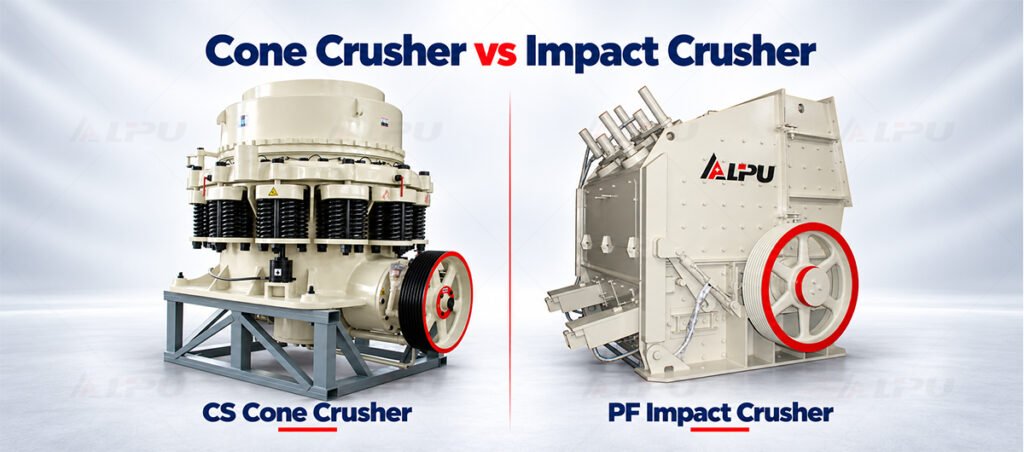
A cone crusher is often considered for secondary crushing of hard, abrasive rock. A horizontal-shaft impact crusher is often considered for suitable less-abrasive materials where aggregate shape and reduction are important.
However, neither machine is the best choice for every plant. The decision depends on the actual feed, required products and cost of delivering those products consistently.
This guide compares cone and impact crushers as alternatives after primary crushing, focusing on material suitability, product quality, circuit design and operating costs.
A cone crusher compresses material between a moving mantle and a stationary concave. An impact crusher uses rotating blow bars and impact surfaces to break the feed.
These breaking actions create different requirements for feed preparation, wear components and operating control.
Selection Factor
Cone Crusher
Horizontal-Shaft Impact Crusher
Crushing action
Compression
High-speed impact
Common secondary duty
Hard-rock and abrasive-material crushing
Suitable less-abrasive rock and recycled-material crushing
Product considerations
Size reduction with chamber and feed control
Size reduction and aggregate shaping
Main wear components
Mantle and concave
Blow bars and impact liners
Important operating factors
Cavity selection, feed distribution and chamber level
Feed characteristics, rotor configuration and impact settings
Main economic question
Can the selected chamber deliver the required products efficiently?
Do product benefits justify wear and maintenance requirements?
This comparison covers horizontal-shaft impact crushers. Vertical-shaft impactors used for shaping and sand production require a separate assessment.
How Do Hardness and Abrasiveness Affect Selection?
Hardness and abrasiveness describe different material characteristics.
A rock may resist breakage without wearing metal as quickly as another rock of similar strength. Mineral composition, including abrasive constituents, should therefore be considered alongside resistance to crushing.
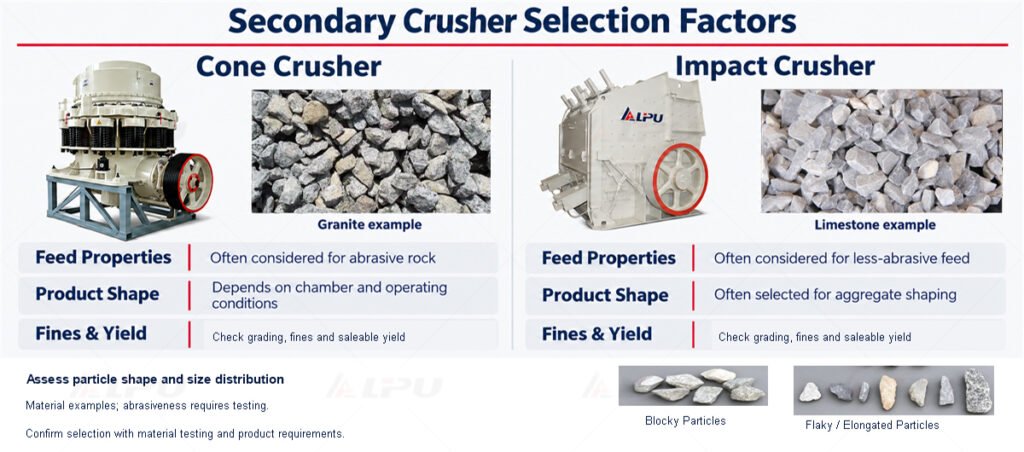
For abrasive granite, quartz-rich rock or similar feed, a cone crusher is commonly evaluated for secondary reduction. Impact crushing may still be technically possible, but blow-bar and liner consumption can affect its economics.
For suitable limestone and other less-abrasive materials, an impact crusher may offer an attractive combination of reduction and aggregate shape.
Rock names provide a starting point, not a final specification. Representative samples and available test results should support selection, particularly where the deposit changes across the working area.
Which Crusher Produces Better Aggregate Shape?
Impact crushing is often selected where cubical aggregate shape is important. However, cone crushers can also produce good-shaped aggregate when the equipment and operating conditions suit the application.
Cone-crusher results depend on the chamber, feed distribution, operating settings and circuit arrangement. Impact-crusher results also depend on the material, rotor configuration and impact settings.
Match crusher selection to feed properties and required products
Compare product samples against the project’s requirements for:
Particle-size distribution.
Particle shape.
Saleable aggregate fractions.
Acceptable fines content.
Product shape should be evaluated together with yield. Producing more fine material may be useful in one project but undesirable in another.
For example, a quarry selling several coarse aggregate sizes should compare the tonnes produced in each saleable fraction. A visually attractive product does not compensate for excessive material reporting to an unwanted fine fraction.
For ore preparation before grinding, suitable mill-feed size and stable throughput may matter more than aggregate appearance.
How Does the Choice Change Between Applications?
The following examples illustrate selection priorities rather than fixed equipment rules.
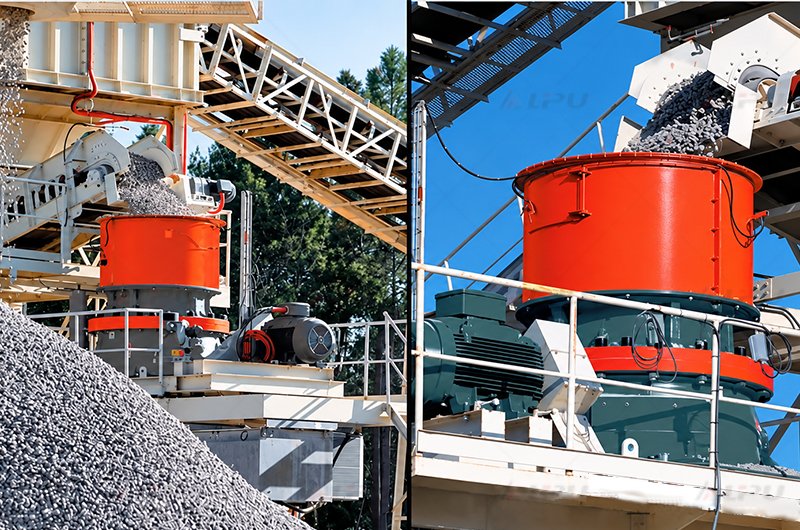
Cone crusher used for secondary crushing of granite
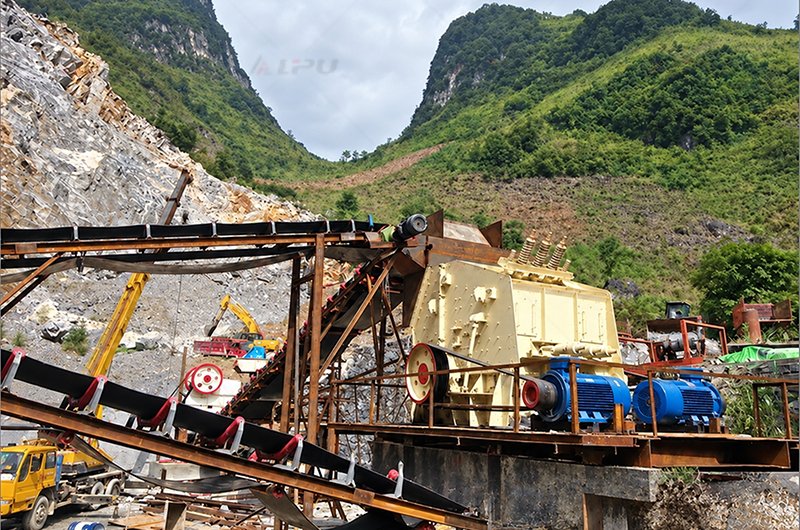
Impact crusher used for limestone aggregate
Application
Equipment Commonly Evaluated
Main Questions
Abrasive granite aggregate
Cone crusher
Can the selected chamber achieve the required grading and shape at acceptable wear cost?
Suitable low-abrasion limestone
Impact crusher
Does the product distribution meet sales requirements without excessive unwanted fines?
Hard ore before grinding
Cone crusher
Can the circuit supply consistent mill feed at the required throughput?
Suitable recycled concrete
Impact crusher
Can the feed be prepared and contaminants managed while meeting recycled-product requirements?
For granite aggregate, start by examining abrasiveness and finished-product specifications. A cone crusher may suit secondary reduction, while further shaping should only be added if the product requires it.
For limestone aggregate, assess both shape and size distribution. Impact crushing may be attractive, but the proposal should show how much material is expected in each required product fraction.
For ore before grinding, judge the secondary stage by its contribution to the grinding circuit. Stable feed size, continuity of supply and operating cost are often more relevant than producing a finished aggregate shape.
These examples also show why similar plant capacities do not necessarily require the same crusher arrangement.
How Should You Match the Crusher to Primary Discharge?
Evaluate the primary crusher’s discharge as a size distribution rather than a single maximum dimension.
Check the largest particles, the proportion of fines and the stability of incoming flow. Moisture and clay can also affect feeding, crushing and screening.
For a cone crusher, the selected cavity must suit both feed acceptance and the required discharge setting. Feed distribution and chamber level should follow the proposed model’s operating guidance.
For an impact crusher, confirm feed-size limits, rotor configuration and suitable operating settings.
Pre-screening may allow selected material to bypass secondary crushing, but it should be justified by feed characteristics and circuit requirements. Material smaller than a crusher setting is not automatically a finished product.
Any bypassed stream must have a defined destination, such as final screening or another processing stage.
Why Does the Screening Circuit Matter?
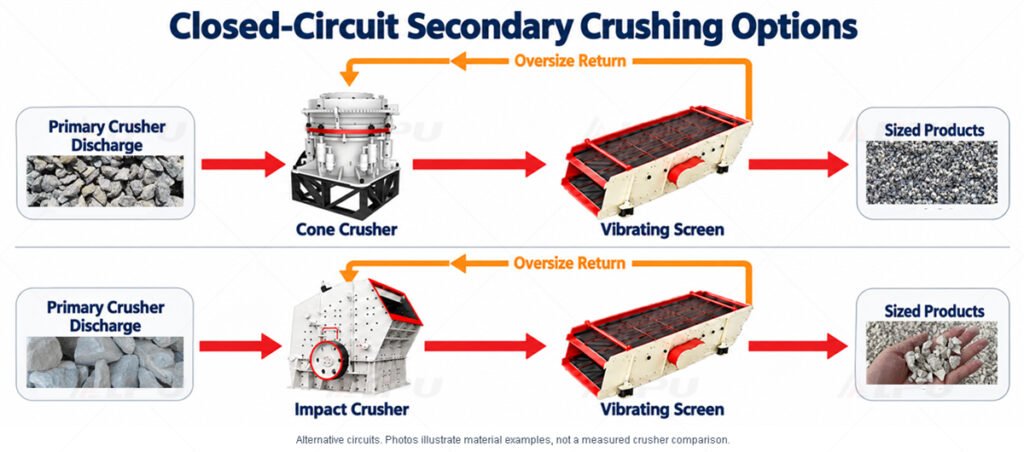
A secondary crusher should be selected together with its screen and material-handling equipment.
Screen oversize returns to the selected secondary crusher
The secondary crusher handles fresh feed plus returning oversize. Its working load can therefore exceed the plant’s fresh-feed rate.
Before comparing models, establish the required screen cuts, expected product distribution and returning load. Check whether the screen and conveyors can support the same duty.
A larger crusher alone will not resolve a restriction caused by inadequate screening or material transfer. Poor screening can also send material back unnecessarily, increasing circulating load.
Which Crusher Has Lower Operating Costs?
Compare the complete cost of producing the required products rather than purchase price alone.
Cost Item
What to Evaluate
Wear parts
Consumption, replacement cost and the material assumptions behind estimates
Energy
Consumption relative to production under comparable conditions
Maintenance
Replacement procedures, access and expected downtime
Product yield
Tonnes meeting the required saleable specifications
Circuit requirements
Screening, returning load and additional crushing stages
A cone crusher may offer a wear-cost advantage in an abrasive application. An impact crusher may be attractive where the material is suitable and its product characteristics benefit the project.
Compare wear costs per tonne rather than the price of one replacement component. A cheaper wear part may not provide a lower operating cost if replacement is frequent or requires lengthy production interruptions.
Similarly, compare energy against the required output. Rated motor power alone does not establish energy consumption per tonne of saleable product.
Ask suppliers to use the same feed and product specifications when preparing estimates.
What Selection Mistakes Should You Avoid?
Choosing by hardness alone. Include abrasiveness, feed grading, moisture and clay conditions in the assessment.
Comparing catalogue capacities directly. Capacity ranges may represent different materials, settings and feed conditions. Confirm the assumptions behind each proposal.
Prioritizing shape without checking yield. Evaluate the complete product distribution, including unwanted fines and returning oversize.
Ignoring the existing plant. Check feed arrangements, supporting structures, conveyors, screen capacity and maintenance access before replacing a crusher.
Assuming tighter settings always improve production. Settings affect grading, load and operating limits. Assess changes across the circuit rather than treating smaller discharge as an automatic improvement.
What Should You Send LIPU for Selection?
For an initial recommendation, provide:
Material type and available test information.
Primary-crusher discharge grading and maximum particle dimensions.
Share your material and production requirements to discuss a suitable secondary crushing arrangement.
Frequently Asked Questions
Is a cone crusher always better for hard rock?
It is commonly considered for hard, abrasive secondary-crushing duties. The final choice also depends on feed size, product requirements, chamber selection and operating economics.
Can an impact crusher process granite?
Some applications may be technically feasible, but granite properties vary. Evaluate abrasiveness and expected wear rather than assuming that the ability to break the material makes the application economical.
Can a cone crusher produce cubical aggregate?
Yes. Suitable equipment and operating conditions can produce good aggregate shape. Verify product quality against the required specification.
Do both crushers need a closed circuit?
Not always. Open or closed operation depends on the product requirements and flowsheet. When oversize is returned, include its additional load in equipment selection.
Can an impact crusher be replaced by a cone crusher?
Possibly, but it is not a direct substitution based on capacity alone. Feed acceptance, product grading, particle shape, installation and screening requirements must be reassessed.


We will reply to you within 24 hours