Choosing gravity separation equipment starts with the material entering the machine. Mineral density matters, but so do liberation, particle size, feed rate and the required concentrate quality.
A centrifugal concentrator, shaking table and spiral concentrator can all recover heavy minerals. However, they perform different duties and should not be selected by nominal capacity alone.
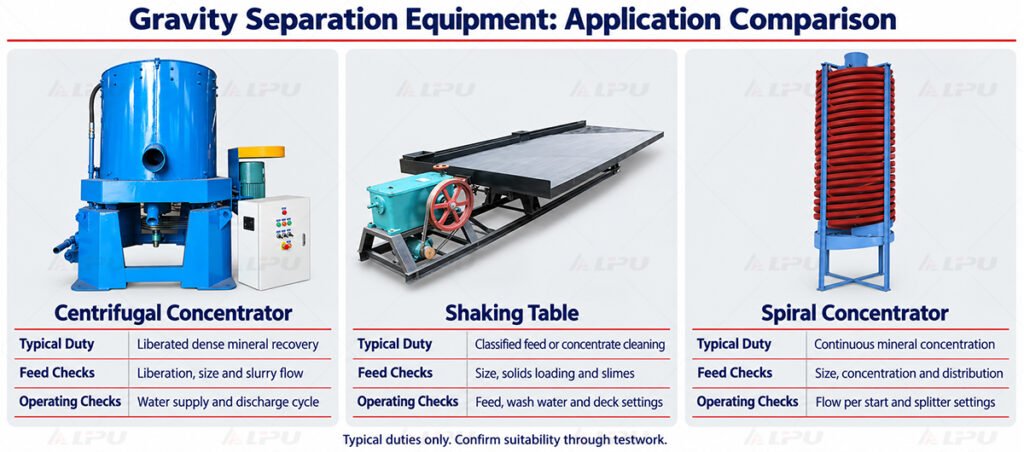
Compare typical duties and selection factors for three gravity separators
This guide compares these three common equipment types and explains how to match them to a mineral processing application.
What Determines Whether Gravity Separation Is Suitable?
Gravity separation uses differences in particle behavior under gravity or enhanced gravitational forces. Density is important, but particle size and shape also influence separation.
The valuable mineral must be sufficiently liberated for its properties to differ from those of the unwanted material. A dense mineral locked inside a lighter particle may not respond like a liberated grain.
Before comparing equipment, establish:
Which valuable and gangue minerals are present.
How liberation changes across particle sizes.
Where the valuable mineral occurs in the size distribution.
How much clay and fine material enters the process.
What grade and recovery the project requires.
A high feed grade does not automatically indicate good gravity response. Representative separation tests provide a stronger basis for selection.
How Do the Main Equipment Types Compare?
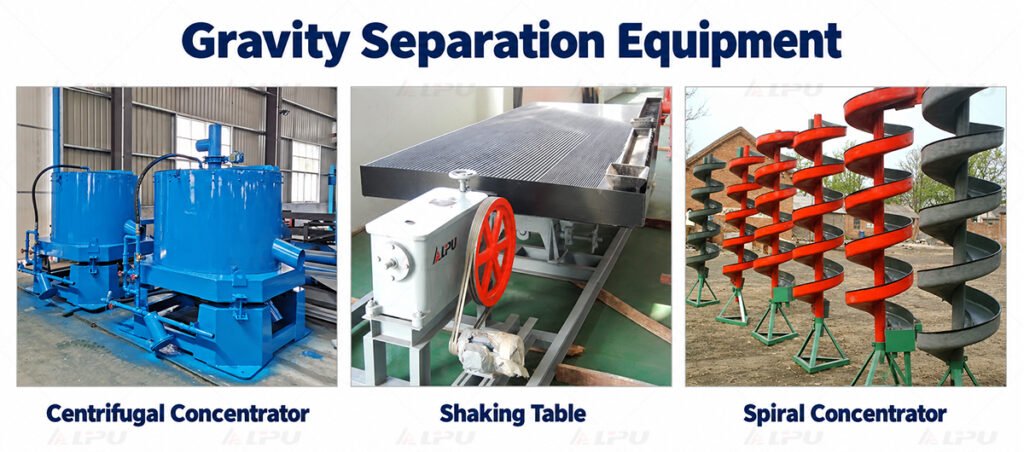
Three common types of gravity separation equipment for mineral processing
Equipment
Common Duty
Main Selection Considerations
Centrifugal concentrator
Recovery of liberated dense minerals, particularly free gold in suitable applications
Gravity response, feed size, water requirements and concentrate discharge mode
Shaking table
Separation of classified feed or upgrading of gravity concentrates
Particle-size distribution, solids loading, wash water and required product quality
Spiral concentrator
Continuous concentration of suitable mineral slurries
Mineral density, feed grading, slurry flow, solids concentration and feed distribution
These are typical duties rather than fixed rules. Equipment design and test results determine the operating limits of a particular application.
When Should You Consider a Centrifugal Concentrator?
A centrifugal concentrator uses a rotating bowl to create an enhanced gravitational field. It can be considered where liberated dense particles are difficult to recover using conventional gravity equipment.
Free-gold recovery is a common application. However, a centrifugal concentrator cannot compensate for gold that remains enclosed in other minerals.
Centrifugal Concentration in a Gravity Processing Plant
Important selection questions include:
What proportion of the valuable mineral responds to gravity recovery?
Can the selected machine accept the proposed feed?
What water flow, pressure and quality does it require?
How much concentrate will it produce?
Is concentrate discharge batch, semi-continuous or continuous?
Discharge mode matters when integrating the machine into a plant. Concentrate collection and subsequent treatment must suit the actual operating cycle.
When Is a Shaking Table the Better Choice?
A shaking table combines deck motion and flowing water to separate particles into different product streams.
Shaking Table Arrangement for Mineral Gravity Separation
Tables can treat suitably prepared ore or upgrade an existing gravity concentrate. Applications include gold, tin, tungsten and tantalum-bearing materials, where mineral characteristics support separation.
Feed preparation is especially important. A broad mixture of coarse and fine particles can make separation more difficult, while unstable feeding can disturb the product bands.
Evaluate the table using the stream it will actually receive. A table cleaning a small concentrate stream should be sized for that duty rather than the plant’s total ore throughput.
Where middlings are produced, testing should establish whether they need further cleaning, regrinding or another treatment.
When Should You Choose a Spiral Concentrator?
A spiral concentrator separates particles as slurry flows down a shaped spiral trough. Separation depends on density, size, shape and the flow conditions within the trough.
Spirals are used in applications such as chromite, iron ore and mineral sands processing. They can perform roughing, cleaning or scavenging duties, depending on the circuit.
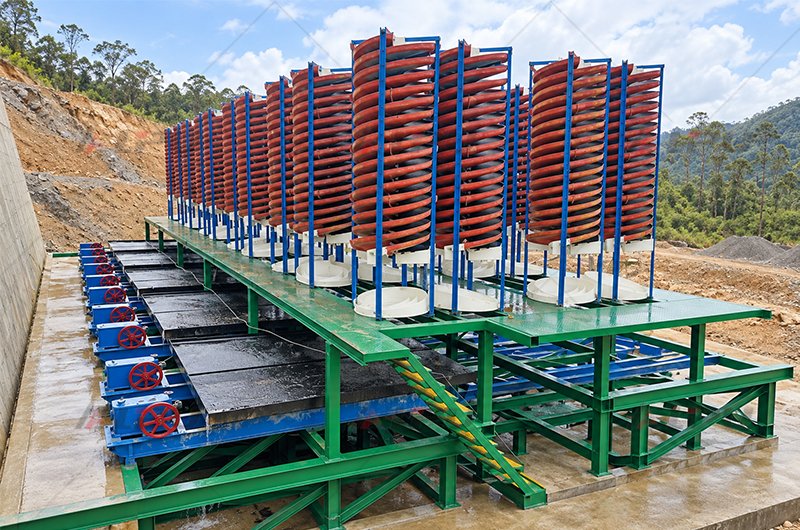
Spiral Concentrator Bank for Continuous Mineral Separation
The spiral trough has no moving parts, but the complete system still needs suitable slurry delivery and feed distribution.
For selection, check:
The particle-size range suited to the proposed spiral design.
Dry solids feed and slurry volume per spiral start.
Distribution between multiple starts.
The influence of slimes and changing feed composition.
Concentrate, middlings and tailings characteristics.
Do not apply one universal particle-size range to every spiral. Different trough designs serve different materials and separation duties.
Why Do Classification and Desliming Matter?
Gravity equipment responds to particle size as well as density. Preparing a suitable size range can therefore improve the conditions for separation.
Classification may divide the feed into streams for separate treatment. Screening may remove material that exceeds an equipment feed limit.
Desliming requires more care. Removing fine material may improve downstream operation, but the removed stream can also contain valuable minerals.
Before discarding slimes, measure their mass and valuable-mineral content. Feed preparation should improve the complete circuit’s performance rather than transfer losses to an unexamined stream.
Can Different Gravity Separators Work Together?
Yes. Different machines can perform successive duties when testwork supports the arrangement.
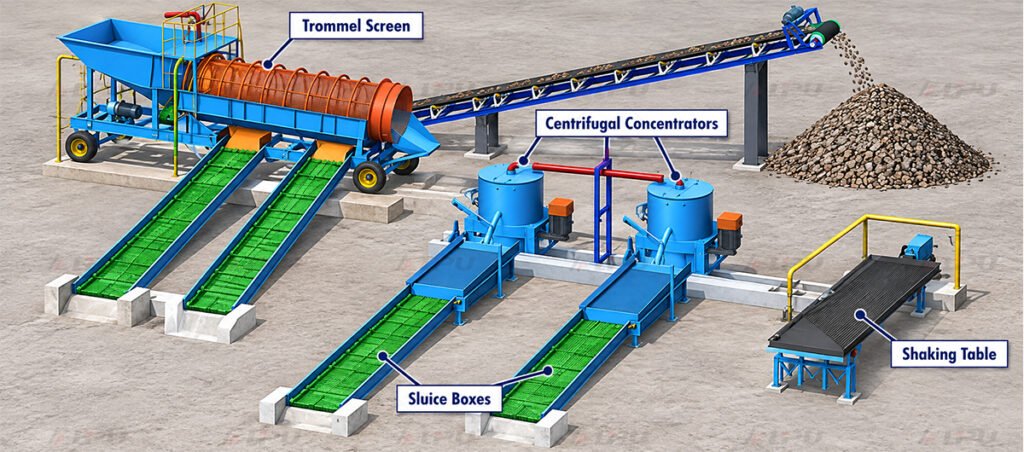
For example, a centrifugal concentrator may recover a gravity concentrate that is subsequently cleaned on a shaking table:
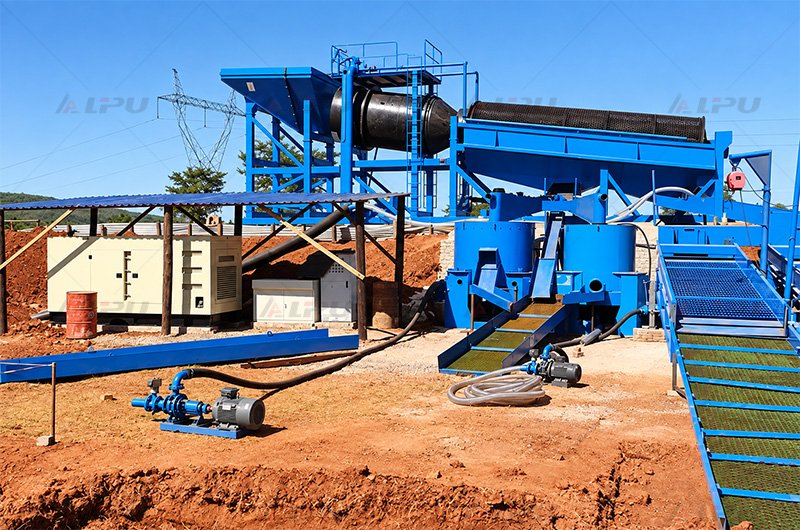
Example equipment layout combining screening and gravity separation
The centrifugal tailings form a separate stream. Their destination must be determined by the overall flowsheet rather than assumed to be final waste.
A spiral circuit may similarly use rougher and cleaner stages. Middlings may require further treatment, but returning them indefinitely can increase circulating load.
A complete flowsheet should identify the destination of every concentrate, middlings and tailings stream.
How Should You Compare Capacity and Test Results?
Compare equipment using the same feed and separation objective.
Record dry solids throughput and slurry flow separately. Two feeds with the same tonnes per hour can impose different hydraulic loads if their solids concentrations differ.
Test results should report more than recovery alone:
Result
Why It Matters
Concentrate grade
Indicates the quality achieved
Recovery
Measures valuable material reporting to the selected product
Concentrate mass yield
Establishes the load sent to downstream treatment
Performance by size fraction
Identifies where recovery or selectivity changes
Water requirements
Supports utility and operating-cost assessment
Response to feed variation
Helps evaluate operation beyond one test condition
A higher recovery obtained by collecting much more gangue may increase downstream processing requirements. Compare grade, recovery and mass yield together.
What Information Should You Send for Equipment Selection?
Prepare the mineral type, available mineralogical information, feed-size distribution, required throughput and representative test results.
Also provide the proposed equipment duty, water availability and target product quality. Explain whether the machine will treat original feed, a classified fraction, a concentrate or a tailings stream.
LIPU supplies centrifugal concentrators, shaking tables and spiral concentrators. Share your material information and processing requirements to discuss suitable equipment and testing needs.
Frequently Asked Questions
Which gravity separator is best for gold recovery?
The choice depends on how the gold occurs and the prepared feed. A centrifugal concentrator may be evaluated for liberated gold recovery, while a shaking table may treat classified feed or clean gravity concentrates. Testwork should establish the appropriate duties.
Can a shaking table process raw ore directly?
It can treat suitably prepared ore within its operating limits. Unscreened feed containing oversized particles, clay lumps or excessive slimes may require preparation before tabling.
Is a spiral concentrator only used for gold?
No. Spirals are used for several mineral applications, including chromite, iron ore and mineral sands. Suitability depends on the material and spiral design.
Should all fine material be removed before gravity separation?
No. Fine fractions may contain recoverable valuable minerals. Assess their mass, grade and separation response before deciding whether to remove or treat them separately.
Can gravity separation replace flotation or other processes?
In some applications it can provide the main separation stage. In others, it forms part of a combined flowsheet. The decision depends on liberation, process response and the required final product.


We will reply to you within 24 hours