Selecting mineral processing equipment should start with the ore—not with a machine capacity table.
Two deposits may contain the same valuable mineral and require similar plant throughput, yet need very different crushing, grinding and beneficiation circuits.
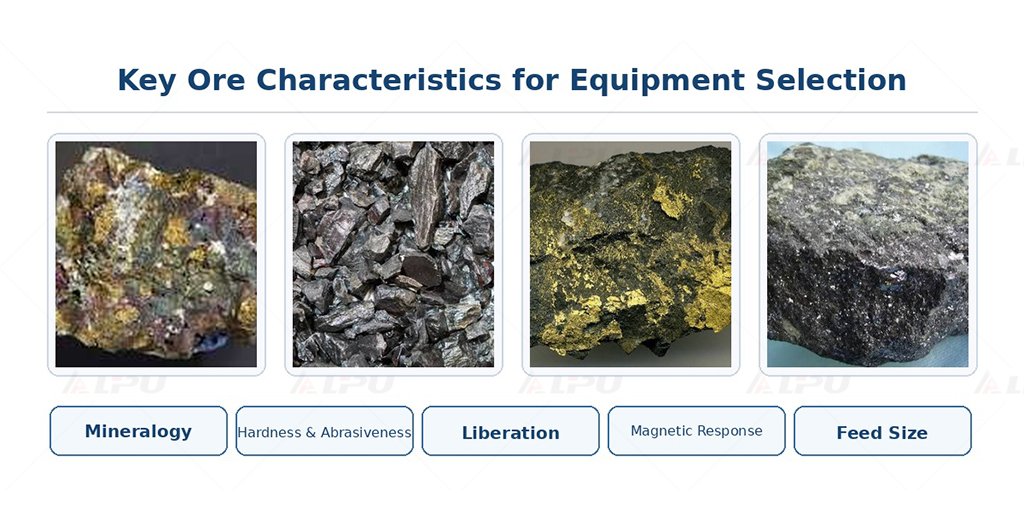
Mineralogy, hardness, feed size, liberation behavior, density, magnetic response and surface properties can all change the required process.
Processing capacity matters, but capacity alone cannot determine a mineral processing flowsheet.
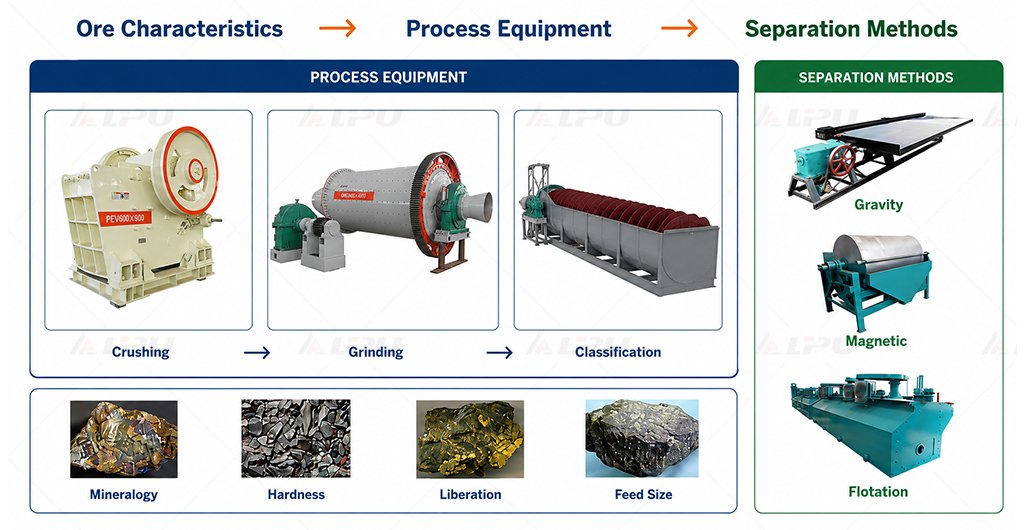
A magnetite ore, for example, may rely heavily on grinding, classification and magnetic separation. A sulfide copper or lead-zinc ore may require flotation. A sufficiently liberated heavy mineral may be suitable for gravity concentration.
Even ores containing the same valuable mineral can behave differently.
The reason is that an ore contains valuable minerals, gangue minerals and different mineral associations. Grain size, texture and physical properties influence how easily these components can be separated.
Before equipment is selected, several questions need answers:
What valuable minerals are present?
Which gangue minerals are associated with them?
How hard and abrasive is the ore?
What is the incoming feed size?
At what size are the valuable minerals sufficiently liberated?
Is there a useful density difference?
Are the target minerals magnetic?
Can flotation exploit differences in surface properties?
Is clay or excessive moisture present?
What processing capacity is required?
What final product or concentrate is expected?
These factors affect both equipment selection and circuit configuration.
Which Ore Characteristics Matter Most?
The most important ore characteristics do not all affect the same part of the plant.
Mineralogy and physical properties influence every stage of ore processing
Ore Characteristic
Why It Matters
Main Process Impact
Mineral composition
Identifies valuable minerals and gangue
Separation route
Ore texture
Influences mineral association
Grinding and separation
Hardness
Affects resistance to size reduction
Crushing and grinding
Abrasiveness
Influences wear
Crushers, mills and liners
Feed size
Determines reduction requirements
Crushing and screening
Liberation characteristics
Determine required grinding
Grinding and classification
Density difference
Indicates gravity separation potential
Jig, table, spiral
Magnetic susceptibility
Determines magnetic response
Magnetic separation
Surface properties
Influence flotation response
Flotation
Clay and moisture
Affect handling and screening
Washing and feeding
Required capacity
Determines equipment size
Entire circuit
No single factor should be considered in isolation.
High hardness, for example, may increase grinding demand. It does not necessarily mean that the ore must be ground extremely fine.
The required fineness depends more directly on mineral liberation and the needs of the downstream separation stage.
Likewise, identifying an ore as “iron ore” does not automatically determine the beneficiation method. The mineral form, gangue association and magnetic characteristics still matter.
How Do Hardness and Feed Size Affect Crushing?
The crushing section prepares run-of-mine ore for grinding or direct beneficiation.
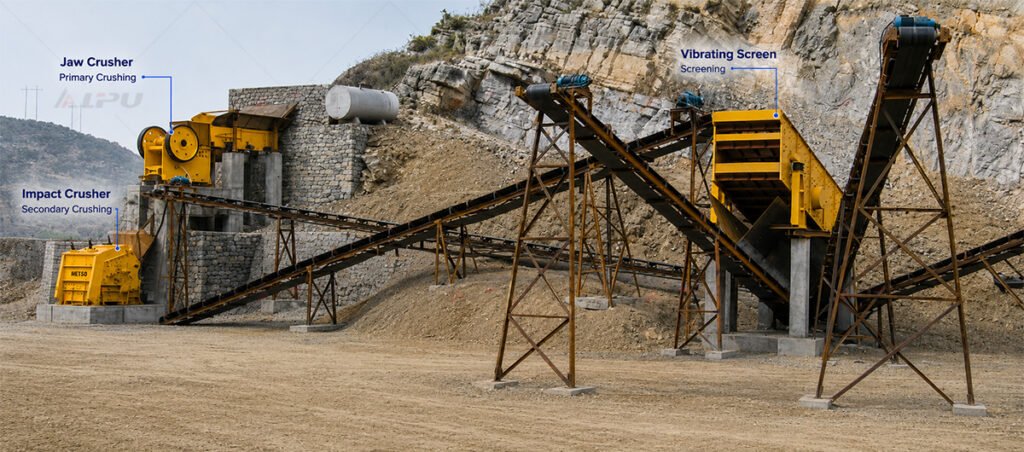
Primary crushing, secondary crushing and screening prepare a stable feed for downstream processing
Large feed generally requires primary size reduction first. A jaw crusher is commonly used at this stage because it can handle relatively large feed and prepare a more manageable product for downstream equipment.
Hard or abrasive ores may then require further compression crushing before grinding.
However, crusher selection should not be based only on rated tonnes per hour.
The real question is whether the crushing section can provide the required feed size, consistency and throughput to the next stage.
If the crushed product remains unnecessarily coarse, the grinding circuit must perform more size reduction.
On the other hand, adding extra crushing stages without a clear process benefit can increase wear, power demand and plant complexity.
Actual crushing performance can also change with:
ore hardness;
feed gradation;
moisture;
crusher setting;
screening performance;
circuit arrangement.
For this reason, the useful question is not simply:
“Which crusher has enough capacity?”
It is:
“Which crushing configuration can prepare this ore correctly for the next processing stage?”
Grinding Is Really About Mineral Liberation
After crushing, valuable minerals may still be locked together with gangue.
Grinding breaks those particles further so the valuable mineral phases become sufficiently exposed for separation.
The progression can be visualized as:
Locked Particle → Partially Liberated Particle → Liberated Mineral
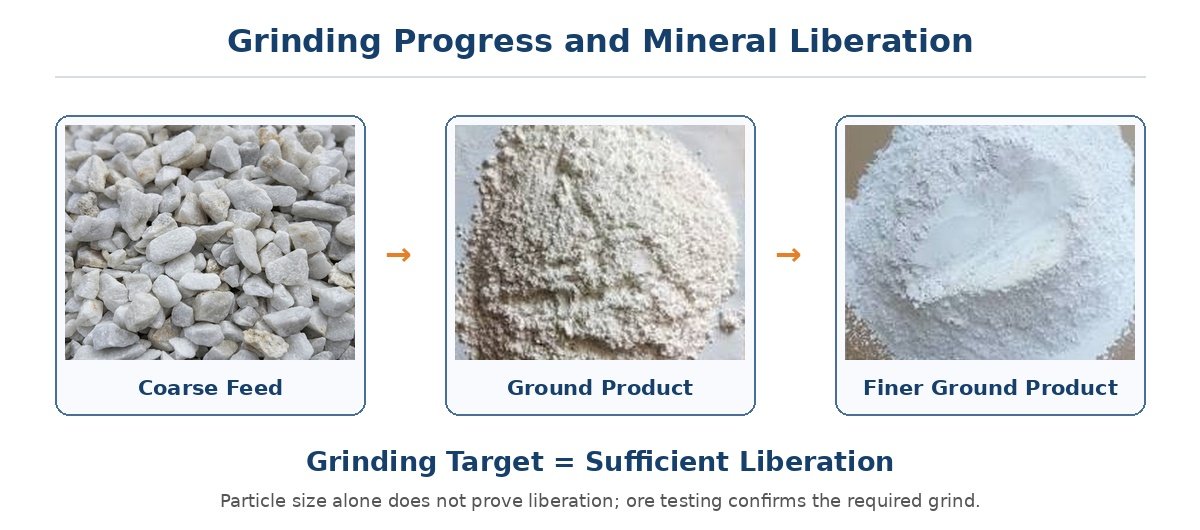
Grinding should achieve sufficient mineral liberation without unnecessary overgrinding
This changes the way grinding should be considered.
The objective is not simply to make the material as fine as possible. It is to achieve enough liberation for the next stage of the process.
If the grind is too coarse, valuable minerals can remain locked with gangue.
A flotation cell, magnetic separator or gravity concentrator cannot fully compensate for poor liberation upstream.
Excessive grinding creates a different problem. It consumes additional energy and may generate unnecessary fines that are more difficult to handle or separate.
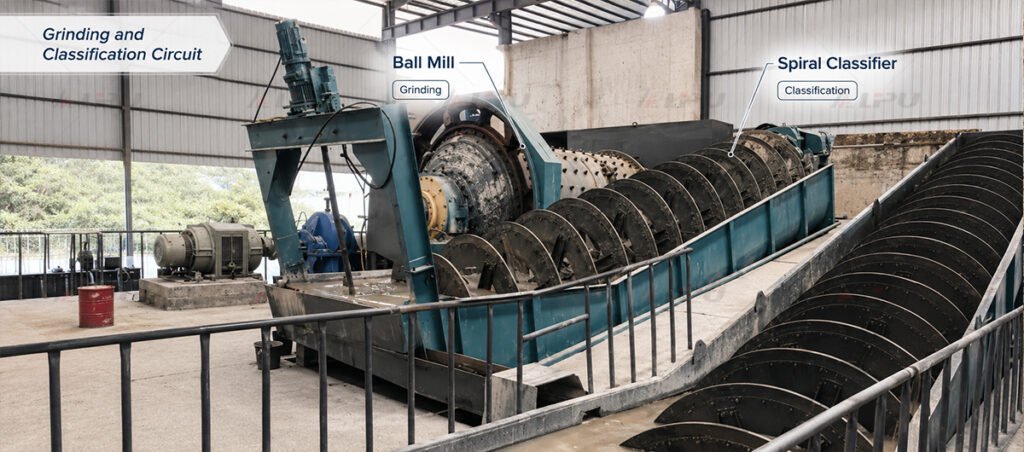
For many mineral processing applications, a ball mill works together with classification equipment.
Fine material that meets the circuit requirement moves downstream. Coarser material is returned for additional grinding.
The final grinding target therefore depends on factors such as:
mineral texture;
liberation behavior;
ore hardness;
downstream separation method;
classification performance;
required plant throughput.
This is why a fixed grind size should not automatically be applied to every ore of the same general type.
The Ore Property Usually Points to the Separation Method
Once sufficient liberation has been achieved, the next question is how the valuable mineral can be separated from gangue.
Different separation processes exploit different properties.
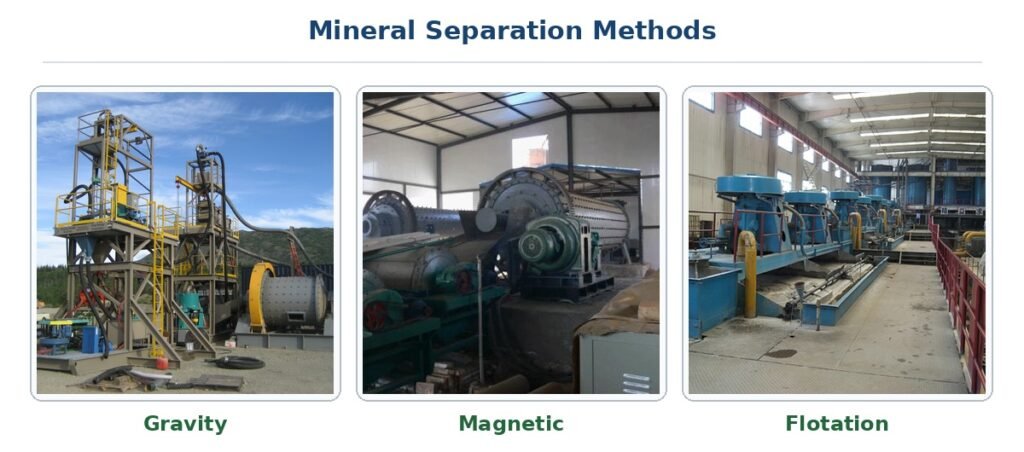
Gravity, magnetic and flotation separation methods are selected according to ore properties
Density Difference → Gravity Separation
When the valuable mineral and gangue have a useful density contrast, gravity concentration may be suitable.
Typical equipment can include shaking tables, spiral chutes, jigs or centrifugal concentrators.
Good liberation is still important. A large density difference is less useful if valuable minerals remain locked inside composite particles.
Magnetic Response → Magnetic Separation
When minerals respond differently to a magnetic field, magnetic separation may become part of the beneficiation route.
The final choice depends on more than the mineral name.
Particle size, liberation, magnetic susceptibility and whether the material is processed wet or dry all influence the circuit.
Surface Properties → Flotation
Flotation separates minerals through differences in surface behavior.
A flotation machine is commonly used for many sulfide ores and other minerals that can be selectively floated.
But flotation does not operate independently of the upstream process.
Grinding must provide suitable liberation, while classification must deliver material within an appropriate size range for the flotation circuit.
Some ores also need combined methods rather than one single separation stage.
Gravity concentration may recover one fraction, magnetic separation another, while flotation may be used for additional recovery or concentrate cleaning.
So the better engineering question is not:
“Which separation machine is best?”
It is:
“Which property of this ore gives us the most useful basis for separation?”
Grinding and Classification Should Be Treated as One Circuit
Selecting the mill correctly is only part of the job.
The classification stage determines which material leaves the grinding circuit and which material requires further size reduction.
A simplified closed circuit can be shown as:
Grinding and classification work together to control the feed entering beneficiation
Ball Mill → Classifier → Qualified Fine Fraction → Beneficiation
while:
Classifier → Coarse Fraction → Return to Ball Mill
Classification controls which particles move forward and which return for additional grinding.
This affects both mill load and downstream feed quality.
If too much coarse material moves forward, liberation may be insufficient.
If material that is already suitable for beneficiation is repeatedly returned, unnecessary grinding can occur.
That is why the mill and classification equipment should not be sized as unrelated machines.
The same principle applies to the entire plant:
Crushing → Grinding → Classification → Separation
Each stage should support the next.
A well-matched circuit aims to ensure that:
crushers provide suitable mill feed;
the mill receives a stable material supply;
classification matches the grinding objective;
coarse material returns efficiently;
downstream separation receives suitable feed;
no single stage creates a major capacity bottleneck.
This is the difference between machine capacity and circuit capacity.
The capacity of a processing plant is not determined by the largest machine in the flowsheet. It is limited by how effectively the stages work together.
What Should You Provide Before Equipment Is Selected?
Not every project begins with a complete laboratory report.
However, better ore and project information leads to a more reliable preliminary configuration.
Useful information includes:
Ore type: gold, copper, iron, lead-zinc, manganese, lithium or another material.
Ore analysis: available grade, assay or mineral composition.
Feed size: maximum and typical incoming size.
Required capacity: hourly or daily throughput.
Target product: concentrate, recovered mineral or required final material.
Beneficiation test results: if available.
Liberation information: if mineralogical testing has been completed.
Moisture or clay condition: especially where washing or handling may be affected.
Existing equipment: important for plant expansion or modification.
Water availability: relevant to wet grinding and beneficiation.
Power conditions: voltage, frequency and available power.
Site conditions: space, elevation and other installation restrictions where relevant.
For an early discussion, the minimum useful starting information is often:
A relatively simple crushing requirement may be evaluated with limited information.
A complex beneficiation plant is different. Mineralogical and beneficiation test data become increasingly important before the final flowsheet is confirmed.
The aim should not be to force the project into a predetermined equipment list.
The equipment and process should be built around the actual behavior of the ore.
Common Questions About Mineral Processing Equipment Selection
Can the same mineral processing equipment be used for different ores?
Yes. Many machines can process several ore types, but model selection, operating conditions and circuit arrangement may differ.
Using the same type of ball mill does not mean two ores should use the same complete grinding and beneficiation configuration.
Is ore testing always required?
Not for every preliminary equipment discussion.
Basic crushing equipment can often be considered from known material and capacity requirements. For complex beneficiation projects, however, ore analysis and beneficiation testing become much more important.
How does ore hardness affect equipment selection?
Hardness influences crushing difficulty, grinding duty, wear and practical capacity.
It should be considered together with feed size, required liberation and the downstream process.
How do I know whether my ore needs flotation or magnetic separation?
The mineral properties provide the answer.
Magnetic separation requires a useful difference in magnetic response. Flotation relies on differences in mineral surface behavior.
Some ores may instead require gravity concentration or a combination of several methods.
Can LIPU recommend equipment from an ore analysis?
Available ore analysis, feed size, required capacity and target product can be used for preliminary process and equipment recommendations.
For complex ores, mineralogical or beneficiation test results should also be considered before the final circuit is confirmed.


We will reply to you within 24 hours