Grinding fineness is not a fixed number that can be applied to every ore.
The correct target depends on how valuable minerals occur in the ore, how easily they become liberated from gangue, and what separation process follows grinding.
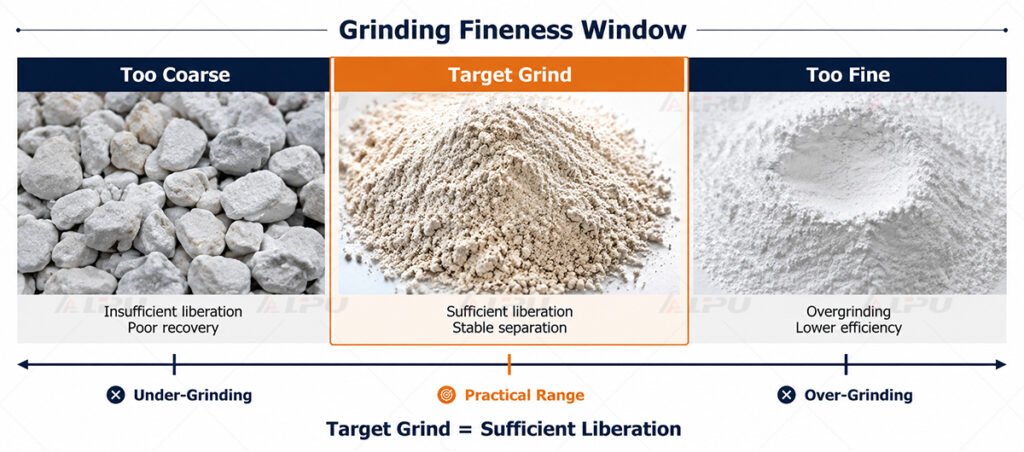
If the product is too coarse, valuable minerals may remain locked inside composite particles. Grinding much finer than necessary, however, can increase energy use and create excessive fines without improving separation.
The practical question is therefore not:
“How fine can the mill grind?”
It is:
“How fine does this ore need to be ground for effective downstream separation?”
Terms such as 200 mesh, 74 μm, or a certain percentage passing a screen are often used to describe grinding products.
These values can be useful for a specific project, but they should not be treated as universal design targets.
Two ores containing the same valuable mineral may require different grinding conditions because their mineral textures and grain associations are different.
A coarse-grained ore may achieve sufficient liberation at a relatively coarse size. A finely disseminated ore may need further grinding before flotation, gravity separation, or magnetic separation can work effectively.
A useful way to think about grinding fineness is:
Too Coarse → Incomplete Liberation
Target Range → Sufficient Liberation
Too Fine → Possible Overgrinding
The grinding target should provide sufficient liberation without unnecessary overgrinding
Ore hardness also matters, but hardness mainly tells us how difficult the ore is to grind.
It does not, by itself, tell us where grinding should stop.
That decision comes from the relationship between mineral liberation and downstream separation performance.
This is one reason equipment selection should begin with the ore itself. The previous LIPU guide on mineral processing equipment selection by ore characteristics explains how mineralogy, hardness, feed size and physical properties influence the complete process.
Factor
Effect on Grinding Fineness
Mineral grain size
Fine dissemination may require finer grinding
Mineral association
Determines how strongly valuable minerals are locked with gangue
Liberation behavior
Shows when sufficient separation becomes possible
Ore hardness
Affects grinding effort, but not the target alone
Downstream process
Determines suitable particle-size conditions
Classification performance
Controls which particles leave the grinding circuit
Overgrinding risk
Limits unnecessary further size reduction
The grinding target should therefore be based on a process requirement, not simply on the finest product the equipment can produce.
Mineral Liberation Sets the First Grinding Target
Grinding is fundamentally a liberation process.
Before grinding, valuable minerals may remain locked with quartz, silicates, sulfides, or other gangue minerals. As particles break, more mineral boundaries become exposed.
The objective is not necessarily complete liberation of every mineral grain.
The practical target is sufficient liberation for stable downstream separation.
Mineral texture strongly influences this point.
A valuable mineral occurring as relatively coarse grains may become exposed after moderate grinding. The same mineral occurring as fine inclusions inside gangue may require substantially more size reduction.
This is why the ore name alone is not enough.
Two copper ores may contain similar copper minerals but show very different liberation behavior. The same applies to iron, lead-zinc, gold, and many other ores.
The relationship is better expressed as:
Mineralogy → Grain Association → Liberation Requirement → Grinding Target
rather than:
Ore Name → Fixed Mesh Size
A grind size that worked for one deposit should therefore not automatically be copied to another.
Downstream Separation Changes the Required Grind Size
Grinding does not have an independent objective.
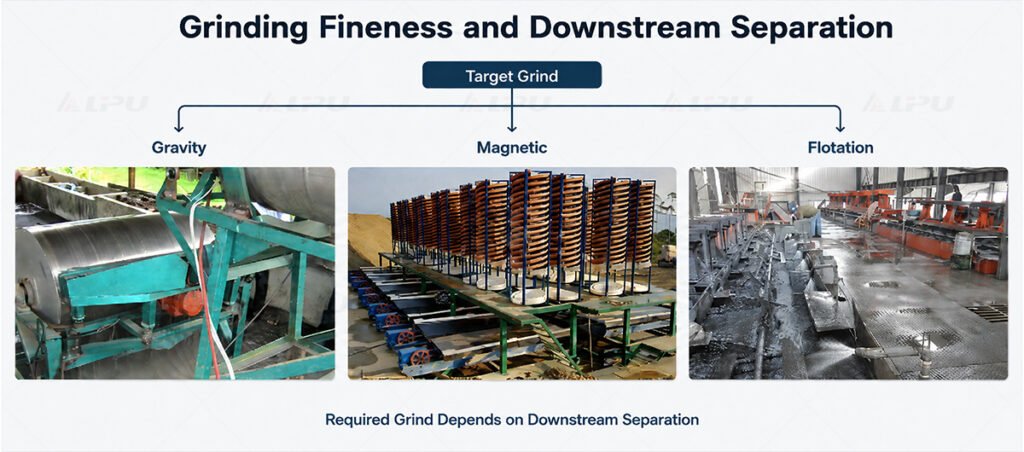
The grinding product is prepared for the process that comes next. Gravity separation, magnetic separation, and flotation can each influence what constitutes a useful grind.
The required grind size depends partly on the separation method that follows grinding
Gravity Separation
Gravity concentration depends on differences in mineral density and particle behavior.
If a heavy valuable mineral is already sufficiently liberated at a relatively coarse size, further grinding may provide little benefit.
Excessive production of very fine particles can also make some gravity-separation processes more difficult.
The objective is therefore to achieve enough liberation without unnecessarily pushing the material into an unsuitable fine-particle range.
Magnetic Separation
Magnetic separation depends on differences in magnetic response.
Liberation is still critical. If a magnetic mineral remains locked with non-magnetic gangue, the composite particle may not separate cleanly.
Further grinding can improve mineral exposure, but particle size also affects magnetic-separation behavior.
The practical target therefore depends on:
Liberation + Magnetic Response + Particle Size
rather than magnetic properties alone.
Flotation
Flotation commonly requires good liberation because the valuable mineral surface must be sufficiently exposed for selective separation.
Coarse composite particles may contain valuable minerals, but their exposed surface may be inadequate for effective flotation.
Grinding finer can improve liberation up to a point.
However, continuing beyond the useful range may produce excessive slimes. Very fine particles can change pulp behavior, reagent demand, and flotation selectivity.
A flotation machine should therefore be considered as part of a complete grinding, classification, and flotation circuit rather than as an isolated machine.
How Do You Know When the Ore Is Ground Fine Enough?
The most reliable answer usually comes from testing rather than assumption.
A practical evaluation can follow five steps.
1. Review the mineralogy
Determine which valuable minerals are present and how they are associated with gangue.
Useful observations include:
mineral grain size;
dissemination pattern;
gangue association;
mineral boundaries;
presence of fine inclusions.
This gives the first indication of whether liberation may occur at a relatively coarse or fine size.
2. Conduct staged grinding tests
The ore can be ground to several different particle-size conditions.
The purpose is not to find the finest sample. Each stage provides material for comparing how liberation and separation change as grinding progresses.
3. Evaluate liberation
Mineralogical or liberation analysis can show how much valuable mineral remains locked in composite particles.
This is more informative than particle size alone.
A fine sample may still contain complex mineral associations, while a coarser sample may already contain enough free valuable mineral for effective separation.
4. Test downstream separation
The different grinding products should then be tested under the intended process.
Depending on the ore, this may include:
gravity tests;
magnetic separation tests;
flotation tests;
combined beneficiation tests.
The objective is to see how separation responds as the grind changes.
5. Select the practical operating target
The best target is not necessarily the finest product or the point with the highest theoretical liberation.
A practical grind should balance:
sufficient mineral liberation;
acceptable separation performance;
stable operating conditions;
manageable fine-particle generation;
reasonable grinding duty.
Engineers are looking for the point where additional grinding provides little extra process benefit.
Classification Determines Whether the Target Grind Is Actually Achieved
Even after the correct target has been established, the plant still needs to maintain it consistently.
That is the job of the grinding and classification circuit together.
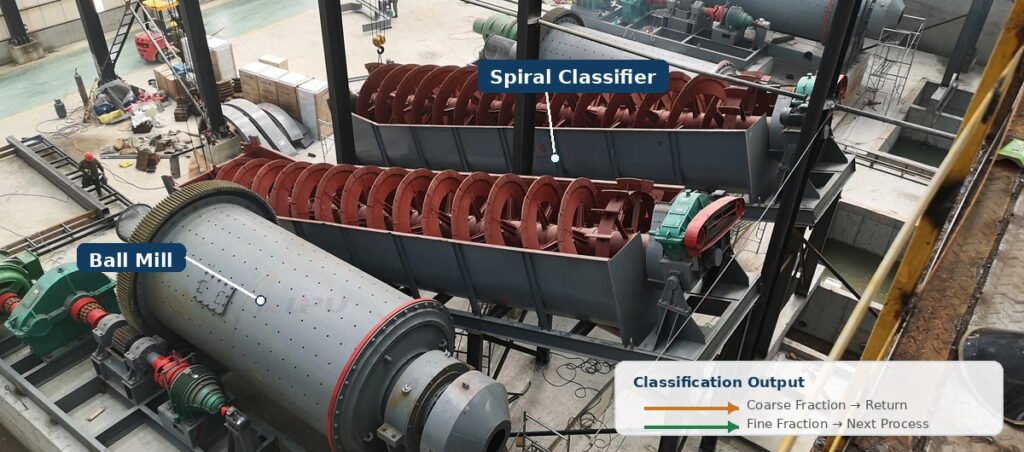
Classification determines which particles leave the grinding circuit and which require further grinding
A typical closed circuit can be represented as:
Mill → Classification → Fine Product → Beneficiation
while:
Classification → Coarse Fraction → Return to Grinding
For many ore-processing applications, a ball mill provides the grinding duty.
But the mill alone does not determine which particles leave the circuit.
Classification decides which particles are fine enough to move forward and which require more grinding.
If coarse material passes forward too easily, downstream beneficiation may receive insufficiently liberated particles.
If material that is already fine enough keeps returning to the mill, unnecessary overgrinding may increase.
The key point is:
Grinding fineness is controlled by the grinding-classification circuit, not by the mill alone.
Classification stability also affects the particle-size distribution delivered to flotation, gravity separation, or magnetic separation.
A plant may therefore have the correct theoretical grind target but still show unstable downstream performance if classification is inconsistent.
What Causes a Plant to Grind Too Coarse or Too Fine?
A target grind is useful only if the circuit can maintain it under changing operating conditions.
Real plant feed is rarely constant. Ore hardness, crusher product size, feed rate, water balance, and circulating load can all change during operation.
These changes may move the grinding product away from the intended range.
Circuit Change
Possible Effect
Coarser mill feed
Product may become coarser
Harder ore
Grinding rate may decrease
Higher feed rate
Residence time may fall
Lower feed rate
More fine material may be produced
Classification instability
Incorrect particles may move forward or return
Water-balance changes
Classification performance may change
Excessive recirculation
Mill load and overgrinding may increase
Poor stage matching
Product-size distribution becomes unstable
This is why grinding control should consider the complete circuit.
For example, increasing mill power or reducing feed rate may make the product finer. That does not automatically mean the plant has improved.
If downstream separation was already receiving adequately liberated material, further grinding may mainly add energy consumption and fine-particle generation.
A sudden coarsening of the product also does not always indicate a problem inside the mill.
The cause may be upstream:
larger crusher product;
harder ore;
unstable feed rate;
or in the classification stage.
Good troubleshooting therefore starts with the circuit, not one machine.
The Practical Target Is a Process Window, Not Just One Number
Grinding fineness is often reported using one representative particle-size value.
That is useful for monitoring, but a real grinding product contains a distribution of particle sizes.
For plant operation, the better question is whether that distribution remains suitable for liberation and downstream separation.
A useful operating window should keep:
coarse locked particles under control;
sufficient liberation;
excessive fines limited;
classification stable;
downstream feed consistent.
This approach is more useful than treating one screen size or mesh value as an absolute rule.
It also explains why laboratory results need to be translated carefully into full-scale operation.
The laboratory identifies what the ore needs.
The grinding and classification circuit must then reproduce that condition consistently at production scale.
Practical Questions About Grinding Fineness
Is 200 mesh fine enough for mineral processing?
There is no universal answer.
A specific mesh value may be suitable for one ore but too coarse or unnecessarily fine for another. Mineral liberation and downstream separation tests should determine the actual target.
Does finer grinding always improve mineral recovery?
No.
Finer grinding can improve liberation while valuable minerals remain locked with gangue. Once sufficient liberation has been achieved, additional grinding may mainly increase energy use and fine-particle generation.
Can ore hardness determine the correct grinding fineness?
Not by itself.
Hardness affects how difficult the material is to grind. Mineral grain size, texture, liberation, and downstream separation requirements determine how far grinding needs to proceed.
Should the ball mill determine the final product size?
No.
The process requirement should determine the target first. The mill and classification circuit are then selected and operated to achieve that condition.
The most useful grinding target is not the finest product a mill can produce.
It is the particle-size condition that provides sufficient mineral liberation, suitable downstream feed, and stable circuit performance.


We will reply to you within 24 hours