A flotation circuit often uses more than one group of flotation cells. Each group has a different task: roughing recovers valuable minerals from the prepared feed, scavenging treats material that still contains recoverable minerals, and cleaning improves concentrate quality.
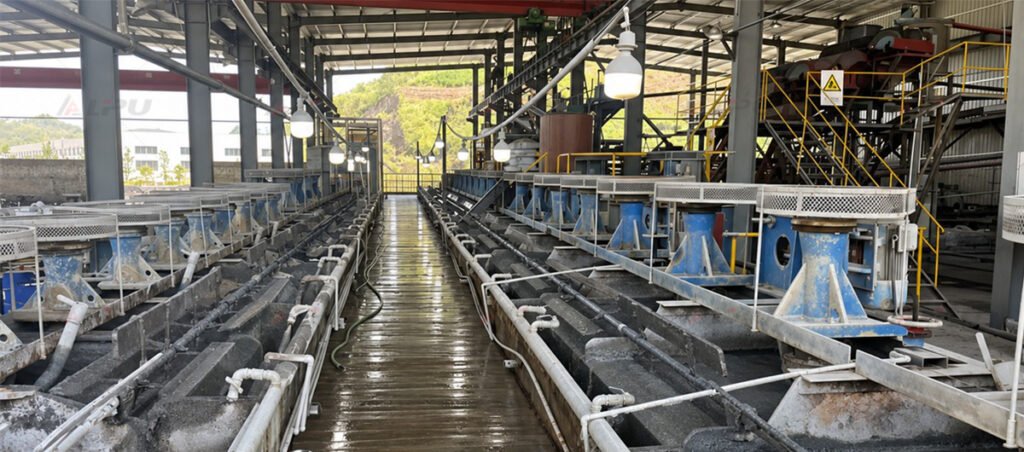
Flotation cell banks can be configured for different process stages
The number and arrangement of cells cannot be determined by ore type alone. Feed rate, mineral liberation, flotation response, concentrate requirements and test results all affect the final configuration.
This guide explains how rougher, scavenger and cleaner flotation stages work together, how their material streams are connected, and what information is needed before selecting flotation equipment.
A single flotation stage may not achieve the required recovery and concentrate grade at the same time.
During flotation, valuable minerals and some unwanted material may both report to the froth. Meanwhile, part of the valuable mineral content may remain in the slurry leaving the cells.
Additional stages allow the circuit to treat these streams separately:
Roughing produces an initial concentrate from the prepared feed.
Scavenging treats a stream such as rougher tailings to recover additional valuable minerals.
Cleaning treats concentrate to improve its quality.
The final arrangement depends on the flotation behavior of the ore. Some projects may require multiple cleaning stages, regrinding or additional treatment of intermediate products. Others may use a simpler configuration.
The objective is to select the combination that meets the project’s recovery, concentrate quality and operating requirements.
What Does Rougher Flotation Do?
Rougher flotation is usually the first main flotation stage after grinding, classification and any required conditioning.
The rougher cells receive prepared slurry and produce two principal streams:
Rougher concentrate: Froth containing recovered valuable minerals, usually sent for further treatment or cleaning.
Rougher tailings: Slurry leaving the rougher stage, which may pass to scavenger flotation if additional recovery is required.
The rougher stage is generally designed to recover a substantial proportion of the floatable valuable minerals. Its concentrate may still contain gangue or insufficiently liberated particles and is often sent for further treatment. Whether it can be used as a final product depends on its quality and the process design.
When planning rougher flotation, important considerations include:
Feed tonnage and slurry flow.
Mineral composition and liberation.
Feed particle size distribution.
Slurry density and variability.
Flotation response from test work.
Required recovery and downstream cleaning capacity.
A rougher bank should be considered together with the upstream grinding and classification circuit. If the feed is too coarse, valuable minerals may remain locked. If excessive fines are produced, flotation behavior and downstream dewatering may also be affected.
What Is the Role of Scavenger Flotation?
Scavenger flotation treats material that may still contain recoverable valuable minerals after an earlier flotation stage.
In a common arrangement, rougher tailings flow to a scavenger bank. The scavenger concentrate is then routed according to its grade, liberation and flotation response. Depending on the flowsheet, it may join another concentrate stream, pass through regrinding, or return to a suitable treatment stage.
Scavenger tailings may proceed to the tailings handling system if they meet the project’s requirements. Their destination should be established through metallurgical testing and circuit design.
Scavenging is not limited to the rougher tailings stream. Some circuits also use a cleaner scavenger stage to recover valuable minerals from cleaner tailings.
When evaluating a scavenger stage, the design team should ask:
How much valuable mineral remains in the stream?
Is the remaining mineral sufficiently liberated?
What recovery is achieved with additional flotation time?
What concentrate grade does the scavenger produce?
Where can that concentrate be treated without overloading another stage?
A scavenger stage should be justified by the value of the additional recovery and its effect on the complete circuit.
How Does Cleaner Flotation Improve Concentrate Quality?
Cleaner flotation treats an earlier concentrate to reduce the proportion of unwanted material and improve the grade of the final product.
Rougher concentrate may contain valuable minerals together with entrained gangue, middlings or other impurities. During cleaning, the circuit attempts to produce a higher-grade concentrate while managing the valuable minerals that remain in cleaner tailings.
Depending on the ore and product specification, the circuit may use:
One cleaner stage.
Multiple cleaner or recleaner stages.
Cleaner scavenger flotation.
Regrinding before cleaning.
Recirculation of selected intermediate streams.
Adding more cleaner stages does not automatically improve the overall result. Each stage changes the movement of valuable minerals and gangue through the circuit. Cleaning conditions and the treatment of cleaner tailings must be evaluated together.
The target concentrate grade, acceptable impurity levels and overall recovery should be defined before the cleaner circuit is finalized.
How Are Rougher, Scavenger and Cleaner Cells Connected?
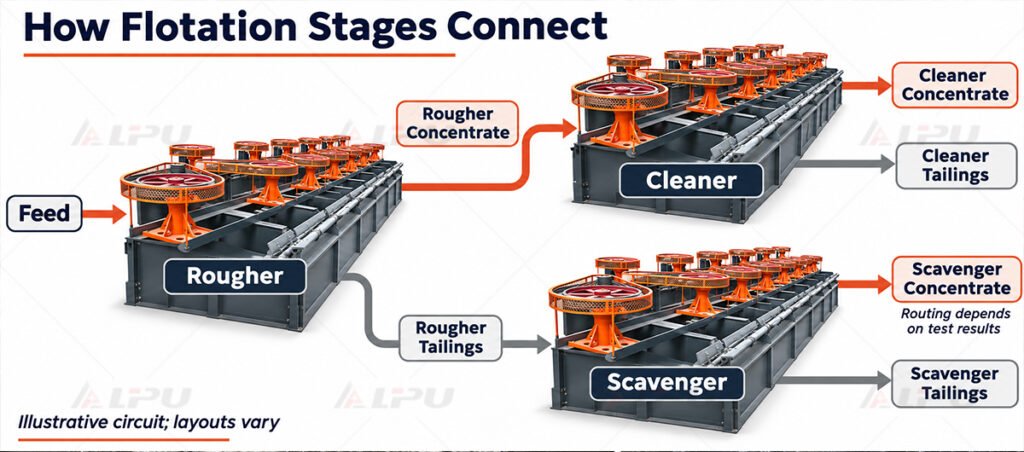
One illustrative arrangement begins with prepared slurry entering rougher flotation. Rougher concentrate proceeds to cleaning, while rougher tailings pass to a scavenger stage for additional recovery.
The scavenger concentrate may then be combined with another concentrate stream or treated separately. Where the concentrate contains insufficiently liberated particles, regrinding may be evaluated before a cleaning stage.
Cleaner concentrate may become the final concentrate or proceed to another cleaning stage. Once the required grade is achieved, concentrate slurry may be sent to a mineral thickener before further dewatering. Cleaner tailings may be recirculated or treated in a cleaner scavenger stage, depending on their composition and the selected flowsheet.
Rougher, scavenger and cleaner stages are connected according to the flowsheet
Stage
Typical feed
Main objective
Streams requiring a defined destination
Rougher
Prepared flotation feed
Initial recovery of valuable minerals
Rougher concentrate and rougher tailings
Scavenger
Often rougher tailings
Recover additional valuable minerals
Scavenger concentrate and scavenger tailings
Cleaner
Earlier concentrate
Improve concentrate quality
Cleaner concentrate and cleaner tailings
Cleaner scavenger, if used
Cleaner tailings or another suitable stream
Recover value from a cleaner circuit stream
Concentrate and tailings
This is a general example, not a fixed flowsheet. The position of each stage and the destination of intermediate streams depend on mineralogy, test results and project objectives.
When Is Regrinding Needed Before Cleaner Flotation?
Regrinding may be considered when rougher or scavenger concentrate contains valuable minerals that are still locked with gangue.
By reducing particle size, regrinding may improve liberation before cleaner flotation. However, it also adds equipment, power demand, water handling and operating complexity. Excessive grinding can create fines that are difficult to process.
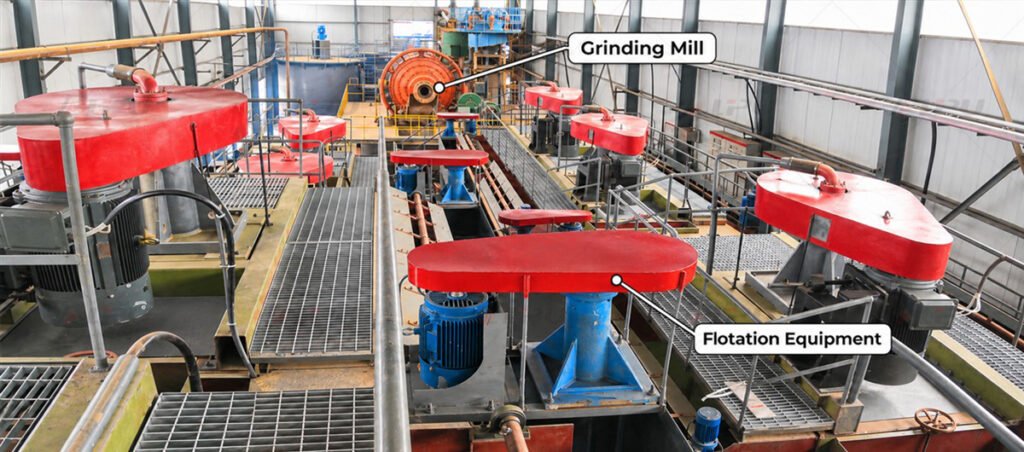
Grinding and flotation equipment in a mineral processing plant
The decision should be based on questions such as:
What proportion of the concentrate consists of locked particles?
At what size does additional liberation occur?
How does regrinding affect cleaner concentrate grade?
What happens to overall recovery?
How much additional grinding energy is required?
Can downstream flotation and dewatering equipment handle the finer material?
Mineralogical examination, grinding tests and flotation tests can help establish whether regrinding is justified and which stream should be reground.
How Are Flotation Cell Volume and Cell Numbers Determined?
Cell size and quantity should be established for each flotation duty rather than selected only from a general equipment catalogue.
A preliminary assessment typically considers:
Slurry flow rate to each stage.
Feed solids concentration.
Flotation test response and required residence time.
Air supply and mixing requirements.
Froth handling and launder arrangement.
Expected variations in feed and circulating streams.
Equipment availability and maintenance requirements.
A preliminary estimate of the effective slurry volume for a flotation stage can be calculated by multiplying the total slurry flow entering that stage by the required residence time. The flow should include any relevant circulating streams, and the units must be consistent.
For example, when slurry flow is expressed in cubic metres per minute and residence time in minutes, the result is an estimated effective slurry volume in cubic metres.
This estimate does not directly determine the installed cell size or number. Laboratory or pilot test time requires appropriate scale-up, and cell design, froth handling, operating allowances and supplier recommendations must also be considered.
Once the required working volume has been assessed, the number and size of cells can be evaluated for each stage. The rougher, scavenger and cleaner circuits may have different duties and do not necessarily require identical cell arrangements.
How Do Air Supply, Mixing and Froth Handling Affect the Circuit?
Flotation cells must provide suitable conditions for particles, air bubbles and reagents to interact. At the same time, froth must be collected and transferred without restricting the process.
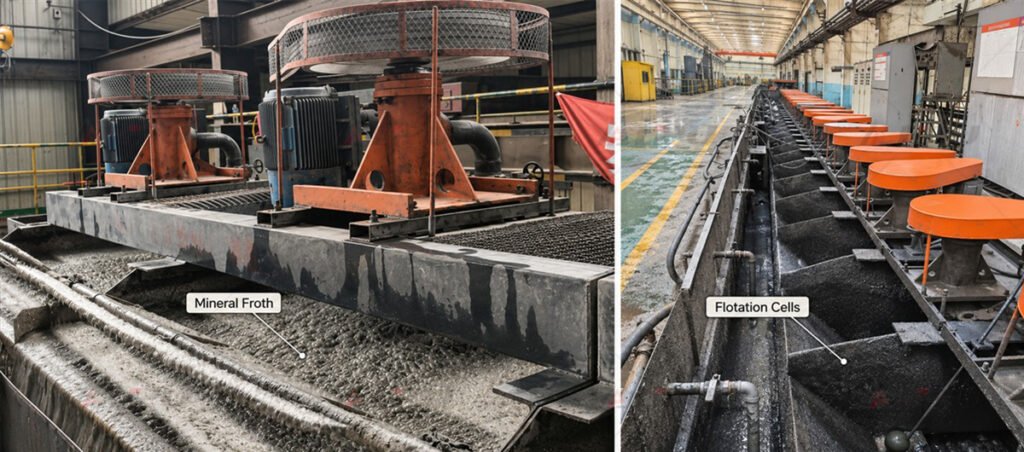
Flotation cells and mineral froth in mineral processing
Important design considerations include:
Air Supply
Air is needed to form bubbles. Depending on the flotation machine, air may be introduced through self-aeration or supplied by external equipment.
The selected arrangement should match the cell type and the air requirements of each flotation stage. Air distribution and control should be reviewed across the entire cell bank.
Mixing and Particle Suspension
Mixing helps keep solids suspended and supports contact between particles and bubbles. The required mixing conditions depend on particle size, slurry properties and cell design.
A circuit should be reviewed for changing feed conditions, particularly when coarse particles, variable density or fluctuating throughput may affect suspension.
Froth Collection
The design must provide a practical path for froth to move into launders and onward to the next stage. Froth characteristics, cell geometry and concentrate flow can affect this duty.
Pumps, launders and transfer points should be considered during circuit design, not added only after the flotation cells have been selected.
What Operating Data Helps Evaluate a Flotation Circuit?
Once the circuit is operating, plant data can show whether each stage is performing its intended duty.
Useful measurements may include:
Feed tonnage and slurry flow.
Feed particle size and solids concentration.
Reagent addition points and dosage.
Air flow and pulp level, where measured.
Concentrate and tailings flow rates.
Concentrate grade and tailings grade.
Recovery across individual stages.
Circulating load from intermediate streams.
Equipment power, availability and maintenance records.
Sampling only the final concentrate and final tailings may not identify where a problem occurs. A stage-by-stage review can help distinguish whether losses are associated with roughing, scavenging, cleaning or the handling of intermediate streams.
The sampling plan and operating measurements should be selected according to the circuit and plant objectives.
What Information Should You Provide for Flotation Equipment Selection?
A useful project brief gives the equipment supplier enough information to assess the flotation stages as a connected system.
Information
Details to provide
Ore
Mineral composition, valuable minerals and major gangue
Feed capacity
Dry solids throughput and expected operating schedule
Feed condition
Particle size distribution and slurry density
Metallurgical targets
Required concentrate grade, recovery and impurity limits
Test work
Flotation results, reagent scheme and response over time
Circuit requirements
Proposed rougher, scavenger and cleaner duties
Intermediate streams
Expected return flows, regrinding or recirculation
Site conditions
Power supply, water availability, layout and environmental requirements
If the project is at an early stage, identify which information is available and which requires testing. Preliminary equipment selection can then be refined as metallurgical and engineering data becomes available.
To review equipment options for different flotation duties, visit the LIPU flotation machine product page. For a project assessment, provide the ore characteristics, throughput, target product requirements and available flotation test results.
Configure the Complete Circuit Around Metallurgical Results
Rougher, scavenger and cleaner cells perform different duties, but their performance is connected. A change in one stage can affect concentrate grade, tailings loss, circulating load and equipment capacity elsewhere.
Start by defining the feed and product requirements. Use representative test work to evaluate flotation response, determine the treatment of intermediate streams, and assess whether additional cleaning or regrinding is needed. The flotation cells and supporting equipment can then be selected for the duties of the complete circuit.
FAQs
1. What is the difference between rougher, scavenger and cleaner flotation?
Roughing produces an initial concentrate from prepared feed. Scavenging treats a stream that may still contain recoverable valuable minerals. Cleaning upgrades an earlier concentrate to improve its quality.
2. Does every flotation plant need all three stages?
No. The required stages depend on ore characteristics, test results and product requirements. Some circuits are relatively simple, while others use multiple cleaning, scavenging or regrinding stages.
3. Where does scavenger concentrate go?
Its destination depends on grade, mineral liberation and the flowsheet. It may join another concentrate stream, pass to regrinding or be treated in another suitable flotation stage.
4. Is regrinding always required before cleaner flotation?
No. Regrinding is considered when additional liberation is expected to improve downstream separation enough to justify the added equipment and operating cost.
5. What determines the number of flotation cells?
The number depends on the duty of each stage, slurry flow, flotation response, required working volume, cell design, scale-up considerations and operating requirements.


We will reply to you within 24 hours