Search the whole station

Mineral ThickenerMineral Thickener

Mineral Thickener

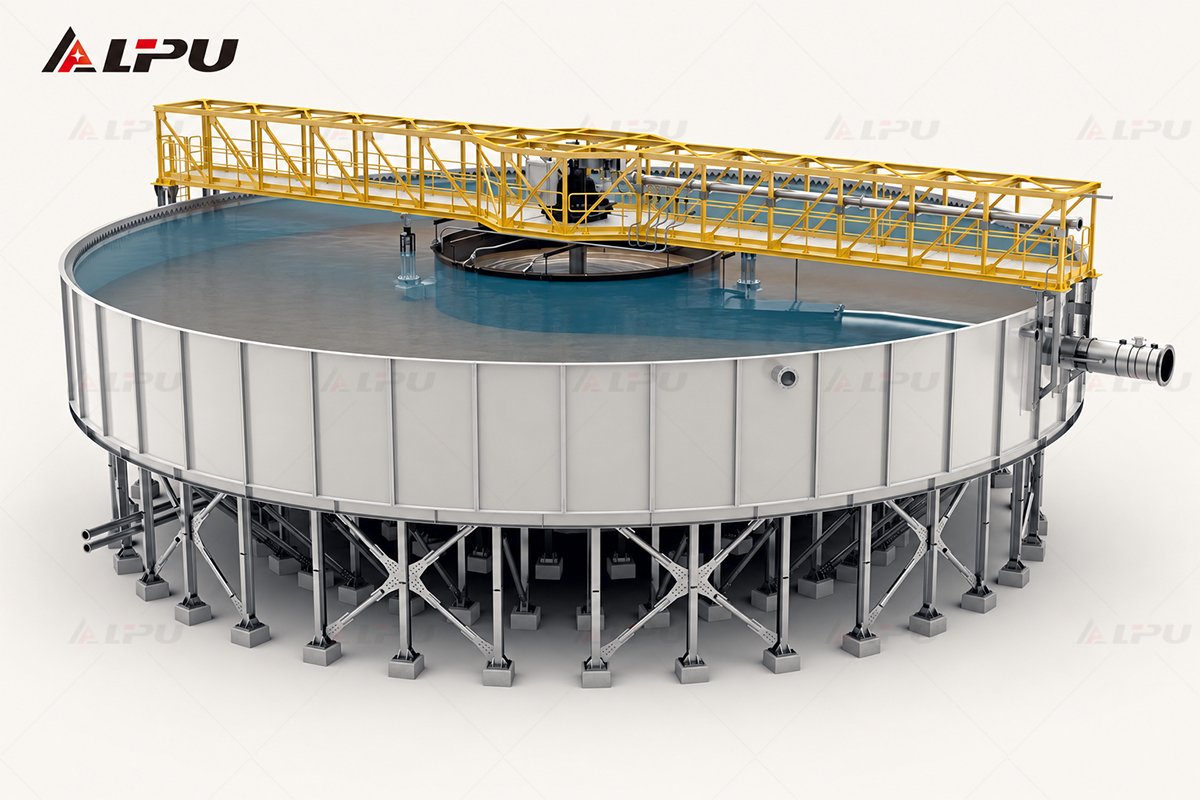
LIPU mineral thickeners are designed for slurry thickening, water recovery and solid-liquid separation in mineral processing plants.

By allowing suspended solids to settle under gravity, the thickener produces a higher-density underflow while clarified water overflows from the top of the tank for reuse or further treatment.

LIPU NZS series thickeners are suitable for concentrate thickening, tailings treatment and process-water recovery in mineral beneficiation plants.

  • Tank Diameter: 1.8–24 m
  • Sedimentation Area: 2.55–452 m²
  • Capacity: 1.3–1440 t/d
  • Applications: Concentrate thickening, tailings thickening and process-water recovery

What Is a Mineral Thickener?

A mineral thickener is a solid-liquid separation unit used to increase the solids concentration of slurry.

It works mainly by gravity sedimentation.

When slurry enters the thickener tank, suspended particles gradually settle toward the bottom. The settled solids form a denser pulp, while relatively clear liquid rises toward the upper part of the tank and flows out through the overflow system.

The thickened slurry is removed from the bottom as underflow.

This allows a mineral processing plant to reduce slurry volume, recover process water and prepare concentrate or tailings for the next dewatering or disposal stage.

Mineral thickeners are commonly used after flotation, gravity separation, magnetic separation and other beneficiation processes.

How Does a Mineral Thickener Work?

The basic thickening process can be summarized as:

Slurry Feed → Sedimentation → Solids Settling → Rake Collection → Thickened Underflow + Clear Overflow

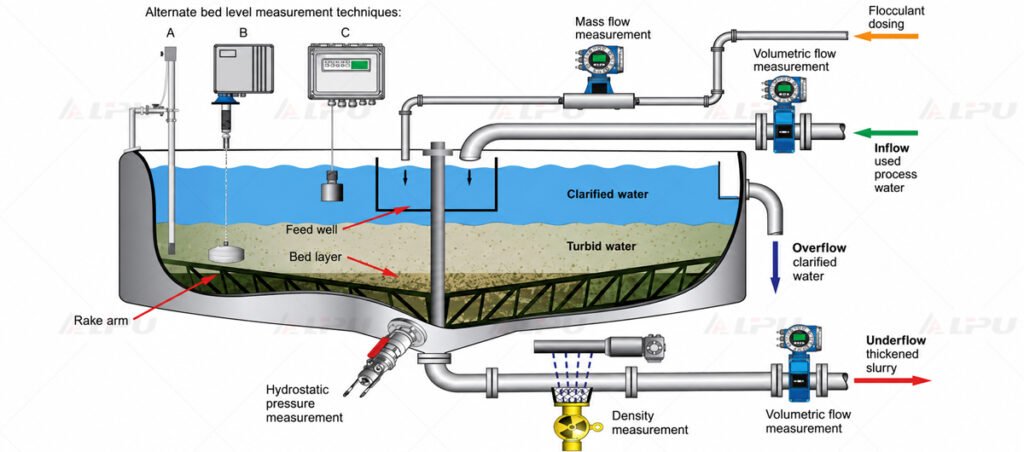
Mineral thickener working principle showing clarified overflow water and thickened underflow slurry
Mineral thickener working principle showing slurry settling, clarified overflow and thickened underflow

Slurry enters the tank through the feed system and is distributed into the settling zone.

As the slurry velocity decreases, suspended solids begin to settle under gravity.

Fine particles may require suitable flocculation conditions to improve settling performance.

The settled solids accumulate near the bottom of the tank. A slowly rotating rake mechanism moves the thickened material toward the central discharge area.

The concentrated slurry leaves through the underflow outlet.

At the same time, clarified liquid rises to the upper section of the tank and flows into the overflow launder.

The overflow water can then return to the processing circuit or proceed to further treatment.

Main Components

The main components of a mineral thickener typically include:

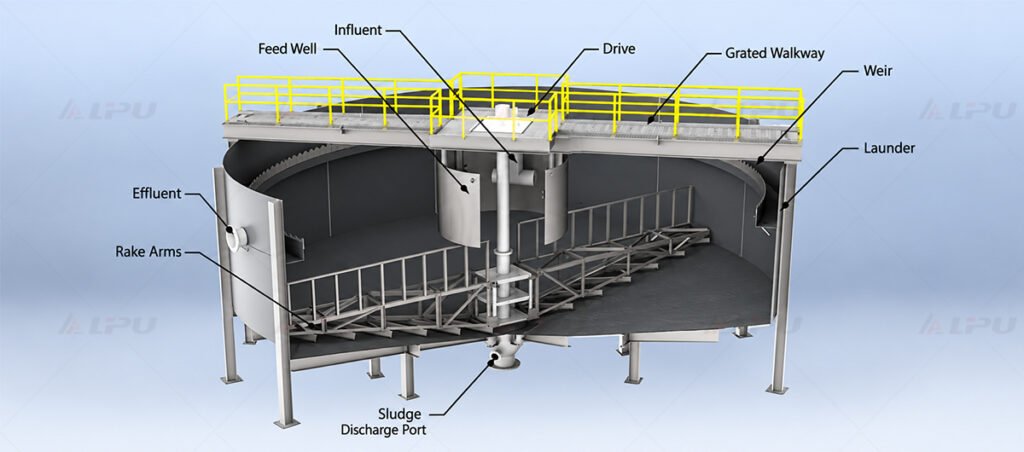
Main components of a mineral thickener with feedwell rake arms overflow launder and underflow discharge
Main structural components of a mineral thickener
  • Thickener tank
  • Feed inlet
  • Feedwell
  • Rake mechanism
  • Rake arms
  • Drive unit
  • Central shaft
  • Overflow launder
  • Underflow discharge
  • Supporting structure

The feedwell helps distribute slurry into the tank, while the rake mechanism continuously moves settled solids toward the discharge point.

The overflow launder collects clarified water from the top of the thickener.

Mineral Thickener Applications

Mineral thickeners are mainly used where slurry concentration and water recovery are required.

Typical applications include:

  • Concentrate thickening
  • Tailings thickening
  • Process-water recovery
  • Slurry volume reduction
  • Pre-dewatering before filtration
  • Mineral beneficiation circuits

Concentrate Thickening

After mineral separation, concentrate slurry often contains a large amount of water.

A thickener increases the solids concentration before the concentrate enters the next dewatering stage.

Tailings Thickening

Tailings slurry can be thickened before pumping, storage or further dewatering.

Reducing the amount of free water lowers the slurry volume that must be handled downstream.

Process-Water Recovery

Clarified overflow water can be returned to the mineral processing plant where water quality allows.

This can reduce fresh-water demand and improve water circulation within the plant.

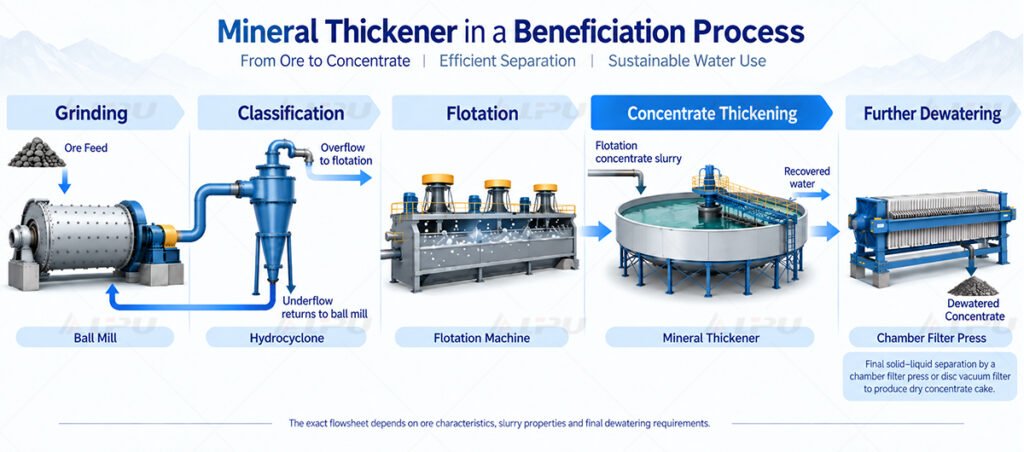
Mineral Thickener in a Beneficiation Process

A thickener normally operates as part of a complete mineral processing circuit.

For a flotation plant, a typical process may be arranged as:

Grinding → Classification → Flotation → Concentrate Thickening → Further Dewatering

Mineral thickener in a beneficiation process with ball mill hydrocyclone flotation and filter press
Typical beneficiation process showing grinding, hydrocyclone classification, flotation, concentrate thickening and final dewatering

A Ball Mill reduces ore size before classification.

A Hydrocyclone or other classification equipment can control the particle-size range entering the beneficiation stage.

A Flotation Machine separates valuable minerals from gangue.

The resulting concentrate or tailings slurry can then enter the mineral thickener for concentration and water recovery.

The exact flowsheet depends on ore characteristics, slurry properties and the final dewatering requirements.

Concentrate Thickening vs Tailings Thickening

The same thickening principle can be applied to both concentrate and tailings, but the process objectives are different.

ApplicationMain Purpose
Concentrate thickeningIncrease concentrate solids concentration before further dewatering
Tailings thickeningReduce slurry volume and recover water before disposal or additional treatment
Process-water recoveryRecover clarified overflow water for reuse where suitable

The required underflow density and settling performance should be determined from the actual slurry characteristics.

Advantages of Mineral Thickener

LIPU mineral thickeners provide several practical benefits in mineral processing plants.

  • Continuous thickening: Slurry can be continuously concentrated during plant operation.
  • Water recovery: Clarified overflow water can be recovered for reuse where process conditions allow.
  • Gravity-based separation: The main separation mechanism relies on sedimentation.
  • Low-speed rake operation: Settled solids are continuously moved toward the underflow discharge.
  • Reduced slurry volume: Higher solids concentration decreases the volume handled downstream.
  • Suitable for beneficiation circuits: Thickeners can be integrated with flotation, magnetic separation and gravity concentration systems.
  • Multiple tank sizes: NZS models cover different processing scales.

Actual thickening performance depends on slurry concentration, particle size, particle density, mineralogy and settling characteristics.

Mineral Thickener Technical Parameters

LIPU NZS series mineral thickeners are available in multiple tank diameters and processing capacities.

ModelTank Diameter (m)Tank Depth (m)Sedimentation Area (m²)Transmission Speed (r/min)Motor ModelMotor Power (kW)Capacity (t/d)
NZS11.81.82.550.5Y90L-61.11.3–5.6
NZS2.52.51.84.90.33Y90L-61.15–10.8
NZS3.63.61.810.20.38Y90L-61.15–22.4
NZS662.956280.35Y90L-41.514–60
NZS88350.20.27Y132S-6325–120
NZS99363.50.25Y132S-6332–150
NZS12123.61130.19Y132S-6350–250
NZS15153.61760.1Y132M2-65.570–350
NZS18183.742550.2Y160M-67.5100–560
NZS20204.43150.2Y160M2-87.5200–1440
NZS24244.7164520.1Y180L-811200–1440

Actual processing capacity depends on slurry concentration, particle-size distribution, solids density, settling characteristics and operating conditions.

How to Select the Right Mineral Thickener

Thickener selection should be based on slurry settling behavior rather than capacity alone.

Important factors include:

Feed solids concentration

The amount of solids entering the thickener affects settling and underflow density.

Required underflow concentration

The downstream filtration, pumping or tailings-handling process determines the required thickened slurry concentration.

Particle-size distribution

Fine particles normally settle more slowly than coarse particles.

Solid density

Higher-density particles generally settle differently from low-density solids.

Settling rate

Settling tests can help determine the required sedimentation area.

Flocculation conditions

Fine particles may require suitable flocculant selection and dosage to improve settling.

Processing capacity

The thickener diameter and sedimentation area should match the required slurry throughput.

Overflow-water requirement

The expected clarity and reuse requirement of the overflow water should also be considered.

For important projects, slurry sedimentation testing is recommended before final equipment selection.

Mineral Thickener vs Dewatering Equipment

A mineral thickener and a mechanical dewatering machine perform different functions.

A thickener mainly increases slurry concentration by gravity sedimentation.

It does not usually replace the final filtration stage where a low-moisture solid product is required.

A typical dewatering sequence may be:

Slurry → Thickener → Thickened Underflow → Further Dewatering

Mineral Thickener Process Flow

This distinction is important when designing concentrate and tailings treatment systems.

Why Choose LIPU?

LIPU provides NZS series mineral thickeners for concentrate treatment, tailings thickening and process-water recovery.

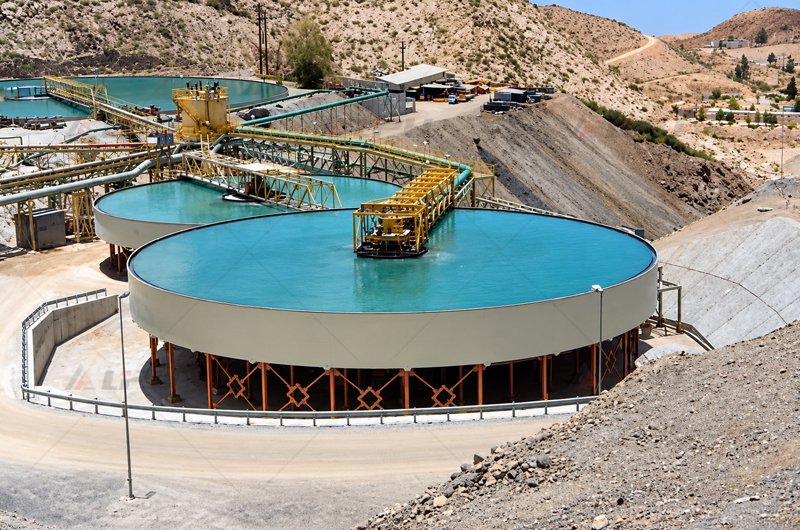
Mineral thickener installed at a copper beneficiation plant
Copper beneficiation plant thickener
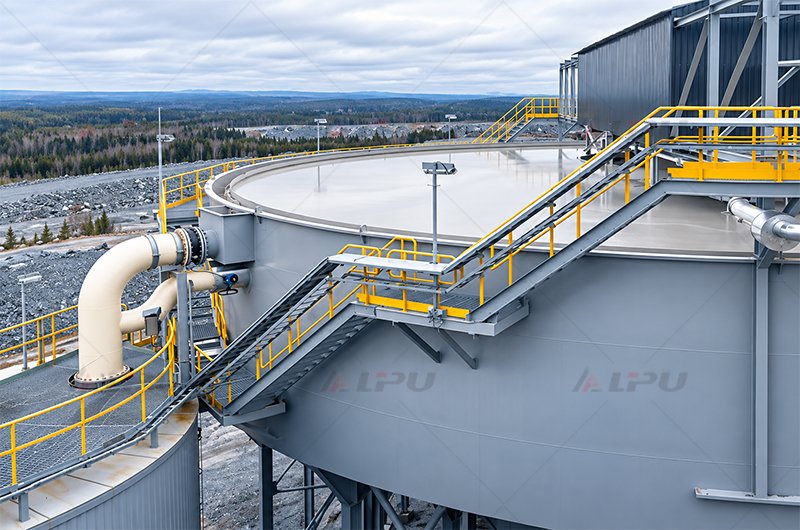
Tailings thickener used for process water recovery at a mining site
Tailings thickener for water recovery
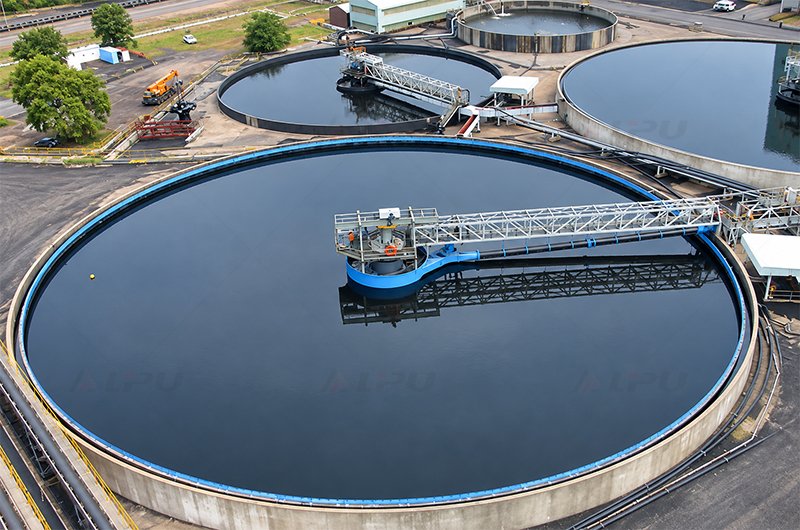
High rate thickener operating in a mineral processing plant
High-rate thickener at a mining site

Equipment selection can consider:

  • Slurry feed concentration
  • Required underflow density
  • Settling characteristics
  • Particle-size distribution
  • Processing capacity
  • Tank diameter
  • Sedimentation area
  • Downstream dewatering requirements

LIPU can also combine thickeners with grinding, classification and beneficiation equipment to configure complete mineral processing systems.

Frequently Asked Questions

What is a mineral thickener used for?

A mineral thickener is used to increase slurry solids concentration and separate clarified water from suspended solids in mineral processing plants.

What is the difference between thickener overflow and underflow?

Overflow is the clarified liquid leaving the upper part of the tank, while underflow is the concentrated slurry discharged from the bottom.

Can thickener overflow water be reused?

In many mineral processing plants, clarified overflow water can be returned to the process if its quality is suitable for reuse.

Does a thickener replace a filter press or other dewatering equipment?

Not usually. A thickener concentrates slurry, while downstream filtration equipment is used when lower final moisture is required.

How do I choose the correct thickener size?

Selection should consider slurry flow, solids concentration, settling rate, particle-size distribution, solids density, required underflow concentration and sedimentation area.

People who viewed this also viewed

loading…

已经是到最后一篇内容了!

LET US REACH YOUNeed detailed customization and latest price? Chat online or leave message below!
*
*
*
Being submitted!
Submitted successfully!
Submission failed! Please try again later
Mailbox error!
Phone Error!