A mineral processing flowsheet should not begin with a list of machines. It should begin with reliable information about the ore, the way valuable minerals occur, how the material responds to processing, and what the final plant is expected to produce.
Two deposits containing the same valuable mineral can require very different crushing, grinding, classification, and separation circuits. Differences in mineral association, liberation size, hardness, clay content, feed variability, and product requirements can all change the final process route.
Why Should Flowsheet Design Start With Data Instead of Equipment?
A common mistake in early project discussions is to start with equipment.
Questions such as “What size ball mill do I need?” or “Should I use flotation or magnetic separation?” are difficult to answer correctly before the process requirements are understood.
Equipment selection should follow the flowsheet, and the flowsheet should follow the ore.
For example, two ores with similar feed grades may behave differently because one contains coarse, readily liberated valuable minerals while the other contains very fine mineral associations that require additional grinding or a different separation route.
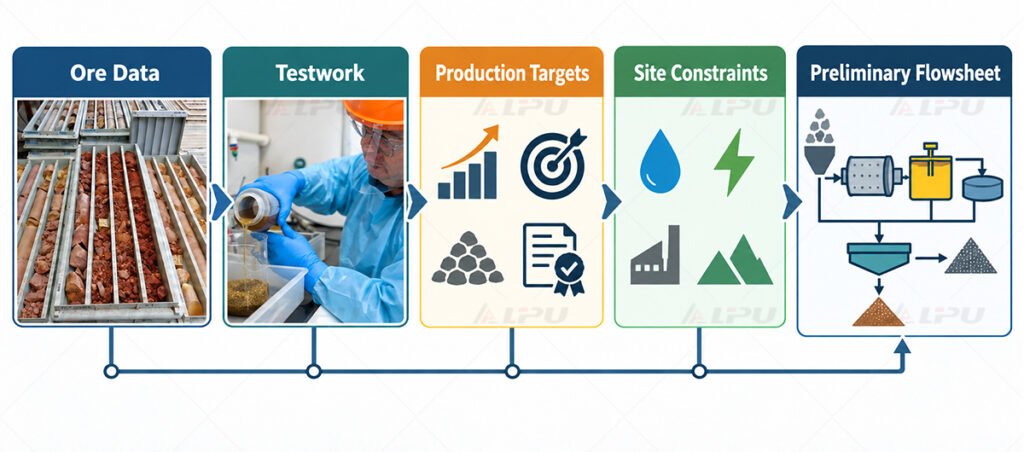
A mineral processing flowsheet should be developed from ore data, test results, production targets, and site conditions rather than from an equipment list alone
Before a preliminary flowsheet is developed, engineers usually need to understand four groups of information:
What the ore is
How the ore responds to processing
What the plant must produce
What site constraints the plant must operate within
Missing information in any of these areas increases design uncertainty.
Is the Ore Sample Representative of the Planned Plant Feed?
Reliable flowsheet development starts with a representative sample.
A laboratory can produce accurate test results from the material it receives, but those results may still be misleading if the sample does not reflect the ore that the future plant will actually process.
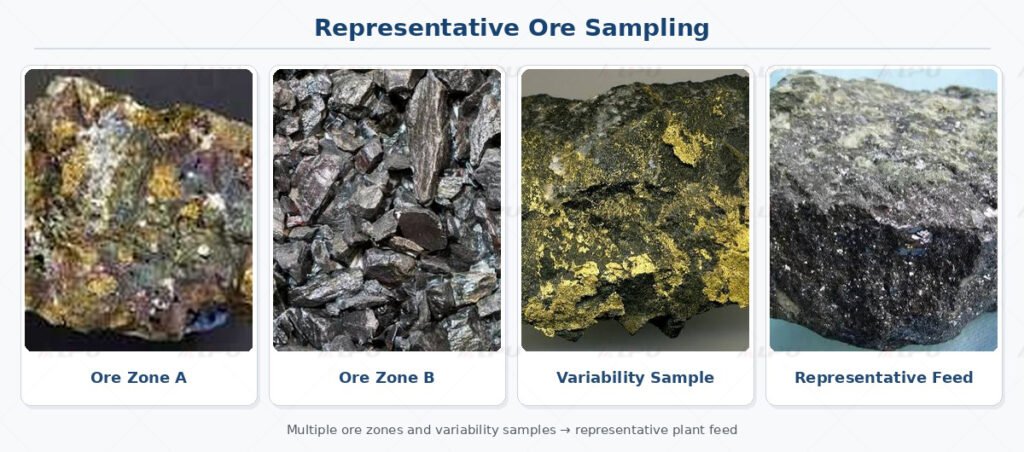
Ore bodies are rarely completely uniform. Different mining zones may contain different grades, textures, oxidation levels, gangue minerals, or valuable-mineral associations.
For example, a deposit may contain:
Fresh and weathered ore
High-grade and low-grade zones
Coarse- and fine-grained mineralization
Different host rocks
Different levels of clay or alteration
If all testwork is based on one small sample from a single zone, the resulting flowsheet may perform well for that sample but poorly when the plant receives more variable feed.
Representative sampling becomes especially important when mineral distribution is heterogeneous or when coarse valuable-mineral particles are present.
In some projects, a single composite sample may be suitable for early-stage testing. In others, several variability samples may be needed to understand how the process responds to different ore types.
Representative sampling helps ensure that laboratory testwork reflects the ore conditions expected in actual plant operation
Sample Question
Why It Matters
Does the sample represent planned plant feed?
Reduces the risk of designing for the wrong ore
Are several ore zones present?
Helps identify process variability
Does grade vary significantly?
Affects interpretation of recovery and concentrate results
Are weathered and fresh ores different?
May require different processing conditions
Are coarse valuable minerals present?
Can influence sampling and testwork requirements
The important point is not to collect the largest possible sample. It is to collect a sample that answers the actual design question.
What Ore Characterization Data Is Needed?
Ore characterization explains what the material is before processing begins.
This information helps engineers understand which physical and mineralogical properties are likely to control crushing, grinding, classification, and separation.
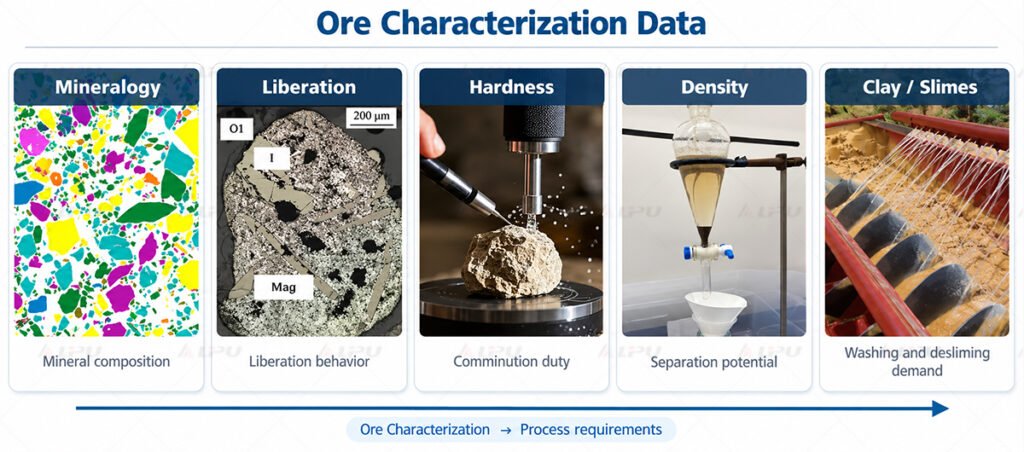
Ore characterization provides the mineralogical and physical data needed to define process requirements before equipment is selected
Important characterization data can include:
Mineral composition
Valuable mineral occurrence
Gangue mineral composition
Mineral association
Grain size
Liberation behavior
Ore texture
Hardness and grindability
Abrasiveness
Density
Clay and slime tendency
Moisture condition
Not every project requires the same level of characterization. The required test program depends on the mineral system and the decisions that must be made.
Mineralogy and Mineral Association
Knowing the valuable element is not enough.
Engineers need to know which mineral carries that element and how it is associated with gangue.
For example, a valuable mineral that occurs as relatively coarse liberated grains may respond very differently from the same mineral finely locked within silicate or sulfide gangue.
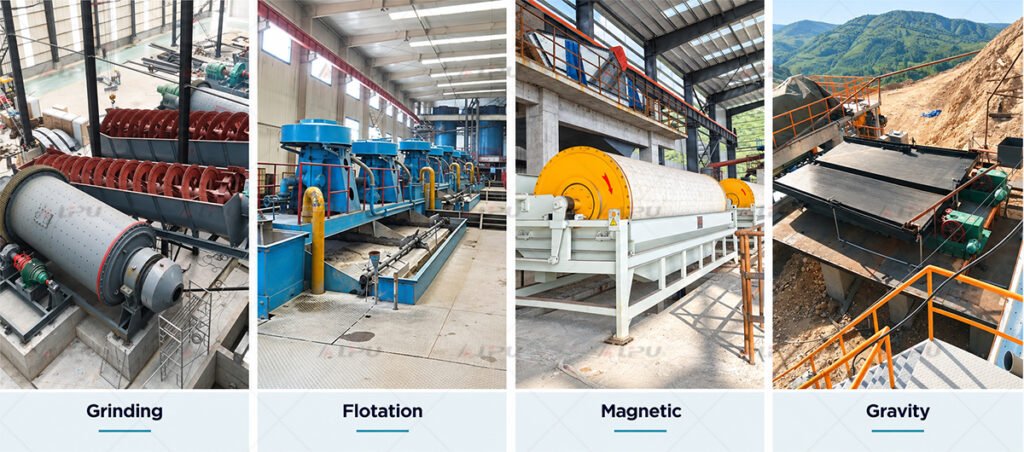
Mineralogy helps determine whether gravity, magnetic, flotation, or another separation method should be investigated.
Liberation and Grain Size
Liberation is one of the most important inputs to grinding and separation design.
If valuable minerals remain locked with gangue, the ore may need further size reduction before separation becomes effective.
However, finer grinding is not automatically better. The target should provide sufficient liberation without creating unnecessary overgrinding.
Hardness, density, clay content, and abrasiveness influence different sections of the circuit.
Ore Data
Main Design Influence
Mineralogy
Separation route
Mineral association
Required liberation strategy
Grain size
Grinding requirement
Hardness / grindability
Crushing and grinding duty
Density
Gravity separation potential
Magnetic response
Magnetic separation potential
Clay / slimes
Washing, desliming, and classification
Abrasiveness
Wear and equipment selection
These properties should be interpreted together rather than as isolated test results.
What Metallurgical Test Results Are Needed?
Ore characterization describes the material. Metallurgical testwork shows how that material responds when it is processed.
This distinction is important.
A process may appear technically suitable based on mineralogy, but it should normally be validated through testwork before it becomes part of the plant flowsheet.
Depending on the ore, relevant tests may include:
Metallurgical testwork confirms how the ore responds to candidate processing methods before they are incorporated into the flowsheet
Crushing and grindability tests
Staged grinding tests
Gravity separation tests
Magnetic separation tests
Flotation tests
Washing and desliming tests
Settling and thickening tests
Dewatering tests
Staged grinding tests can show how separation performance changes as the ore becomes finer.
In flotation projects, testwork can confirm whether sufficient liberation has been achieved and how the mineral responds under different flotation conditions before equipment such as a flotation machine is specified.
Magnetic separation testing may also be needed to evaluate how particle size and liberation influence magnetic response.
The objective is not simply to produce the highest laboratory result. The objective is to identify a process route that can be translated into stable plant operation.
Pilot-scale testing may become useful when the ore response is complex, when scale-up risk is significant, or when continuous circuit behavior needs to be evaluated.
What Production and Product Targets Must Be Defined?
Even a well-characterized ore cannot define the full flowsheet by itself.
The plant also needs a clear design basis.
Important production targets include:
Required throughput
Planned operating hours
Expected feed variability
Required final product or concentrate quality
Number of final products
Required product particle size
Tailings requirements
Future expansion expectations
Throughput is especially important because it affects equipment duty throughout the plant.
A crushing circuit feeding 100 t/h and one feeding several hundred tonnes per hour may use similar process stages, but equipment sizes, buffer capacity, number of units, and material-handling arrangements can be very different.
Product requirements also matter.
A process designed to produce one rough concentrate may be simpler than a circuit that must produce several saleable products or meet tighter downstream specifications.
Feed variability should also be considered. A plant should not be designed only around one ideal laboratory sample if actual mine feed is expected to change significantly.
This is why flowsheet development should connect metallurgy with production planning rather than treating them as separate tasks.
What Site and Utility Conditions Can Change the Flowsheet?
A laboratory flowsheet may be technically successful and still need to change when real site conditions are considered.
Important project constraints can include:
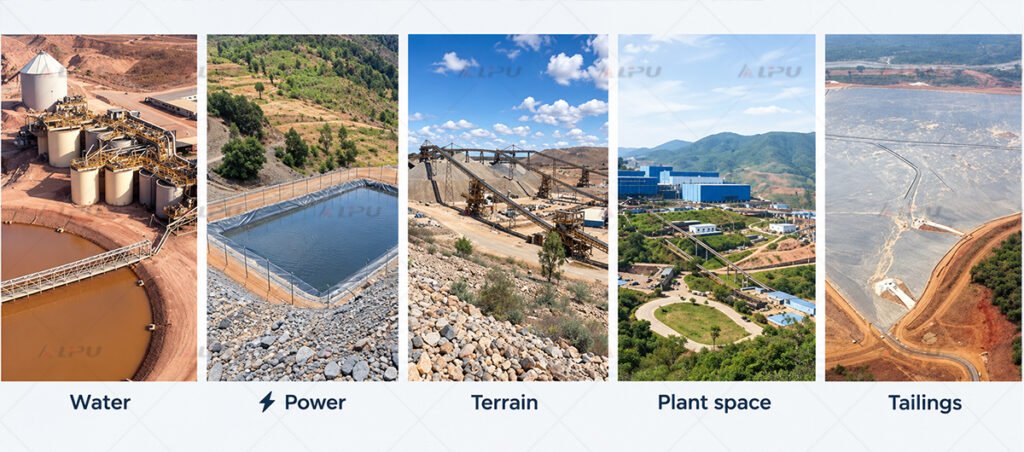
Site utilities and physical constraints can change how a technically suitable process is implemented at plant scale
Water availability
Power supply
Site elevation
Climate
Available plant footprint
Terrain
Tailings disposal method
Water recycling requirement
Road and transport access
Expansion space
Water availability is particularly important in wet mineral processing.
A flowsheet that relies heavily on wet grinding, classification, flotation, or washing must consider how process water will be supplied, recovered, and recycled.
Similarly, limited power availability may influence equipment selection or the practical scale of the plant.
Terrain and plant footprint can affect equipment arrangement, material transfer, pumping requirements, and stockpile placement.
Tailings characteristics may also influence thickening and dewatering requirements near the end of the flowsheet.
The key engineering principle is simple:
A process that works in the laboratory must also work under the actual conditions of the project site.
Site constraints should therefore be introduced before detailed equipment sizing begins, not after the full plant has already been designed.
How Is the Data Converted Into a Preliminary Flowsheet?
Once the main ore, testwork, production, and site information has been collected, engineers can begin converting the design basis into a process sequence.
A practical development path is:
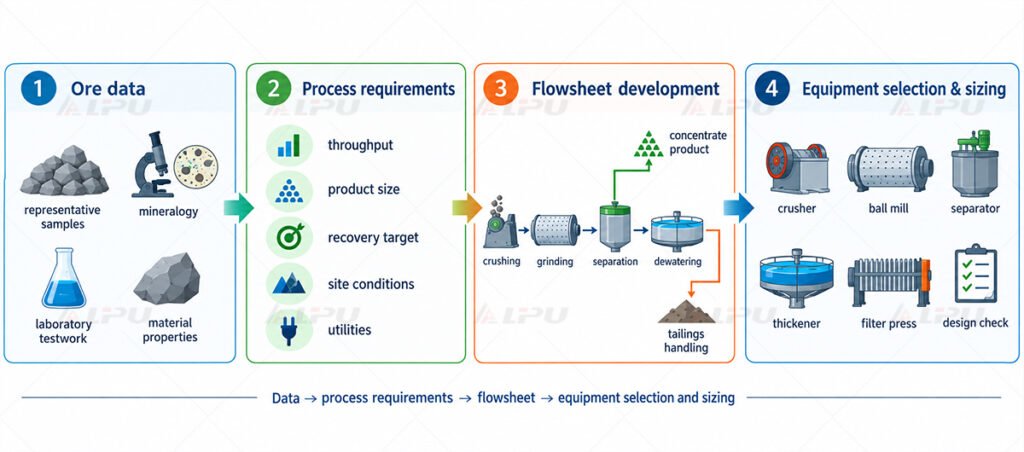
Reliable plant design moves from data to process requirements, then to flowsheet development and finally to equipment selection and sizing
Confirm that the test samples represent expected plant feed.
Review mineralogy and ore variability.
Define crushing and grinding requirements.
Determine the likely mineral liberation range.
Compare suitable separation methods.
Review metallurgical test results.
Define plant throughput and final product targets.
Apply water, power, layout, and tailings constraints.
Build the preliminary flowsheet.
Select and size the major equipment.
Review how the individual units interact as a complete circuit.
Only after these steps should individual machines become the main design focus.
For example, a jaw crusher can be selected once primary crushing duty, feed size, and required throughput are understood.
A ball mill can be selected after the grinding requirement, target product size, throughput, and classification strategy have been defined.
The same logic applies to separation and dewatering equipment.
This leads to one of the most useful rules in mineral processing plant design:
Flowsheet first, equipment list second.
Selecting machines before the process requirements are defined can create mismatched capacities, unnecessary equipment, or a circuit that performs well only under a narrow range of operating conditions.
Frequently Asked Questions
Can a mineral processing flowsheet be designed from ore grade alone? No. Grade indicates the amount of a valuable element or mineral, but it does not explain mineral association, liberation behavior, hardness, clay content, or response to separation. These factors can change the required process route substantially.
Do I need laboratory testwork before selecting mineral processing equipment? For most beneficiation projects, testwork is highly valuable because it reduces uncertainty about grinding requirements and separation response. The required level of testing depends on the ore and project stage.
How much ore sample is needed for flowsheet development? There is no universal sample quantity. The amount depends on ore heterogeneity, particle size, mineral distribution, required tests, and whether bench-scale or pilot-scale work is planned.
Can the same mineral use different processing flowsheets? Yes. Two deposits containing the same valuable mineral can require different circuits because mineralogy, grain size, gangue minerals, oxidation, liberation, and site conditions may differ.
When is pilot-scale testing necessary? Pilot testing may be useful when process behavior is complex, scale-up risk is important, continuous circuit interaction needs to be studied, or laboratory tests do not provide enough confidence for plant design.
A mineral processing flowsheet is ultimately a model of how the ore should move through the plant.
The quality of that model depends on the quality of the information used to build it.
Representative sampling, ore characterization, metallurgical testing, production targets, and site constraints should therefore be established before the project moves into detailed equipment selection.
A reliable sequence is:
Understand the Ore → Test the Process → Define the Design Basis → Build the Flowsheet → Select the Equipment
That approach gives engineers a stronger basis for developing a circuit that is not only technically feasible, but also better matched to the actual ore and project conditions.


We will reply to you within 24 hours