The main difference between a jaw crusher and an impact crusher is how they break material. A jaw crusher uses compression, while an impact crusher uses high-speed impact.
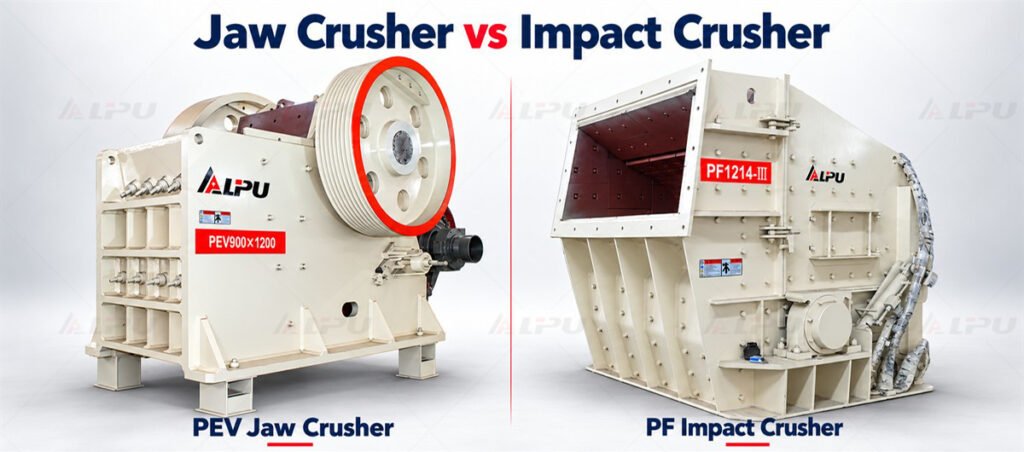
LIPU PEV jaw crusher and PF impact crusher for different crushing duties
This affects their suitability for different feed materials, crushing stages and product requirements. Jaw crushers are commonly used to reduce large rock before further processing. Impact crushers are often selected for suitable less-abrasive materials where aggregate shape is important.
The two machines can also work together. Choosing the right arrangement requires evaluating the feed, finished product and complete crushing circuit.
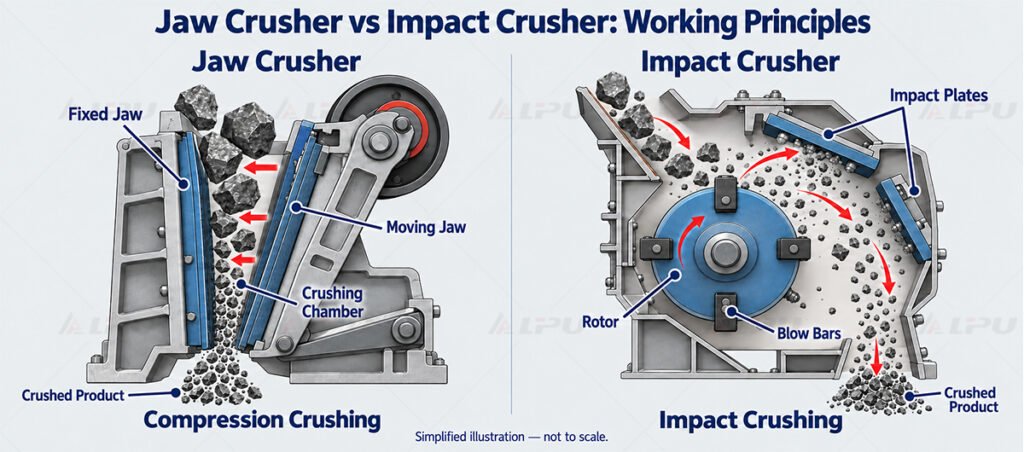
A jaw crusher breaks rock between a fixed jaw and a moving jaw. As the moving jaw approaches the fixed jaw, material is compressed and fractured.
A horizontal-shaft impact crusher uses rotor-mounted blow bars to strike incoming material. Further breakage occurs as material collides with impact surfaces inside the chamber.
This comparison covers horizontal-shaft impact crushers, rather than vertical-shaft impactors used in applications such as sand production.
A jaw crusher compresses rock between jaw plates, while an impact crusher uses rotating blow bars and impact plates to break material
Factor
Jaw Crusher
Impact Crusher
Crushing action
Compression
High-speed impact
Common application
Primary crushing
Secondary crushing; primary crushing with suitable equipment and feed
Feed suitability
Large rock, including hard and abrasive materials
Feed within the model’s size and abrasiveness limits
Product role
Prepares material for further processing
Often selected for reduction and aggregate shaping
Main wear parts
Jaw plates and cheek plates
Blow bars and impact liners
Neither machine produces a single uniform particle size. Screening is generally needed to separate defined product fractions.
Which Crusher Suits Your Material?
For hard and abrasive rock, a jaw crusher is commonly considered for primary crushing. Further reduction may use a cone crusher where impact-crusher wear would be uneconomical.
Hardness and abrasiveness should be assessed separately. A material’s resistance to breakage does not directly describe how quickly it wears metal components.
For limestone and similar quarry materials, an impact crusher can be suitable when abrasiveness is acceptable and aggregate shape matters. Large incoming blocks may still require a jaw crusher first.
For concrete recycling, either type may be considered. Selection depends on feed dimensions, reinforcement, contamination and recycled-product requirements. Sorting, metal removal and screening must also be included in the process.
Rock names alone are insufficient for selection. Representative material information provides a stronger basis than assuming all granite, limestone or concrete behaves alike.
How Do Feed Size and Product Requirements Affect Selection?
Check both maximum lump dimensions and the overall feed-size distribution. Occasional oversized slabs can create different handling problems from consistently sized rock.
For jaw crushers, irregular feed can bridge above the chamber and interrupt production. For impact crushers, incoming material must remain within the selected model’s feed limits.
Next, define the required discharge. Material intended for a secondary crusher has different requirements from finished concrete aggregate or mill feed.
Confirm:
Required throughput.
Finished-product sizes.
Aggregate shape requirements, where applicable.
Moisture and clay conditions.
Upstream and downstream equipment limits.
These requirements determine whether one crushing stage is sufficient or further crushing and screening are needed.
Can an Impact Crusher Replace a Jaw Crusher?
Sometimes, provided the impact crusher can accept the feed and perform the required duty economically.
Direct impact crushing may be considered for suitably sized, less-abrasive material. Large blasted rock may still require primary jaw crushing before entering the selected impact crusher.
Compare feed acceptance, wear requirements, throughput and product quality together. Matching rated tonnes per hour alone does not establish that one machine can replace the other.
When Should Both Crushers Work Together?
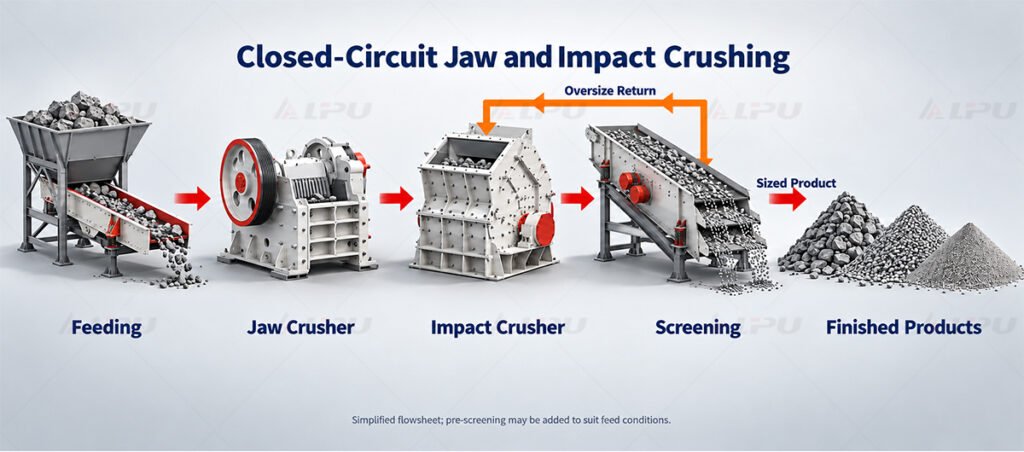
A combined arrangement may suit projects requiring large-feed reduction followed by impact crushing:
Screen oversize returns to the impact crusher; sized aggregate leaves as finished product
The jaw crusher prepares feed for the impact stage. Screening separates finished fractions, while oversize may return for further crushing.
The impact crusher must handle both fresh feed and any returning material. The screen and conveyors must also support the circuit load.
LIPU offers jaw and impact crushing equipment that can be evaluated as part of a complete plant. The final arrangement should match the actual material and production requirements.
Which Crusher Has Lower Operating Costs?
There is no universal cost advantage. Compare proposals against the same feed conditions and finished-product requirements.
Cost Factor
What to Compare
Wear parts
Expected consumption, replacement cost and supporting assumptions
Energy
Consumption relative to production, rather than motor power alone
Maintenance
Access, replacement procedures and planned downtime
Product yield
Output meeting the required saleable specifications
Circuit load
Additional crushing, screening and material return
Highly abrasive feed can increase impact-crusher wear costs. However, a jaw crusher that requires additional downstream processing must be evaluated as part of that complete arrangement.
Ask suppliers to explain the basis of performance and wear estimates rather than comparing purchase prices alone.
What Information Does LIPU Need for Selection?
For an initial equipment recommendation, provide:
Material type and available test information.
Feed-size distribution and maximum lump dimensions.
Moisture and clay conditions.
Required capacity and finished-product specifications.
Existing equipment, if the crusher will join an operating plant.
Project location and site conditions.
Explain whether you need a standalone machine, a replacement crusher or a complete production line.
Planning a crushing project? Share your feed information and product requirements with LIPU to discuss a suitable jaw, impact or combined crushing arrangement.
Frequently Asked Questions
Is a jaw crusher better than an impact crusher?
It depends on the duty. Jaw crushers are commonly used for primary reduction of large rock. Impact crushers are often considered for suitable less-abrasive feed where reduction and aggregate shape matter.
Can an impact crusher be used for primary crushing?
Yes, if the machine is designed for that duty and the feed meets its operating limits. LIPU’s impact crusher range is positioned primarily for secondary crushing, so confirm the proposed model’s application before selection.
Which crusher is more suitable for granite?
A jaw crusher is commonly used for primary granite crushing. For further reduction, a cone crusher is often considered where the granite is highly abrasive. Impact crushing requires careful evaluation of wear costs.
Does an impact crusher produce better aggregate shape?
Impact crushing often produces a more cubical product. Actual results depend on the material, feed grading, operating settings and screening circuit.
Can a jaw crusher and an impact crusher work together?
Yes. A jaw crusher can reduce large feed before impact crushing and screening. Equipment matching must account for feed size, throughput and returning oversize.


We will reply to you within 24 hours