Wet and dry magnetic separation are widely used in mineral processing. However, the best method depends on ore properties, particle size, moisture, and the required separation results.
Dry separation is often considered for coarse pre-concentration and dry material processing. Wet separation is commonly used after grinding, especially when fine minerals must be recovered from slurry. Understanding these differences helps buyers choose suitable equipment and avoid unnecessary processing costs.
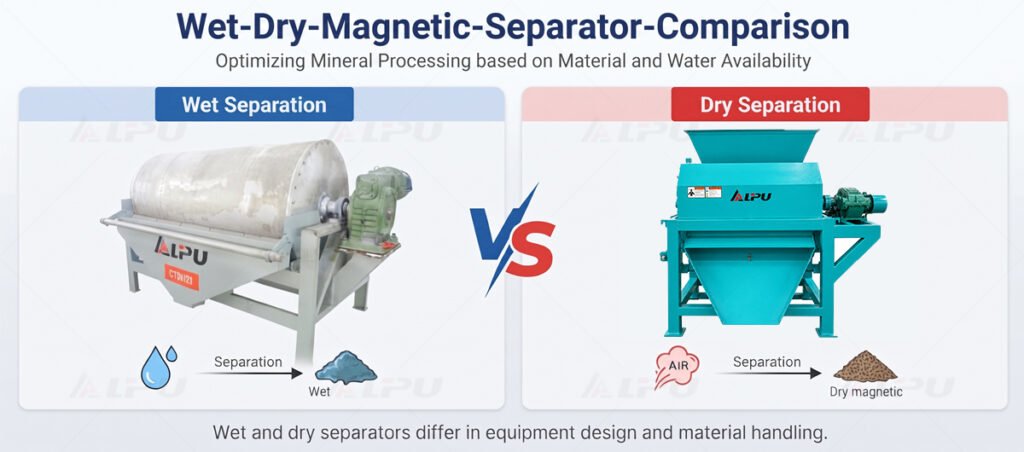
Both methods separate minerals according to their magnetic response. The main difference is how the material enters and moves through the magnetic field.
Wet magnetic separation processes ore mixed with water. The slurry passes through a magnetic separation zone, where magnetic particles are recovered while less magnetic material is discharged.
Dry magnetic separation handles free-flowing solid particles without added process water. Depending on the equipment design, magnetic drums, rollers, or belts separate materials with different magnetic properties.
Wet and dry separators differ in equipment design and material handling
Factor
Wet magnetic separation
Dry magnetic separation
Feed condition
Slurry
Dry, free-flowing solids
Typical application
Fine mineral recovery
Coarse pre-concentration or impurity removal
Water requirement
Process water needed
No added process water
Moisture sensitivity
Slurry conditions must be controlled
Damp material may cause sticking
Supporting equipment
Pumps and dewatering systems
Feed control and possible dust collection
Common circuit position
After wet grinding
Before grinding or in dry circuits
Neither method is universally better. Separation efficiency depends on mineral properties, liberation, feed preparation, and magnetic field characteristics.
For example, strongly magnetic magnetite may respond to low-intensity separation. Weakly magnetic minerals can require higher-intensity equipment, regardless of whether the process is wet or dry.
Which Ores Are Suitable for Each Method?
Ore composition is a major factor in selecting magnetic separation equipment. However, the same mineral may require different methods depending on particle size and processing objectives.
Magnetite
Magnetite is strongly magnetic and commonly processed using magnetic separation.
Dry separation may be suitable for preliminary waste rejection when the ore is sufficiently liberated at a coarse size. After grinding, wet drum separators are often used to recover magnetite from slurry.
Hematite
Hematite generally responds less strongly to magnetic fields than magnetite. Therefore, some hematite ores require high-intensity or high-gradient magnetic separation.
Wet or dry operation may be considered depending on liberation, particle size, and test results.
Ilmenite and heavy minerals
Dry magnetic separation is used in some heavy mineral processing circuits, particularly after drying and particle-size preparation. Wet separation may also be used at other processing stages.
Quartz and feldspar
For industrial minerals, magnetic separation often aims to remove iron-bearing impurities rather than recover magnetic concentrates.
Dry separation may suit granular materials, while wet high-intensity separation can be considered for certain fine impurities.
However, not all iron-bearing contaminants respond sufficiently to magnetic fields.
How Do Particle Size and Moisture Affect Selection?
Particle size, mineral liberation, and moisture directly influence magnetic separation performance.
Particle size
Dry separators require suitable particle distribution and consistent feeding. Large differences in particle size can affect how materials move through the magnetic field.
Wet separators are commonly used for finer particles after grinding. However, excessive fines can also create separation and concentrate-handling challenges.
There is no universal feed-size limit for all magnetic separators. The acceptable range depends on equipment design and material properties.
Mineral liberation
Magnetic separation works best when valuable minerals are sufficiently separated from unwanted gangue.
Poorly liberated particles may carry impurities into the magnetic concentrate. Although finer grinding can improve liberation, excessive grinding increases energy consumption and may produce unnecessary fines.
As a result, water availability and feed moisture should be evaluated together with mineral characteristics.
Where Does Each Method Fit in a Processing Circuit?
Magnetic separation should be selected according to its role in the complete mineral processing flowsheet.
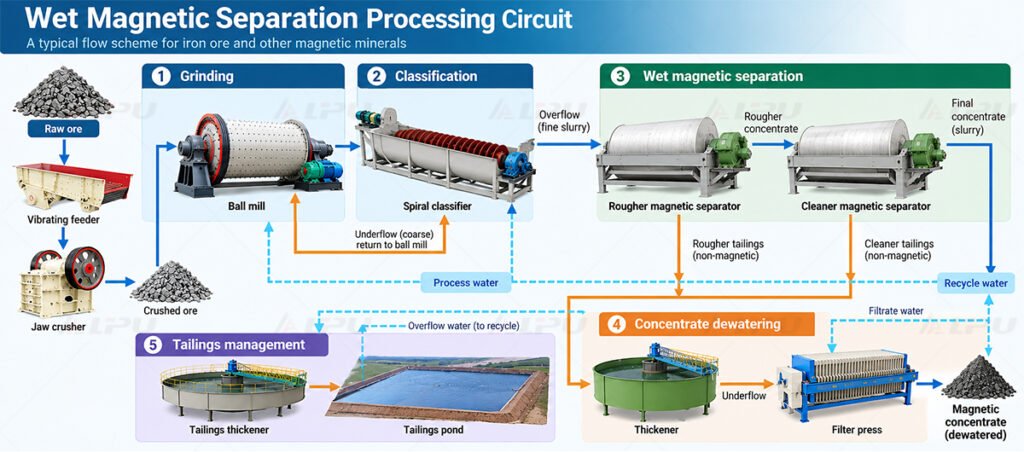
Wet magnetic separation is often integrated with grinding and classification
Dry pre-concentration
Dry separation may be installed after crushing and screening to reject part of the non-magnetic waste before grinding.
When suitable, this can reduce the amount of material entering downstream equipment.
However, the benefit depends on whether valuable minerals can be separated at the available particle size. Poorly liberated ore may require further grinding instead.
Wet separation after grinding
Wet magnetic separation is commonly integrated with grinding and classification.
After the ore reaches the required liberation size, slurry enters the magnetic separator. The recovered concentrate may then require thickening or filtration.
Process water can also be recovered where the plant design allows.
Combined dry and wet separation
Some projects use dry pre-concentration followed by wet magnetic separation.
This arrangement can be useful when coarse waste rejection is possible but finer grinding is still required for final concentration.
Nevertheless, combined circuits should be justified by test results rather than treated as a standard configuration.
What Are the Cost and Operating Differences?
Equipment price alone does not determine the more economical separation method.
Dry separation avoids adding process water. However, wet ore may require drying, while dry material handling can require dust control and additional feed preparation.
Wet separation can handle slurry directly after grinding. Nevertheless, it requires water management, slurry transport, and often concentrate dewatering.
The main cost considerations include:
Equipment investment: Separator type, capacity, magnetic system, and supporting machinery.
Energy consumption: Grinding, drying, pumping, conveying, and auxiliary equipment.
Water management: Supply, circulation, recovery, and treatment.
Maintenance: Wear parts, magnetic drum components, pumps, and material-handling systems.
Recovery performance: Valuable mineral losses and final concentrate quality.
A lower equipment quotation does not always mean lower production costs.
For example, dry pre-concentration may reduce downstream grinding demand when waste can be rejected early. However, additional drying costs or mineral losses could offset the benefit.
Similarly, wet separation may increase water-system costs but provide better results for a particular fine, liberated ore.
Therefore, buyers should compare complete circuit performance rather than separator purchase prices alone.
How Should Buyers Select a Magnetic Separator?
The first step is defining the separation objective.
A magnetite recovery project may require different equipment from an industrial mineral iron-removal application. Feed preparation and target product quality must also be considered.
Magnetic separator selection depends on ore properties, feed conditions, and processing capacity
Before requesting a quotation, prepare the following information:
Required information
Selection purpose
Ore type and mineral composition
Identify separation requirements
Magnetic mineral characteristics
Determine suitable magnetic system
Feed size and particle distribution
Check equipment compatibility
Moisture or slurry condition
Evaluate wet or dry operation
Processing capacity
Determine preliminary equipment size
Feed grade and target product quality
Establish recovery and separation objectives
Water availability
Evaluate circuit requirements
Existing processing equipment
Plan equipment integration
Laboratory separation tests are especially important for unfamiliar ores.
Testing helps determine whether magnetic separation is suitable, how much grinding may be required, and which operating conditions produce acceptable results.
1. Is wet magnetic separation better than dry separation?
Not always. Wet separation is often suitable for fine mineral recovery in slurry circuits, while dry separation may be preferred for coarse pre-concentration or dry material processing. Ore testing should guide the decision.
2. Can magnetite be processed using both methods?
Yes. Suitable coarse magnetite ore may undergo dry pre-concentration, while wet separation is commonly used after grinding. The correct arrangement depends on mineral liberation and recovery requirements.
3. Does dry magnetic separation require completely dry ore?
Not necessarily completely dry, but the material must remain sufficiently free-flowing. Excess moisture can cause agglomeration and uneven separation. Acceptable moisture depends on the separator and feed characteristics.
4. Can magnetic separation remove iron from quartz sand?
Yes, when the iron-bearing impurities have a suitable magnetic response and are sufficiently liberated. Some contaminants may require additional treatment.
5. What information is needed for a magnetic separator quotation?
Buyers should provide ore type, capacity, feed size, moisture, mineral characteristics, and target product quality. Mineralogical reports and separation test results can improve equipment selection.
About LIPU Heavy Industry
LIPU Heavy Industry manufactures crushing, grinding, classification, magnetic separation, flotation, and related mineral processing equipment.
We support equipment selection and process configuration based on ore characteristics, required capacity, and project operating conditions.


We will reply to you within 24 hours