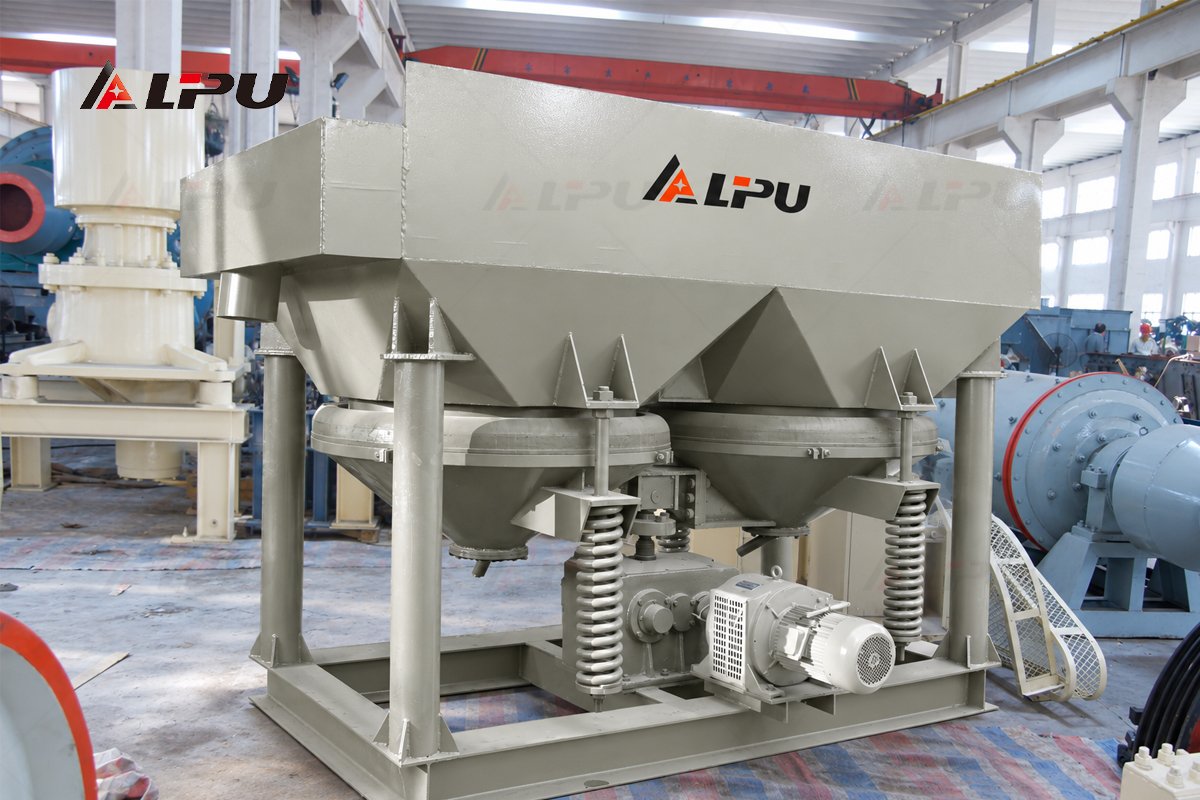
LIPU Mineral Jig Concentrators use pulsating water to separate suitable mineral particles according to differences in density and settling behavior.
The range includes models from JT0.57-1 to JT6-3. Listed capacities vary by model from 1 to 25 t/h. Feed-size limits and operating requirements also vary by model.
Separation method: Water-based gravity jigging
Available models: JT0.57-1, JT1-1, JT2-2, JT4-2, JT4-2A, JT5-2, and JT6-3
Listed capacity range: 1–25 t/h, according to the product-page table
Listed feed-size limits: Less than 10 mm or less than 25 mm, depending on model
Configuration: Jigging unit with model-specific drive, water supply, and discharge systems
What Is a Mineral Jig Concentrator and Where Is It Used?
A mineral jig concentrator is a gravity-separation machine that uses pulsating water to stratify particles in a jigging chamber. Under suitable conditions, denser particles settle toward the lower part of the bed while lighter particles remain higher and move toward the tailings outlet.
Jigging may be considered for alluvial or crushed ores when the valuable mineral is sufficiently liberated and has suitable separation characteristics. It can be installed as a standalone machine or integrated with other mineral-processing equipment.
How Does Water Pulsation Separate Mineral Particles?
The separation process takes place in three main stages:
Working Principle Of Mineral Jig Concentrator
Prepare and feed the material: Feed ore within the selected model’s rated size range into the jigging chamber.
Stratify the particle bed: Pulsating water repeatedly expands and settles the bed. Heavier particles tend to move lower, while lighter particles remain in the upper layers.
Discharge the products: The machine’s discharge arrangement directs the resulting products to separate concentrate and tailings outlets.
Separation results depend on feed size, mineral liberation, density contrast, water conditions, and operating settings. Discharge paths and internal arrangements vary by model.
How Does a Mineral Jig Fit into a Processing Flowsheet?
A mineral jig is usually integrated into a flowsheet that prepares the feed before separation and handles the resulting products afterward. A typical setup may include:
Mineral jigger process flow
Feed preparation: Screen or classify the material to meet the selected jig’s feed-size requirements. Washing or scrubbing may be needed for clay-rich feed.
Jig separation: Feed the prepared material into the jigging chamber. Pulsating water helps stratify particles according to their density and settling behavior.
Product discharge: Direct the heavier fraction to the concentrate outlet and the lighter fraction to the tailings outlet, according to the machine configuration.
Downstream treatment: Collect, dewater, or further process the products as required by the recovery target and overall plant design.
The flowsheet depends on ore characteristics, feed size, required capacity, water availability, and test results. The diagram should therefore be presented as a typical process illustration, not a fixed layout for every installation.
Key Benefits of LIPU Mineral Jig Concentrators
Gravity-based separation: Uses differences in particle density and settling behavior to separate suitable materials.
Multiple model options: A range of jigging areas and capacities supports different feed and process requirements.
Adjustable operating parameters: Stroke and water conditions can be selected or adjusted according to the model and process.
Flexible plant integration: A jig can be incorporated into a flowsheet with suitable screening, washing, or conveying equipment.
Different installation options: Model selection can take account of plant layout and available installation space.
Separation performance depends on feed characteristics and operating conditions. Confirm suitability through material testing and process evaluation.
Ores and Applications for Jig Separation
Mineral jigs may be considered for gravity separation of suitable materials, including:
Mineral jigger application material
Gold-bearing and alluvial materials
Tin and tungsten ores
Manganese and iron ores
Chrome and titanium-bearing ores
Diamonds and other heavy minerals
Fluorite, barite, garnet, and other materials with suitable density differences
This list is indicative. Suitability depends on particle size, mineral liberation, density contrast, and feed preparation. Representative testing is recommended before equipment selection.
Mineral Jig Concentrator Structure and Main Components
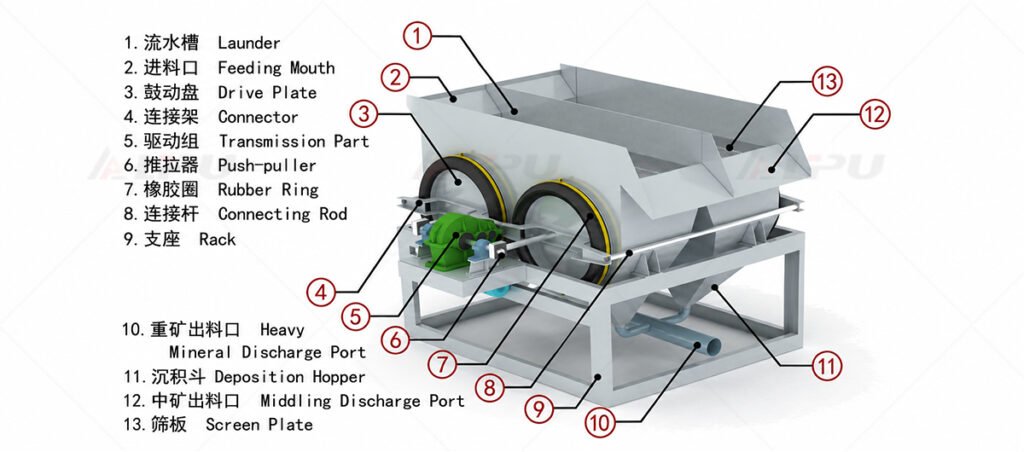
A mineral jig concentrator generally includes a jigging chamber, screen or bed, water supply connections, drive or pulsation system, feed inlet, and product discharge points. Construction varies by model.
Main components of a mineral jig concentrator
Mineral Jig Concentrator Models and Technical Specifications
The table below reproduces the specifications currently listed on the product page. Confirm the values and unit definitions with LIPU before ordering or publication.
Mineral Jig Concentrator
Model
jigging chamber
diaphragm
Feeding size(MM)
Back Wash Water (M3/H)
Back Wash Water Pressure(Mpa)
Process Capacity (T/H)
Motor power (KW)
Dimension (MM)
Weight (Ton)
Shape
Area
Stroke
Jig frequency
JT0.57-1
Trapezoid
0.57
10-17
80-120
<10
18-20
≥0.1
1-3
1.5
1550x780x1530
0.6
JT1-1
Trapezoid
1.1
10-17
<10
20-30
2-4
2.2
2270x1110x1890
0.9
JT2-2
Trapezoid
2.3
10-17
60-100
<25
40-50
4-8
3
2900x1550x2000
1.4
JT4-2
Trapezoid
4.5
20-30
<25
80-100
10-15
7.5
3900x2000x2460
3.2
JT4-2A
Trapezoid
4.5
20-30
<25
80-100
10-15
4*2pc
3900x2000x2460
4
JT5-2
Trapezoid
5
20-30
<25
80-100
10-20
7.5
4000x2050x2660
3.2
JT6-3
Trapezoid
6.8
20-30
<25
120-150
20-25
7.5*4
5400x2000x2460
5
Technical note: Some source-table headings and values appear misaligned, and several entries are missing or ambiguous. Confirm diaphragm stroke, jig frequency, backwash pressure, process capacity, motor power, and units with LIPU before publishing the table as final.
How to Choose the Right Mineral Jig Model
When comparing models, consider:
Ore type and mineral properties: Identify the valuable mineral, gangue, density contrast, and liberation characteristics.
Feed size and preparation: Check the maximum feed size and whether screening or classification is required.
Required throughput: Match the rated capacity to the intended operating rate and feed conditions.
Water supply: Confirm available flow, pressure, and water-recirculation arrangements.
Installation conditions: Review plant footprint, foundation, power supply, and connection requirements.
Process test results: Use representative samples to evaluate separation performance and operating settings.
Provide LIPU with the ore type, feed-size range, target capacity, and available water and power conditions for a model recommendation.
Mineral Jigging Equipment in Field Applications
Field photographs can show how jigging equipment is arranged at mineral-processing sites. Machine appearance, supporting equipment, and plant layout may vary between projects and models.
Use available site images as examples of related jigging equipment in field applications. Do not identify them as installations of the specific model shown on this page unless the model and project details have been confirmed.
Thailand Customer Site
Kenya customer site
South African customer site
Installation, Training, and After-Sales Support
LIPU can provide support for equipment installation and commissioning, operator training, maintenance guidance, and parts supply. Confirm the scope and availability of support for each order and destination.
Mineral Jig Concentrator FAQs
What does a mineral jig concentrator do?
It uses pulsating water and gravity to stratify suitable mineral particles by density and settling behavior, directing heavier and lighter products to separate outlets.
Which ores can be processed in a jig?
Jigs may be suitable for gold-bearing ores, tin, tungsten, manganese, iron, chrome, and other minerals with suitable separation characteristics. Confirm suitability through testing.
Does jigging work for every particle size?
No. Each model has a listed feed-size range, and performance also depends on feed preparation and particle characteristics. Check the confirmed specifications for the selected model.
How do I choose a jig concentrator capacity?
Capacity selection depends on the feed material, required throughput, particle size, water supply, and process layout. A representative sample test can help establish suitable operating conditions.
Can a mineral jig be integrated into a processing plant?
Yes, where the flowsheet and material are suitable. A jig may be combined with screening, washing, and conveying equipment. Determine the final configuration through process design.
Does a jig concentrator refine or purify gold?
A jig performs gravity separation; it does not by itself refine gold or guarantee impurity removal. Further processing may be required depending on the concentrate and final product requirements.