High-G Gravity Separation for Fine Free Gold and Heavy Minerals
The LIPU centrifugal concentrator generates an enhanced 60–100G centrifugal field with fluidized backwash water to effectively capture fine, liberated gold (down to 10–20 microns) and heavy minerals such as chromite, wolframite, and scheelite.
Capacity: 0.5 – 120 TPH
Feeding size: 0 – 6 mm Optimal: 0.01 – 2.5 mm
Hard Rock Gold Circuits: High-ratio gravity trap in grinding/classification loops (cyclone underflow / ball mill discharge).
Alluvial & Placer Gold: Primary roughing and scavenging after trommel screen washing (-5 mm undersize).
Tailings & Heavy Minerals: Fine gold scavenging from flotation tailings, and gravity recovery of heavy sands (scheelite, chromite, zircon, tin).
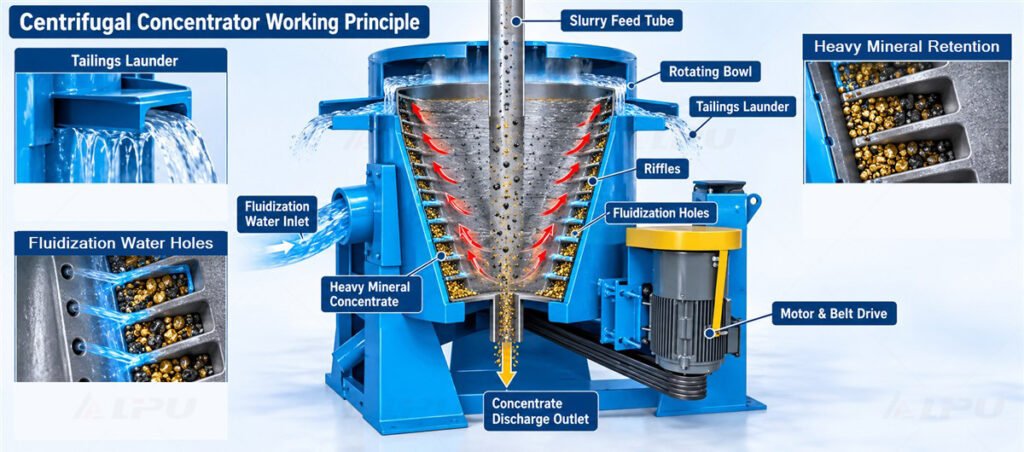
Separation in a centrifugal concentrator relies on fluidization mechanics inside a rotating ribbed cone:
Working principle of a water-jacket centrifugal concentrator
High-G Centrifugal Field: Slurry enters centrally through the feed tube into the inner rotating bowl. The high-speed rotation generates an artificial centrifugal field 60 to 100 times greater than Earth’s gravity (G-force).
Pressurized Fluidization Water: Clear backwash water is injected through multiple fluidization holes drilled in the rings of the inner bowl. This upward water pressure keeps the trapped mineral bed loose and fluidized, preventing gangue compaction.
Selective Mineral Entrapment: Under combined centrifugal force and fluidizing water, high-density gold particles (specific gravity 15–19) overcome water drag and penetrate deep into the retention grooves. Lower-density gangue minerals (specific gravity ~2.6–3.0) cannot penetrate the fluidized bed and are continuously carried upward to the tailings overflow.
Concentrate Discharge:
Batch / Semi-Continuous Type (STL Series): After operating for a predetermined cycle (typically 1–4 hours for placer gold, 30–60 minutes for grinding circuit feeds), feeding stops, the bowl slows down, and concentrated gold is flushed out through the bottom discharge port.
Fully Automatic PLC Type: Automation valves control washing, feeding, stopping, concentrate dumping, and rinsing sequences without manual intervention.
Technical Specifications (LIPU STL Series)
Model
Feeding Capacity (Dry Solids)
Slurry Capacity
Max Feed Particle Size
Optimal Recovery Size Range
Slurry Density (Solids %)
Fluidization Water Pressure
Fluidization Water Consumption
Motor Power
STL-20
0.5 – 2 t/h
2 – 4 m³/h
0 – 3 mm
0.02 – 1.5 mm
20% – 40%
0.10 – 0.20 MPa
2 – 3 m³/h
1.5 kW
STL-30
3 – 5 t/h
5 – 10 m³/h
0 – 4 mm
0.02 – 2.0 mm
20% – 40%
0.15 – 0.25 MPa
3 – 5 m³/h
3.0 kW
STL-60
10 – 15 t/h
15 – 25 m³/h
0 – 5 mm
0.02 – 2.5 mm
20% – 45%
0.15 – 0.30 MPa
8 – 12 m³/h
7.5 kW
STL-80
20 – 30 t/h
30 – 45 m³/h
0 – 5 mm
0.015 – 2.5 mm
20% – 45%
0.18 – 0.35 MPa
15 – 20 m³/h
11.0 kW
STL-100
40 – 60 t/h
60 – 90 m³/h
0 – 6 mm
0.010 – 2.5 mm
20% – 45%
0.20 – 0.40 MPa
25 – 35 m³/h
18.5 kW
STL-120
80 – 120 t/h
120 – 160 m³/h
0 – 6 mm
0.010 – 2.5 mm
25% – 50%
0.25 – 0.45 MPa
45 – 60 m³/h
30.0 kW
Note: Clean fluidization water is required (suspended solids < 50 ppm) to avoid clogging water injection orifices.
Core Engineering Advantages
Superior Recovery of Ultrafine Gold: Traditional sluice boxes lose gold finer than 100 mesh (150 µm). LIPU centrifugal concentrators reliably recover liberated particles down to 10–20 µm.
Variable Frequency Drive (VFD): Allows stepless bowl rotation speed control to dial in exact G-force according to specific ore weight and particle liberation.
Wear-Resistant Polyurethane & Stainless Steel Components: Inner ribbed bowls are fabricated from high-grade polyurethane or wear-hardened stainless steel, offering extended operating life in abrasive slurries.
One-Touch PLC Automation Option: Automated pneumatic pinch valves control the entire cycling, rinsing, and concentrate collection process with minimal operator oversight.
Chemical-Free, Eco-Friendly Operation: Pure physical gravity beneficiation with zero cyanide or mercury, providing high-grade concentrate directly to melting or shaking table cleaning.
Applications Across Ore Processing Circuits
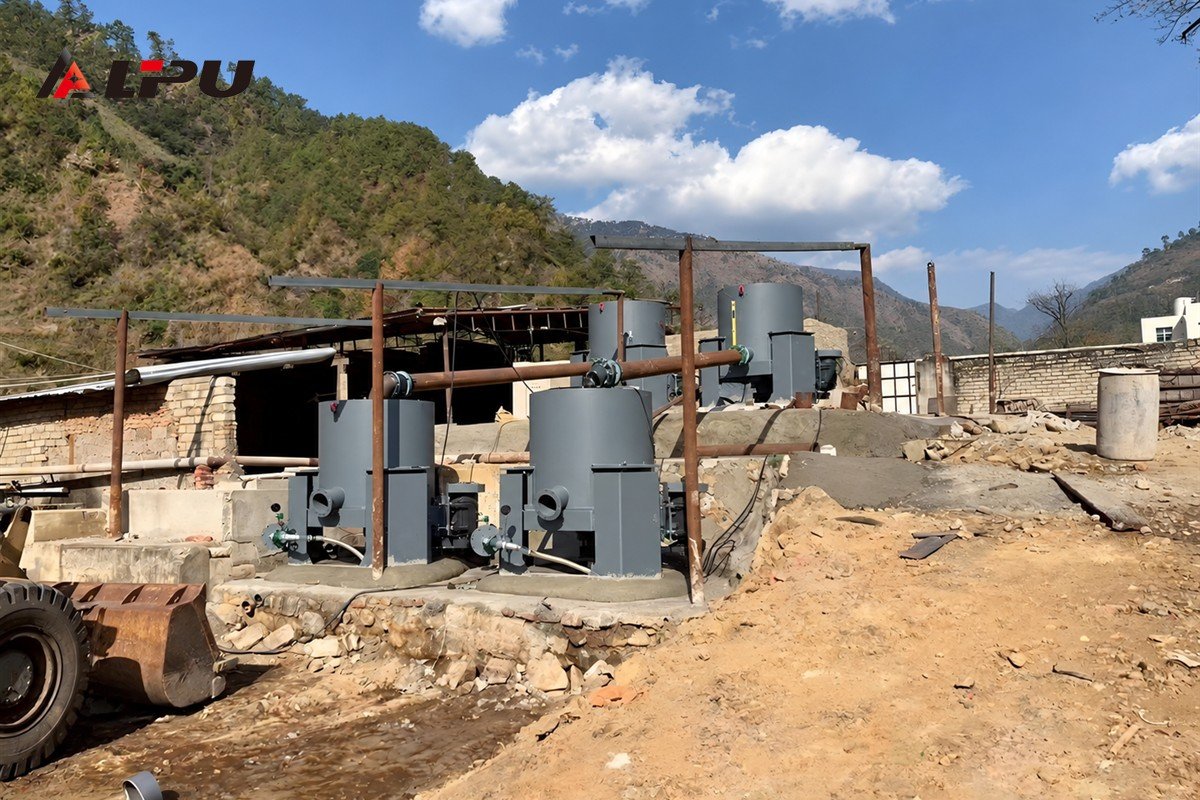
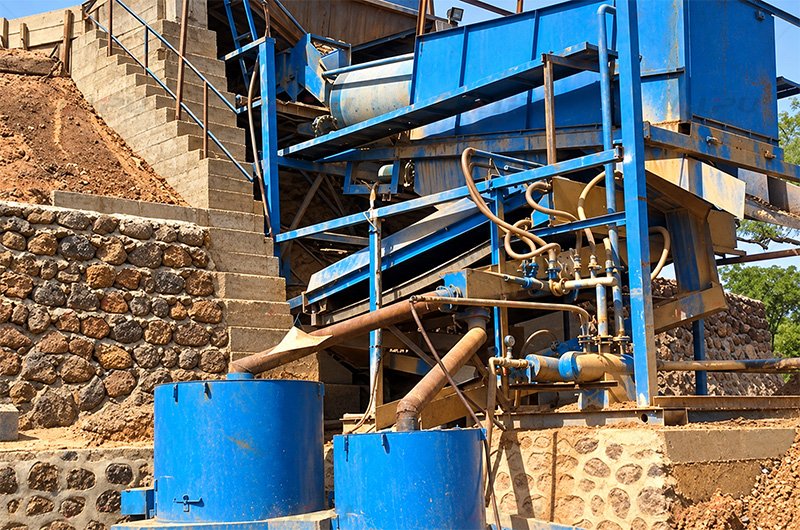
Centrifugal concentrator in a hard-rock grinding circuit
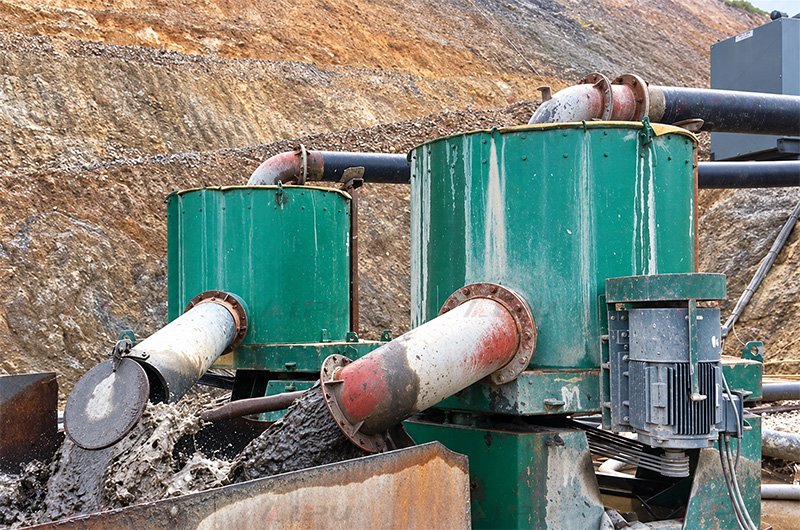
Centrifugal concentrators placer alluvial cleaned
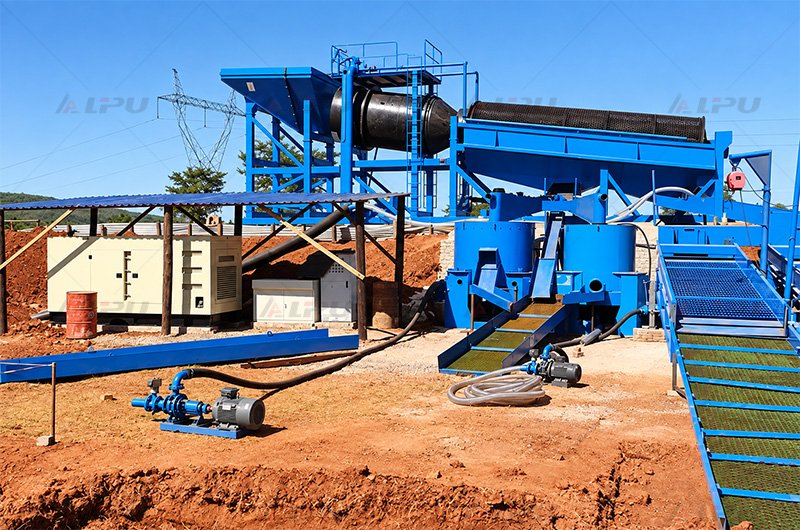
Centrifugal concentrator and alluvial trommel screen
1. Grinding Circuit Gravity Trap (Hard Rock Gold)
Positioned on the hydrocyclone underflow or ball mill discharge. Recovers liberated coarse and fine free gold early in the comminution circuit, preventing gold overgrinding and reducing subsequent flotation reagent demand or cyanide consumption.
Installed after trommel scrubber screening. It treats the screen undersize (typically -2 mm to -5 mm) as a primary rougher or scavenger, replacing or upgrading traditional sluice circuits.
Recovers escaped fine gold from historical flotation tailings, gravity tailings, or heap leach residue streams before final tailings dry stacking.
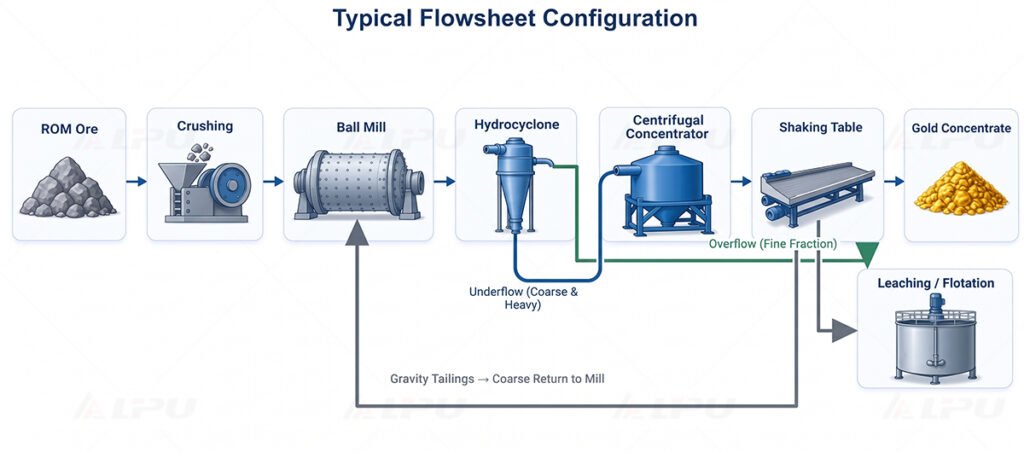
Typical Flowsheet Configuration
Typical gold recovery flowsheet
Feed Preparation: Slurry feed is screened to minus 5 mm and conditioned for uniform feeding.
Centrifugal Separation: Feed enters the LIPU Gold Centrifugal Concentrator operating under controlled backwash fluidization water pressure.
Tailings Handling (Overflow): Overflow discharges continuously to hydrocyclone dewatering units and proceeds to flotation or leaching (CIL/CIP) circuits.
Concentrate Upgrading (Underflow): High-grade gold concentrate flushes periodically to a finishing shaking table, producing direct smelting-grade gravity concentrate.
Frequently Asked Questions (FAQ)
What is the minimum particle size a centrifugal concentrator can recover? With proper fluidization water pressure and slurry control, LIPU centrifugal concentrators effectively capture liberated free gold down to 10–20 microns (approx. 625–1250 mesh), which cannot be recovered by conventional jigs or sluice mats.
Why is backwash fluidization water necessary? Without fluidization water, dense solids would quickly compact against the cone wall, eliminating the grooves and allowing fine gold to be washed away with tailings. Water injection keeps the bed fluid and porous, allowing heavy gold to continuously displace lighter gangue particles.
How often should the concentrate be discharged? For alluvial gold with high grades of free coarse gold, concentrate discharge is recommended every 1 to 4 hours. In closed grinding circuits where heavy minerals (pyrite/magnetite) quickly saturate the grooves, shorter cycle times of 30 to 60 minutes are common.
What water quality is required for fluidization? Clean, solids-free process water is essential. Water containing excessive coarse suspended solids will block the laser-drilled fluidization nozzles. LIPU supplies integrated inline backwash strainers/filters with each unit.
LET US REACH YOUNeed detailed customization and latest price? Chat online or leave message below!
How we use cookies
This Cookie Privacy Policy statement explains how Zoneding Machine (hereinafter referred to as "we", "our", or "this website") uses cookies and similar technologies (collectively referred to as "cookies") to identify you when you visit our website lepuu.com. It explains what these technologies are, why we use them, and your rights to control our use of them.
Privacy Policy
Leave a Message
We will reply to you within 24 hours
Hello, I am Lipu Heavy Industry, what can we do for you please?