A jaw crusher needs a steady supply of material to operate efficiently. However, rock arriving from a quarry or mine rarely has a uniform size. Large lumps, smaller stones, and fine particles often enter the receiving hopper together.
A vibrating grizzly feeder helps control this material flow before primary crushing. It delivers rock toward the jaw crusher while allowing suitably sized particles to pass through the grizzly section.
For quarry operators, mining companies, and equipment buyers, selecting the right feeder can improve material handling and support more consistent crushing operations. This guide explains how vibrating grizzly feeders work, where they are used, what affects their price, and how to choose a suitable model.
Why Does a Jaw Crusher Need a Vibrating Grizzly Feeder?
In a typical quarry, excavators or wheel loaders deliver raw rock to a receiving hopper. Without a controlled feeding system, material may enter the jaw crusher unevenly, causing sudden loading changes or interruptions in the crushing process.
A vibrating grizzly feeder regulates the movement of material from the hopper into the crusher. It helps maintain a more consistent feed rate and reduces the risk of large quantities of rock entering the crushing chamber at once.
The grizzly section provides another advantage. When the incoming material contains smaller particles, some can pass through the openings instead of entering the primary crusher.
This arrangement can reduce unnecessary crushing of material that is already sufficiently small. However, the benefit depends on the feed size distribution, grizzly openings, and downstream material handling system.
For buyers planning a new crushing line, the feeder should be selected together with the primary crusher rather than treated as an unrelated accessory.
LIPU supplies vibrating feeder equipment for mining, quarrying, and aggregate production. Available models can be evaluated according to material conditions, feeding requirements, and installation arrangements.
Buyer Tip: A feeder with a higher advertised capacity is not automatically the better choice. It must match the crusher, hopper, and expected material flow.
What Does a Grizzly Feeder Do Before Crushing?
A vibrating grizzly feeder combines controlled feeding with preliminary separation, commonly called scalping.
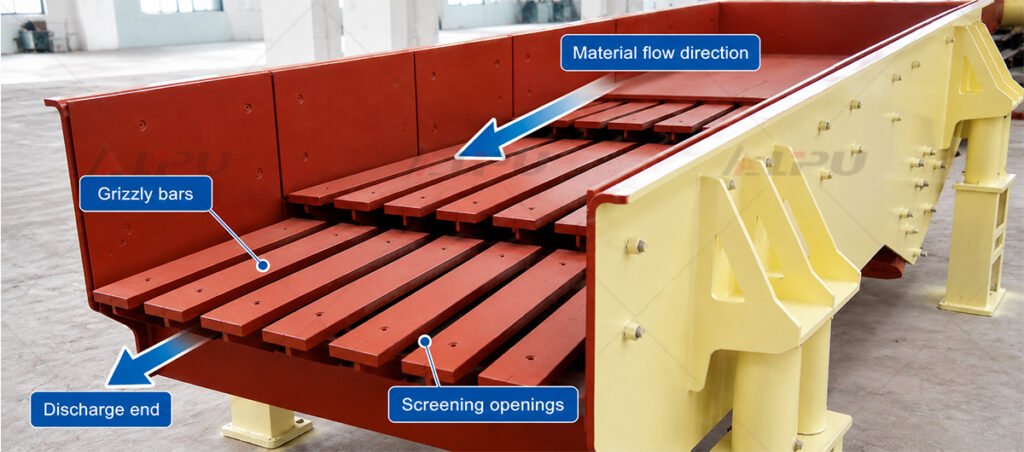
Material moves along the feeder trough toward the crusher. In the grizzly section, particles small enough to pass through the openings are separated from larger rocks.
The oversized material continues toward the primary crusher, while the undersized fraction follows a separate discharge path. Depending on the plant design, this material may join a downstream conveyor or enter another processing stage.
This separation is particularly useful when the raw feed contains a significant proportion of smaller particles. However, it is not necessary for every crushing application.
Grizzly bars allow suitable undersized material to bypass primary crushing
Vibrating Feeder vs. Vibrating Grizzly Feeder
Although the terms are sometimes used interchangeably, the equipment configurations can differ.
Feature
Vibrating Feeder
Vibrating Grizzly Feeder
Main function
Controlled material feeding
Feeding and preliminary separation
Grizzly bars
Not necessarily included
Included for the separation duty
Undersize bypass
Not inherent
Possible through grizzly openings
Typical use
Hopper discharge and material transfer
Primary crushing of mixed-size rock
Key selection factor
Feed rate and material handling
Feed rate, material size, and separation needs
A standard vibrating feeder may be sufficient when the material is relatively uniform or does not require preliminary separation.
By comparison, a grizzly feeder is often suitable for primary crushing systems handling mixed-size rock. The decision should be based on actual material conditions rather than equipment appearance alone.
For a complete crushing system, the feeder must also match the receiving opening and operating requirements of the jaw crusher.
What Materials Can a Vibrating Grizzly Feeder Handle?
Vibrating grizzly feeders are widely used in mining, quarrying, and aggregate production. They can handle different rocks and ores when the equipment is properly selected for the material’s physical characteristics.
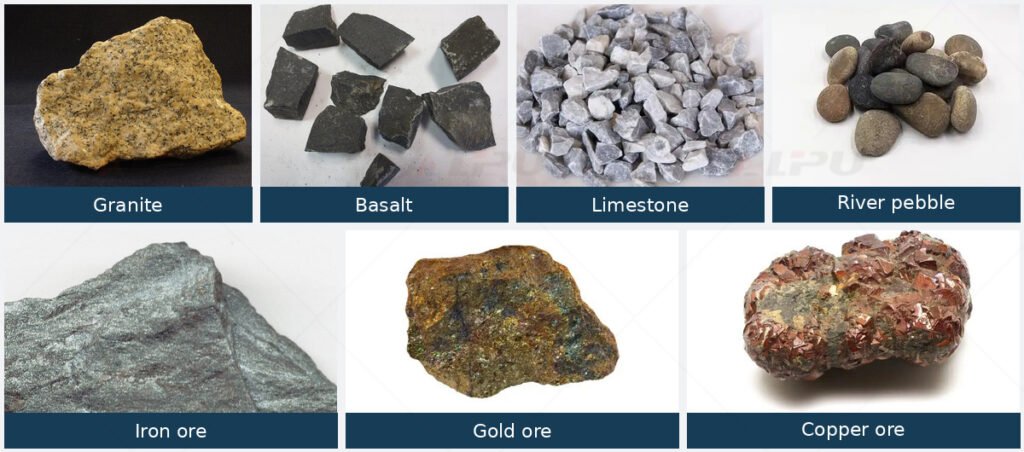
Common applications include granite, basalt, limestone, river pebble, iron ore, gold ore, and copper ore.
However, these materials do not behave in the same way during feeding.
Material size, moisture, and rock characteristics influence feeder selection
Material
Common Application
Main Selection Consideration
Granite
Hard-rock aggregate production
Large lumps and abrasive material
Basalt
Road aggregate and quarrying
Abrasiveness and feed distribution
Limestone
Cement and aggregate production
Feed size and fines content
River pebble
Aggregate crushing
Rounded particles and variable sizes
Iron ore
Mining and ore processing
Bulk density and lump size
Gold ore
Primary mineral crushing
Rock characteristics and feed consistency
Copper ore
Mineral processing plants
Feed gradation and crusher compatibility
For example, a granite quarry receiving large blasted rock may require a different feeder configuration from a limestone plant handling smaller, more uniform material.
Moisture is another important consideration. Wet or clay-rich material can accumulate around grizzly openings, restricting separation and affecting material movement.
Likewise, high-density ore places different demands on feeding equipment than lighter aggregate. Buyers should therefore provide material information rather than selecting a feeder based only on the name of the rock.
Representative photographs, maximum lump size, and details about moisture or clay content can help suppliers understand the application.
What Should Buyers Check Before Choosing a Grizzly Feeder?
Choosing a vibrating grizzly feeder involves more than comparing model numbers. The equipment must support the intended crushing capacity while fitting the receiving hopper and primary crusher.
The following factors are especially important for equipment buyers.
Maximum feed size
The feeder must accommodate the largest expected rocks without creating frequent blockages or handling problems. Its allowable feed size should be checked alongside the jaw crusher’s receiving opening.
Required production capacity
The feeder should provide sufficient material for the intended crushing rate. However, actual throughput depends on rock characteristics, feed conditions, equipment configuration, and operating settings.
Hopper dimensions
The receiving hopper and feeder must work together. An unsuitable hopper outlet may cause uneven loading or material bridging, even when the feeder itself has adequate capacity.
Grizzly bar spacing
The openings should suit the intended separation size. If the gaps are inappropriate, the feeder may separate too little material or allow particles to enter an unsuitable discharge route.
Moisture and clay content
Wet or sticky rock may move differently from dry, free-flowing material. Projects handling clay-rich ore should discuss possible buildup and blockage issues before choosing the equipment.
Installation and maintenance access
The layout must provide space for the feeder supports, drive components, discharge chutes, inspection, and maintenance. These requirements are particularly important when replacing equipment in an existing crushing plant.
Common Mistakes When Buying a Feeder
One common mistake is choosing a feeder only by its advertised tonnes-per-hour capacity. Another is ordering the machine before confirming the jaw crusher model or hopper dimensions.
Buyers may also overlook the discharge arrangement for material passing through the grizzly bars. If the plant has no suitable route for this fraction, the intended benefit of preliminary separation may be reduced.
The most practical approach is to review the feeder, hopper, crusher, and conveyors as a connected system.
How Does a Vibrating Grizzly Feeder Work with a Jaw Crusher?
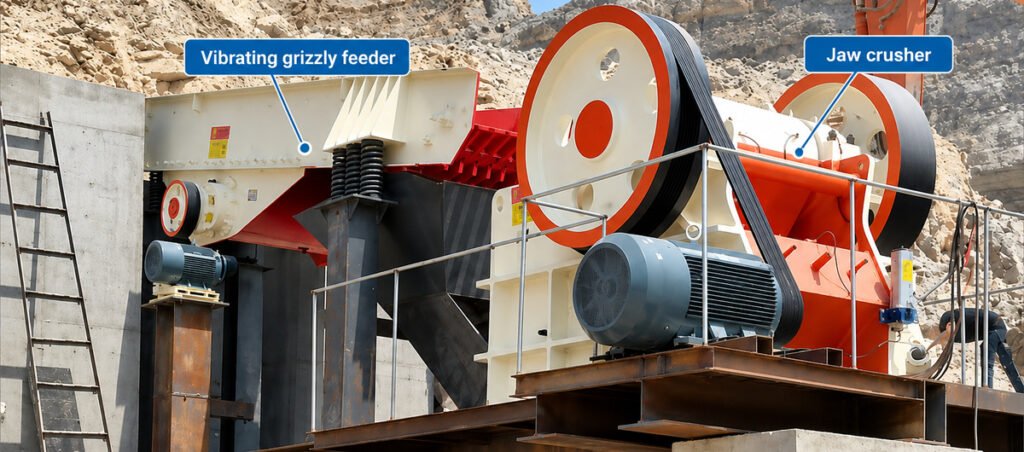
In a stationary crushing plant, the vibrating grizzly feeder is normally positioned below or near the receiving hopper. It delivers larger material into the primary jaw crusher while allowing suitably sized smaller particles to bypass the crushing chamber.
After primary crushing, the material may move to secondary crushing, screening, or further mineral processing. The exact arrangement depends on the rock type and required finished product.
Different applications therefore require different equipment combinations.
The feeder and jaw crusher should be matched for stable material handling
Hard-Rock Aggregate Production
Granite and basalt crushing plants commonly use jaw crushers for primary size reduction. Depending on the required aggregate sizes, the material may then pass through a cone crusher and screening equipment.
The feeder helps maintain the supply of material at the beginning of this process. However, the overall plant capacity depends on the complete equipment arrangement, not the feeder alone.
Limestone and Other Aggregate Applications
Some limestone crushing plants use a jaw crusher followed by an impact crusher. This arrangement may be suitable where the material characteristics and finished aggregate requirements support impact crushing.
Although the downstream equipment differs, the feeder still performs the same essential task: delivering material to the primary crusher at a controlled rate.
For this reason, buyers should describe their final product requirements when requesting a complete crushing plant quotation.
Mobile Crushing Applications
Vibrating feeders are also used in mobile crushing systems, where several machines are integrated into a compact arrangement.
In these applications, available space, equipment dimensions, transportation requirements, and material transfer arrangements influence feeder selection.
What Affects Vibrating Grizzly Feeder Price?
Vibrating grizzly feeder prices vary according to equipment size, construction, configuration, and project requirements.
Two machines that appear similar may have different specifications, included components, and installation requirements. Therefore, comparing prices without reviewing the quotation scope can be misleading.
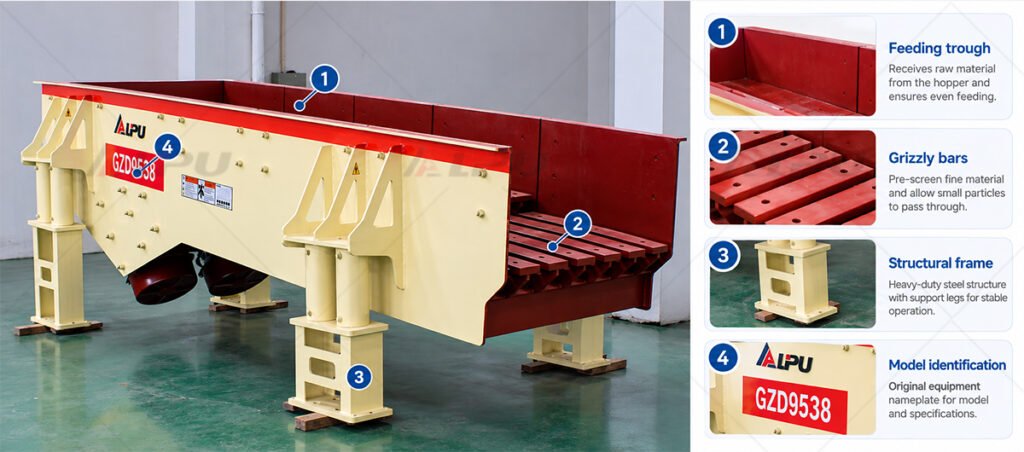
Feeder configuration and included components affect the final equipment quotation
The main cost factors include:
Price Factor
Why It Matters
Equipment size
Larger structures generally require more manufacturing materials
Required capacity
Influences equipment dimensions and drive requirements
Feeder configuration
Trough and grizzly arrangements may differ
Material characteristics
Abrasive applications may require suitable wear protection
Drive system
Motor and vibration components vary by model
Supporting equipment
Hoppers, chutes, supports, and controls may be separate items
Delivery destination
Packaging, freight, and delivery terms affect total cost
For example, one supplier may quote only the feeder, while another includes a supporting structure and electrical control components. Both quotations may be reasonable, but they do not represent the same equipment scope.
Shipping terms also affect the final cost. An ex-factory quotation does not include every expense associated with delivery, installation, and commissioning at the customer’s site.
Instead of focusing only on the lowest purchase price, buyers should compare the equipment specifications, included components, spare parts, and available technical support.
A properly matched feeder can be a better investment than a cheaper machine that requires significant modifications after delivery.
What Information Is Needed for a Feeder Quotation?
A useful quotation starts with a clear description of the customer’s project.
Suppliers need enough information to understand the material, expected production rate, and relationship between the feeder and the crusher. Without these details, an initial recommendation may rely on assumptions.
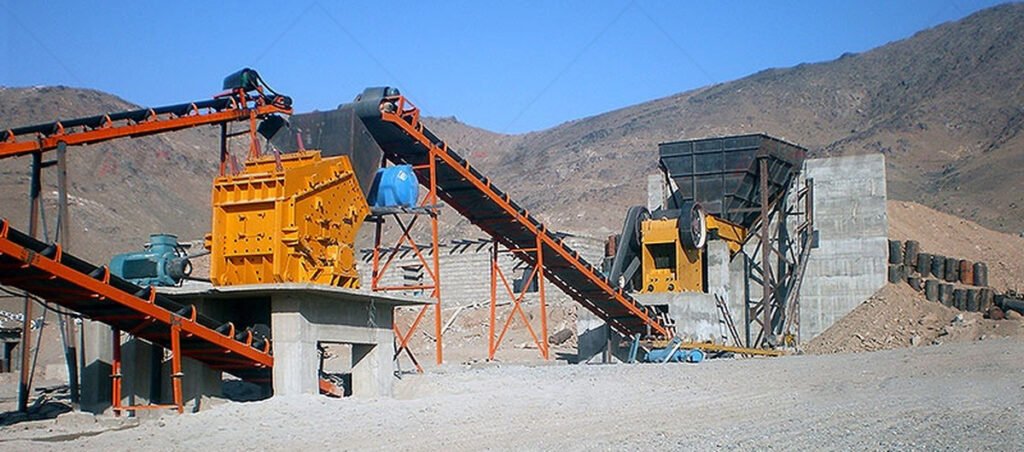
Primary crushing plants integrate feeding, crushing, and conveying equipment for continuous material processing
Before requesting a quotation, prepare the following information:
Project Information
What to Provide
Material type
Granite, basalt, limestone, iron ore, or another material
Maximum feed size
Largest expected rock entering the feeder
Required capacity
Target production in tonnes per hour
Material condition
Dry, wet, sticky, or containing substantial fines
Jaw crusher model
Existing crusher model or planned equipment
Hopper information
Dimensions or drawings, if available
Project location
Country and delivery destination
Plant arrangement
Stationary, mobile, new installation, or replacement
For a new crushing plant, customers should also describe the required finished aggregate sizes and any planned downstream equipment.
This information helps the supplier evaluate the feeder as part of the complete crushing system rather than as an isolated machine.
For existing plants, photographs and equipment drawings are especially useful. They can help identify installation restrictions and potential compatibility problems before an equipment order is placed.
New Plant vs. Existing Crusher Replacement
For a new installation, the feeder and primary crusher can be selected together. This provides greater flexibility when planning the hopper, equipment foundations, and material discharge arrangements.
Replacing a feeder in an existing plant requires additional attention to available space and connection dimensions. The new equipment must work with the current crusher and surrounding structures.
LIPU offers vibrating feeder configurations for different mining and crushing applications. Suitable equipment should be recommended according to the actual project conditions and verified model specifications.
Customers can begin by providing their material type, maximum feed size, target capacity, and project location. These details are generally sufficient to start a preliminary equipment discussion.
Frequently Asked Questions
What is the difference between a vibrating feeder and a grizzly feeder?
A vibrating feeder primarily controls material flow. A vibrating grizzly feeder also uses grizzly openings to separate suitable undersized material before primary crushing.
Can a vibrating grizzly feeder work with any jaw crusher?
It can be paired with many jaw crusher configurations, but compatibility must be checked. The feeder’s capacity, maximum feed size, dimensions, and discharge arrangement must suit the crusher and hopper.
Is a vibrating grizzly feeder suitable for granite and basalt?
Yes. These feeders are commonly used in hard-rock crushing applications, provided the selected model is suitable for the material’s size, abrasiveness, and required throughput.
Can a vibrating grizzly feeder handle wet or sticky ore?
Some moist materials can be handled, but sticky clay may cause buildup or blockage around the grizzly section. The supplier should review the material conditions before recommending equipment.
What information is needed to request a vibrating feeder quotation?
Provide the material type, maximum feed size, target capacity, crusher model, and project location. Hopper drawings and material photographs can help improve the accuracy of the equipment recommendation.
Conclusion
A vibrating grizzly feeder is an important component of many primary crushing plants. It helps regulate material flow and can separate suitable undersized particles before they reach the jaw crusher.
For buyers, the main selection factors are material characteristics, feed size, production requirements, crusher compatibility, and installation conditions. Reviewing these factors together helps avoid unsuitable equipment combinations.
Looking for a vibrating grizzly feeder for your quarry or mining project?
LIPU Heavy Industry supplies vibrating feeders, jaw crushers, and related crushing equipment for mining and aggregate production.
Share your material type, maximum feed size, required capacity, and project location to discuss a suitable feeder configuration and request a quotation.


We will reply to you within 24 hours