Designing a crushing plant for hard rock ores requires more than selecting a jaw crusher and a cone crusher. The complete system must reduce run-of-mine material to a controlled particle size while maintaining stable production.
Gold, copper, iron, and other hard-rock ores can differ significantly in strength, abrasiveness, fragmentation, and moisture. These characteristics influence crushing performance, screening requirements, equipment loading, and the size distribution delivered to downstream grinding.
Unlike an aggregate plant, which may prioritize several saleable stone sizes, an ore crushing plant usually prepares material for further mineral processing. Its final product must therefore meet the requirements of the grinding circuit.
A reliable design begins with ore characterization and production targets. Engineers can then determine the crushing stages, equipment duties, screening arrangement, and material-handling requirements.
What Information Is Needed Before Designing a Hard Rock Crushing Plant?
A crushing plant cannot be designed accurately from production capacity alone. Two projects requiring the same throughput may need different equipment because their ores behave differently during size reduction.
The first requirement is a representative description of the run-of-mine material. This includes the expected maximum lump size, particle-size distribution, rock strength, abrasiveness, moisture, and clay content.
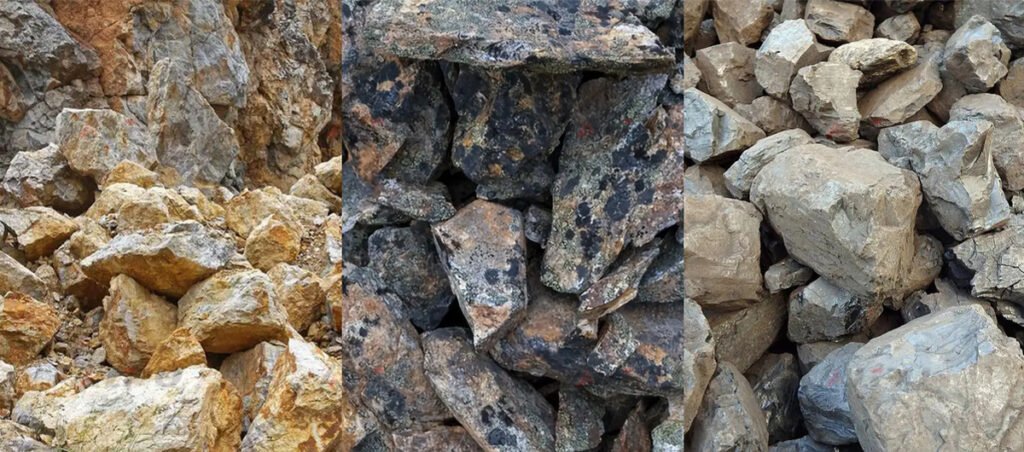
Variations in ROM rock size and appearance influence crushing plant design
Mining and blasting conditions also matter. Coarse fragmentation increases the duty of the primary crusher, while a large proportion of natural fines may change screening and conveying requirements.
Establish the Ore and Production Design Basis
Before equipment selection, engineers should collect the following information.
Design parameter
Required information
Engineering purpose
Ore type
Gold, copper, iron, lead-zinc, or other ore
Establish material and process context
Maximum feed size
Largest expected ROM fragment
Determine crusher feed opening
Feed-size distribution
Coarse, intermediate, and fine fractions
Estimate stage loading
Rock strength
Suitable laboratory test results
Evaluate crushing duty
Abrasiveness
Mineralogy and relevant abrasion testing
Assess wear requirements
Moisture and clay
Expected operating range
Evaluate feeding and screening
Production capacity
Required net throughput in t/h
Establish plant duty
Operating schedule
Hours per day and expected availability
Determine required operating rate
Final crushed size
Mill feed specification
Define crushing endpoint
Site conditions
Elevation, layout, power, and access
Develop installation requirements
For example, a mine requiring 120 tonnes per hour while the plant is operating has a different design basis from a mine requiring an average of 120 tonnes per calendar hour.
In the second case, planned downtime and expected availability must be considered when determining the required operating throughput.
Similarly, rock hardness alone does not describe every crushing challenge. A relatively fractured ore may break readily but contain clay that restricts screening performance.
The design basis should also identify normal and difficult operating conditions. This helps engineers avoid selecting equipment using only an average ore sample.
How Many Crushing Stages Does Hard Rock Ore Require?
The required number of crushing stages depends on the incoming rock size, target crushed product, ore characteristics, and capacity of the selected equipment.
A single crushing stage may be sufficient when the feed is relatively small and the downstream process accepts a coarse product. However, large ROM fragments usually require additional reduction before entering a conventional grinding circuit.
Two-stage and three-stage crushing arrangements are common options for hard-rock mineral processing plants.
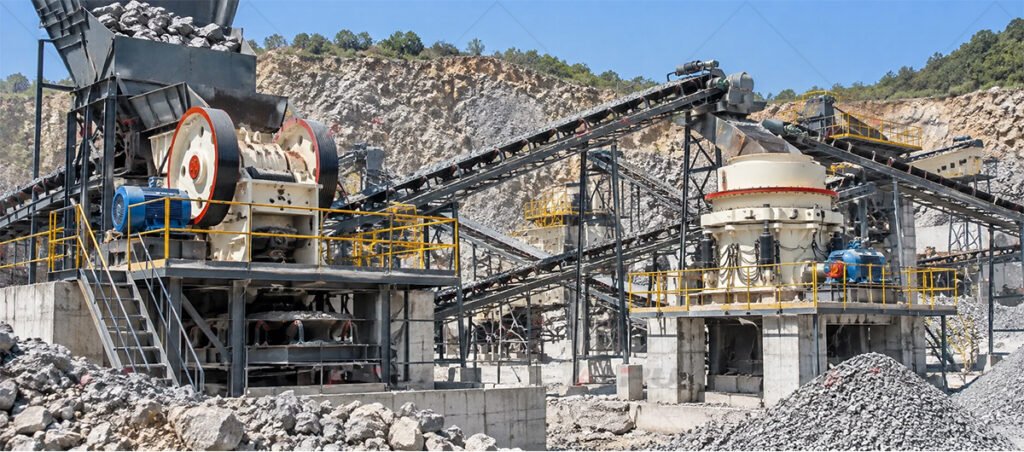
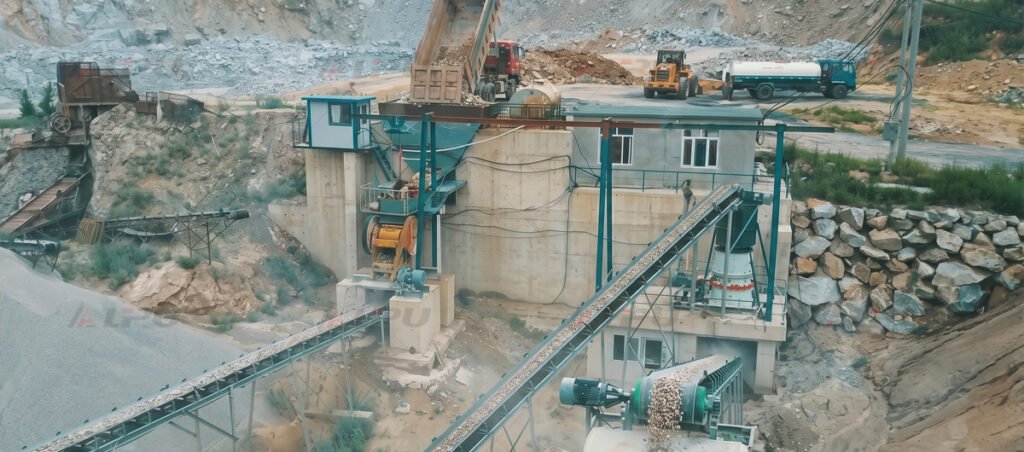
Primary jaw crusher and secondary hydraulic cone crusher operating in a multi-stage hard rock crushing plant
Circuit arrangement
Typical application
Main design consideration
Single-stage crushing
Smaller feed or relatively coarse product requirement
Limited overall size reduction
Two-stage crushing
Primary reduction followed by secondary crushing
Secondary crusher duty and product gradation
Three-stage crushing
Large ROM feed combined with a finer product requirement
Distribution of reduction across stages
Closed-circuit fine crushing
Controlled product top size before grinding
Screen performance and circulating load
These are possible configurations rather than fixed rules. The final arrangement should be based on crusher performance data and the required product-size distribution.
When Is a Third Crushing Stage Necessary?
A third stage becomes worth evaluating when the required reduction cannot be achieved efficiently within the operating limits of two selected crushers.
For example, forcing a secondary cone crusher to produce an excessively fine product may reduce practical throughput. It may also create unsuitable chamber-loading conditions.
Adding a tertiary stage distributes the reduction duty across more equipment. However, it also increases capital investment, maintenance requirements, and material-handling complexity.
The decision should compare complete circuit performance rather than simply count the number of machines.
A third stage is not automatically necessary for every hard ore. The selected ball mill, feed-size specification, crusher cavity options, and ore test results must all be considered.
For projects involving conventional crushing before grinding, the crushing and grinding circuit design guide explains the relationship between these two processing sections.
How Should Primary and Secondary Crushers Be Matched?
Crusher matching begins with the product from the preceding stage, not only the nominal capacity listed in an equipment catalogue.
The primary crusher must accept the expected ROM feed. Its discharge must then be suitable for the secondary crusher’s selected crushing chamber.
In many hard-rock ore plants, a jaw crusher provides primary reduction. A cone crusher handles subsequent reduction where compression crushing is suitable for the material.
The LIPU Jaw Crusher range includes configurations for different feed sizes and crushing duties. Model selection should consider the maximum lump size, expected throughput, discharge setting, and material characteristics.
Neither type should be assigned a fixed crushing stage solely because of its cylinder arrangement. Suitable duty depends on the actual model, chamber, feed opening, and required product size.
A common design mistake is checking only the average feed size.
Even when most of the primary crusher product fits the secondary chamber, occasional oversized fragments can interrupt feeding or create abnormal loading.
Engineers should therefore review the complete expected feed distribution, including its coarse tail.
Other important matching factors include:
The maximum permitted feed size for the selected chamber
The expected crusher product distribution
Required reduction across each stage
Material strength and abrasiveness
Available motor power and operating limits
Feed stability and chamber-loading requirements
Wear-part access and maintenance conditions
The primary and secondary crushers should also be matched in actual operating capacity.
A primary crusher capable of producing more material than the secondary stage can process will not increase the net output of the complete plant.
Instead, material may accumulate in transfer systems or storage areas.
Engineering note: Manufacturer capacity ranges are useful for preliminary screening, but final equipment selection should use the relevant cavity configuration, ore properties, and operating conditions.
How Should Screening and Closed-Circuit Crushing Be Designed?
Screening determines which particles have reached the required crushed size and which require further reduction.
In an open circuit, material generally passes through a crushing stage without being returned for additional processing. This arrangement can be appropriate when the product-size requirements are relatively broad.
A closed circuit uses a screen to separate oversized material and return it to a crusher. This provides greater control over the final product-size distribution.
However, closed-circuit crushing creates an additional equipment duty: the returned material must be processed again.
The circulating load can become significant when crusher product gradation or screening efficiency changes.
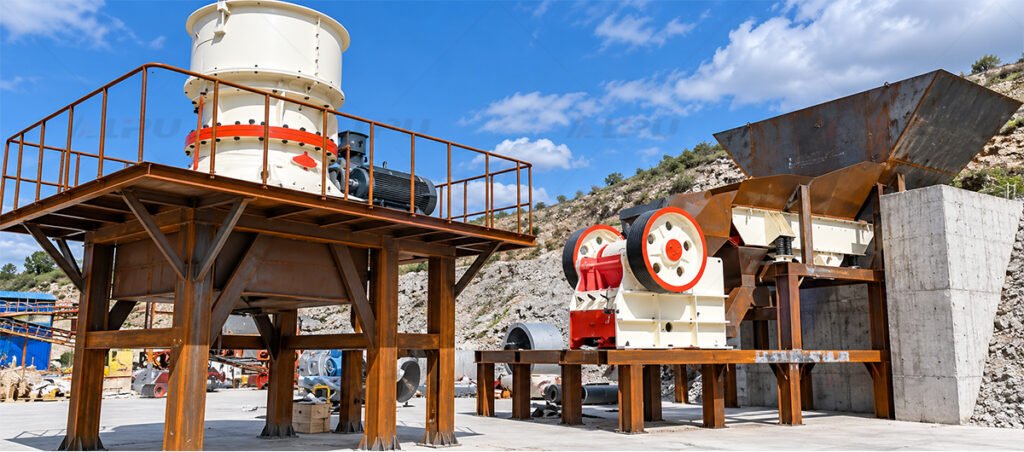
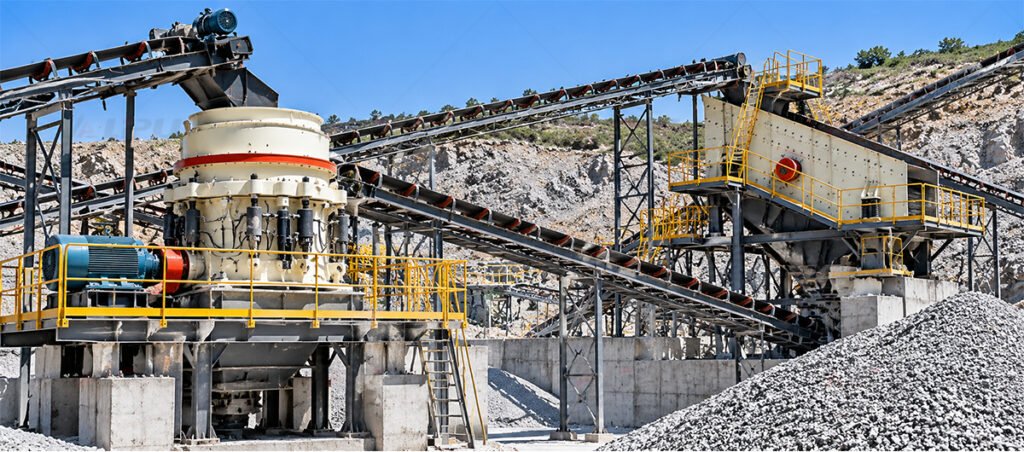
Cone crushing and conveyor systems support staged ore reduction and material transfer
Consider a simplified illustrative case:
Material flow
Rate
New ore entering the circuit
120 t/h
Oversized material returned from screening
40 t/h
Total material handled by the closed-circuit crusher
160 t/h
Net product leaving the circuit
120 t/h
This example assumes steady-state operation without material losses or accumulation. The values are illustrative, not a recommended plant configuration.
The key point is that a crusher handling 160 t/h internally may deliver only 120 t/h of net finished material.
Therefore, specifying a crusher based only on net plant output can underestimate its required duty.
Screening performance also depends on aperture size, feed gradation, moisture, clay content, screen area, and operating conditions.
Wet or cohesive material may blind screen openings and reduce effective separation. Consequently, the circuit should be evaluated under the expected range of ore conditions.
For reliable operation, engineers should establish a material balance for every crusher, screen, and return conveyor.
How Can Crushing Capacity and Material Flow Be Balanced?
A crushing plant should be treated as one connected processing system. The capacity of each machine matters, but the net production rate depends on how those machines operate together.
The design should account for fresh feed, intermediate material, screened products, circulating loads, and temporary storage.
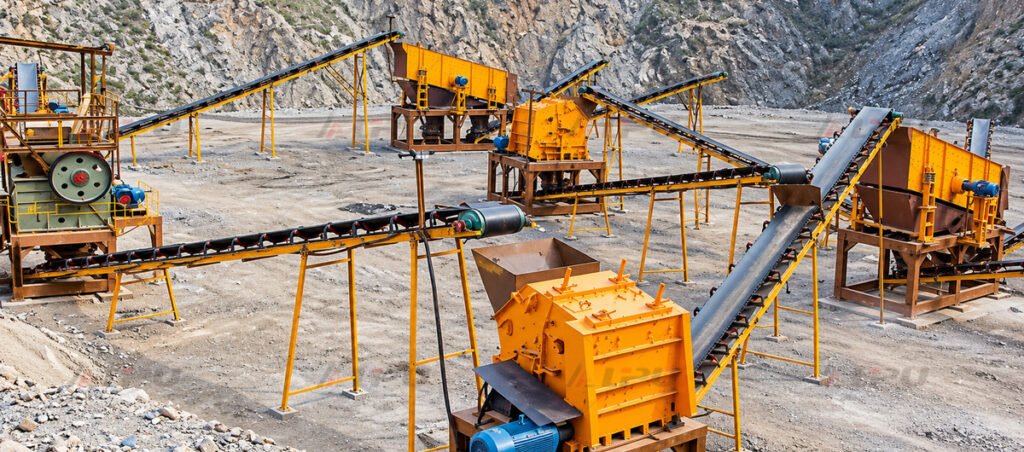
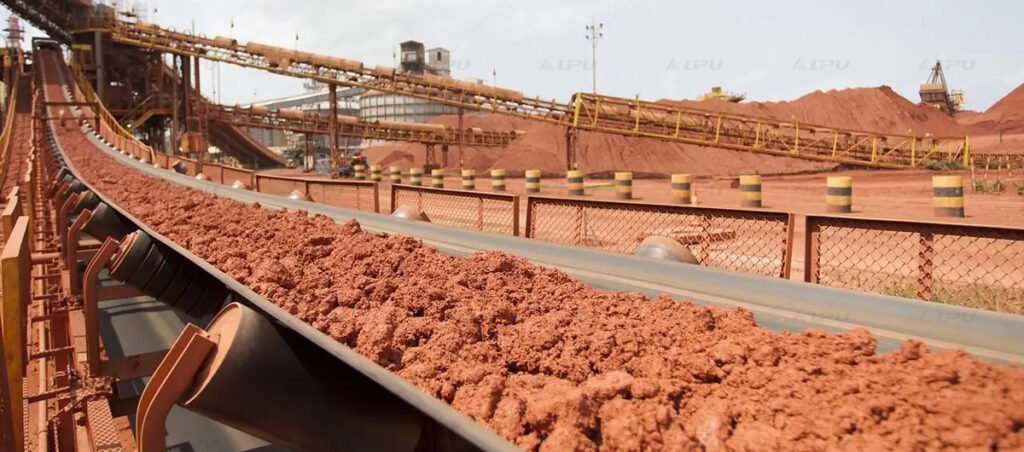
Real hard rock crushing plant showing belt conveyors, transfer points, and intermediate ore storage equipment
Identify the Actual Bottleneck
A crusher may have sufficient rated capacity while the plant still operates below its target.
Possible restrictions include a small receiving hopper, irregular feeding, limited screen capacity, undersized conveyors, or a restricted discharge chute.
The operating schedule can create another constraint.
For example, if a project requires an average production rate of 120 t/h across scheduled time and the assumed effective availability is 80%, the plant would need to average 150 t/h during productive operating time.
This is a calculation example only. Actual availability should be estimated from the maintenance strategy, operating schedule, and project conditions.
A complete capacity review should cover the following systems.
Plant section
Capacity requirement
Receiving hopper
Accept expected truck or loader deliveries
Vibrating feeder
Regulate flow within crusher limits
Primary crusher
Process the expected ROM feed
Intermediate storage
Accommodate short-term differences in stage operation
Secondary crusher
Handle feed and applicable recirculation
Vibrating screen
Separate the expected material load
Return conveyor
Carry screened oversized material
Product conveyor
Deliver net crushed product
Fine ore storage
Supply the grinding circuit consistently
A vibrating feeder helps regulate material entering the primary crusher. Meanwhile, belt conveyors connect crushing stages and transfer material to screening or storage.
Intermediate storage can reduce the immediate effect of interruptions between processing stages. However, its useful capacity depends on discharge behavior, available volume, and operating requirements.
Conveyor sizing must also consider bulk density, belt loading, inclination, and transfer-point conditions.
For example, a conveyor receiving both fresh crushed ore and screen returns must be sized for their combined flow where those streams are carried together.
Ignoring these internal flows can create bottlenecks even when every crusher appears correctly selected.
How Fine Should Hard Rock Ore Be Crushed Before Ball Milling?
The crushing section should deliver material that the grinding circuit can accept and process efficiently.
For a conventional ball mill circuit, the required feed size depends on mill design, grinding duty, ore characteristics, and downstream processing requirements.
A smaller crushed product is not automatically the best option.
Finer crushing may reduce some of the size-reduction work required inside the mill. However, achieving that product can require additional crushing equipment, screening capacity, energy, and maintenance.
The correct decision compares the complete crushing and grinding system.
Crushed ore particle size must be controlled to meet downstream grinding feed requirements
For reference, the published LIPU Ball Mill product page lists a feeding size below 25 mm for its covered equipment range. This should not be interpreted as a universal limit for every industrial ball mill.
A specific mill’s permissible top feed size and recommended operating conditions must be confirmed during equipment selection.
Engineers should distinguish three measurements:
Measurement
Meaning
Design relevance
Maximum particle size
Largest particle expected in the product
Protects downstream equipment from oversize
P80
Particle size at which 80% of the sample passes
Describes the overall size distribution
Fine fraction
Proportion of relatively small particles
Influences handling and grinding feed characteristics
These measurements are related but not interchangeable.
For example, a product may have an acceptable P80 while still containing occasional oversized fragments. If those fragments exceed the mill’s allowable feed size, additional screening or crushing may be necessary.
Likewise, excessive fines may introduce handling difficulties when the material contains moisture or clay.
The final product specification should therefore include a suitable top-size requirement and a representative particle-size distribution.
Where possible, engineers should use crushing tests and grinding testwork to compare alternative feed-size options.
The goal is to prepare material for effective grinding, not simply to produce the smallest particles achievable by the crusher.
What Should Be Checked Before Finalizing the Plant Design?
The preliminary flowsheet should be reviewed against the expected ore characteristics, production schedule, and site conditions before equipment models are finalized.
An effective review covers both process performance and practical installation requirements.
Process design review
Confirm that the primary crusher accepts the expected ROM feed. Check that each downstream crusher can handle the full feed distribution and required reduction duty.
Next, verify screening capacity and calculate the internal material flows. Closed-circuit returns must be included in crusher and conveyor duties.
Finally, compare the crushed product with the grinding circuit’s feed specification.
Mechanical and installation review
Equipment foundations, access platforms, lifting arrangements, and maintenance clearances should be considered early.
For example, sufficient space is needed to replace jaw plates, cone liners, screen panels, and conveyor components safely.
The site layout must also account for ore receiving, truck movement, dust control, electrical distribution, and equipment protection.
Commissioning and performance verification
After installation, the plant should be tested with representative ore under controlled operating conditions.
Useful measurements include:
Actual fresh-feed throughput
Crusher motor load and operating settings
Feed and product-size distributions
Screen separation performance
Closed-circuit return flow
Conveyor loading and material buildup
Equipment interruptions and maintenance observations
These results help determine whether the installed circuit meets its design objectives.
Where performance differs from the preliminary design, engineers should identify the limiting section before changing equipment settings.
A crushing plant may require adjustments to feeding, screening, or material transfer rather than a larger crusher.
For a complete mineral processing project, the crushing section should also be reviewed alongside grinding, classification, and recovery requirements.
1. What is the best crusher combination for hard rock ore?
A jaw crusher followed by a cone crusher is a common option for hard and abrasive ores. However, the final combination depends on feed size, ore properties, required throughput, and crushed product specifications.
2. Is two-stage crushing enough before a ball mill?
It may be sufficient when the selected crushers can produce the required mill feed within their operating limits. A third stage should be evaluated if the required reduction or product-size control cannot be achieved efficiently.
3. Why is screening necessary in a hard rock crushing plant?
Screening separates material according to particle size. In a closed circuit, it allows oversized particles to return for additional crushing while suitable material leaves the circuit.
4. Does a finer crusher product always improve grinding efficiency?
Not necessarily. Finer crushing can change the grinding duty, but it also affects crushing energy, equipment requirements, and operating cost. The preferred size should be established by evaluating the complete circuit.
5. What information is needed to select crushing plant equipment?
Engineers need the ore type, feed-size distribution, strength and abrasiveness information, moisture conditions, required throughput, and target product size. Site conditions and downstream grinding requirements are also important.


We will reply to you within 24 hours