Wheel sand washers and spiral sand washers can both form part of a sand washing installation, but their structures, material movement and installation requirements differ.
Choosing between them involves more than comparing hourly capacity. The machine must suit the incoming sand, the material you want to remove, the product you need to retain and the water entering the system.
This guide compares the equipment itself, including its main components, installation interfaces, wear parts and quotation scope.
What Feed Information Is Needed to Select a Sand Washer?
Before choosing a machine, define the purpose of washing.
Removing loose dust from crushed sand is different from breaking down persistent clay coatings. Retaining valuable fine sand is also different from deliberately removing an unwanted fine fraction.
Provide the supplier with:
Normal and maximum feed rate.
Particle-size distribution and maximum feed size.
Moisture condition and water entering with the feed.
Clay, silt and other unwanted material.
Required product grading and cleanliness.
Downstream handling and moisture requirements.
Describe the contamination rather than simply stating that the sand is “dirty.” Material photographs and representative samples help establish whether a conventional washer is suitable or whether additional scrubbing is needed.
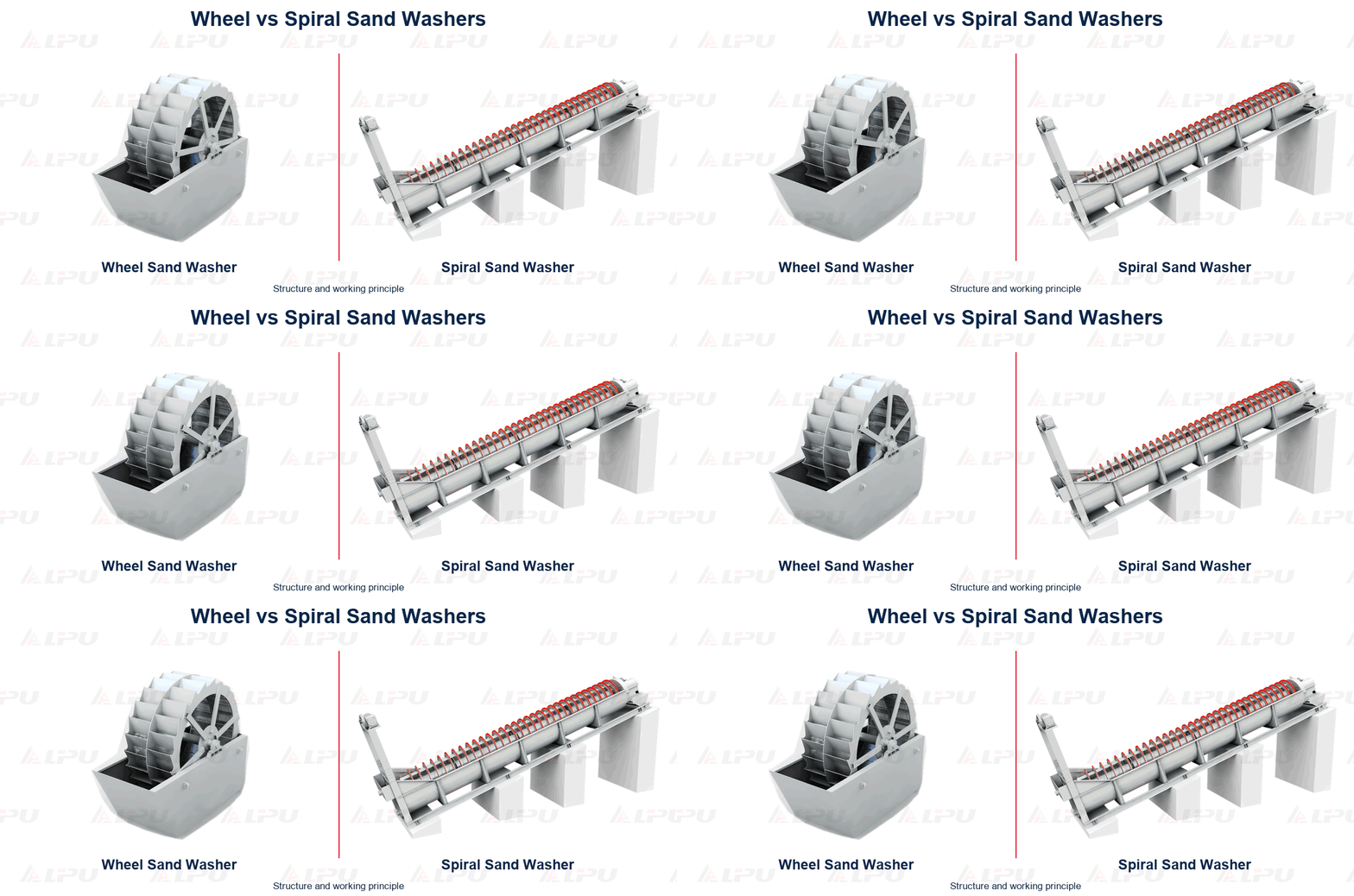
Wheel vs Spiral Sand Washers: Structure and Working Principle
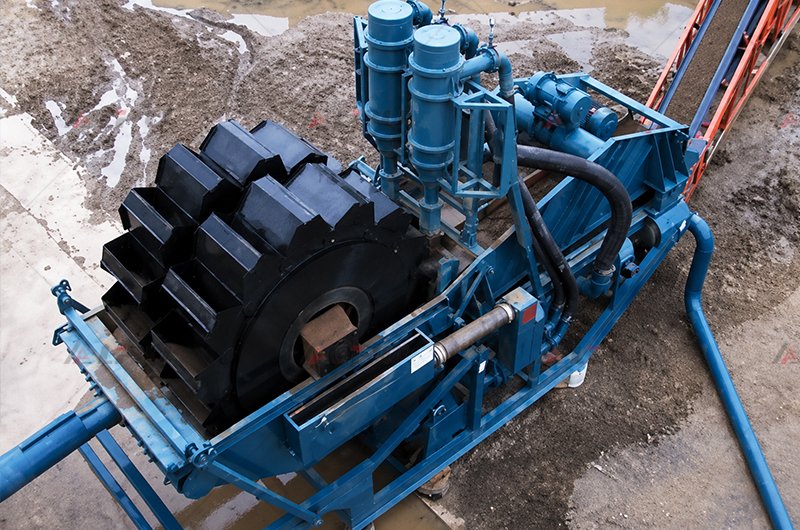
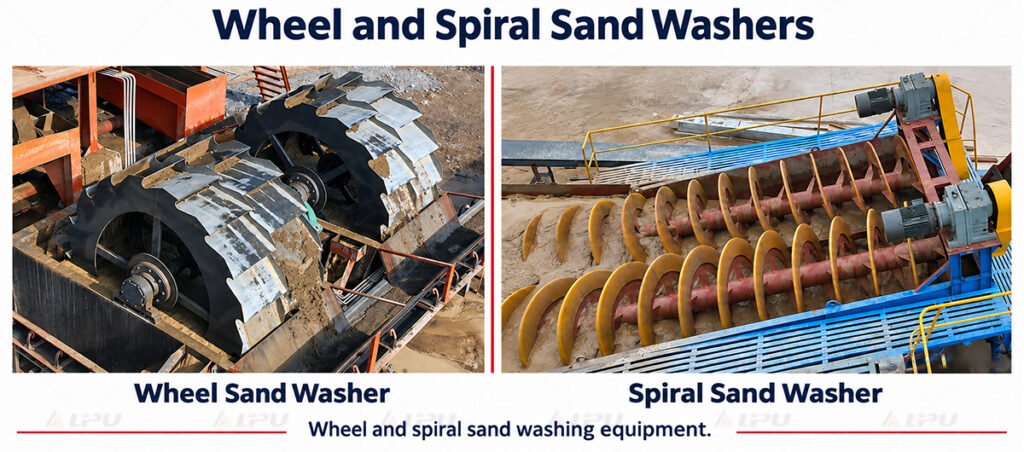
A wheel sand washer uses a rotating bucket wheel to collect sand from a washing tank and lift it toward the discharge. Water drains through the bucket arrangement as the wheel turns.
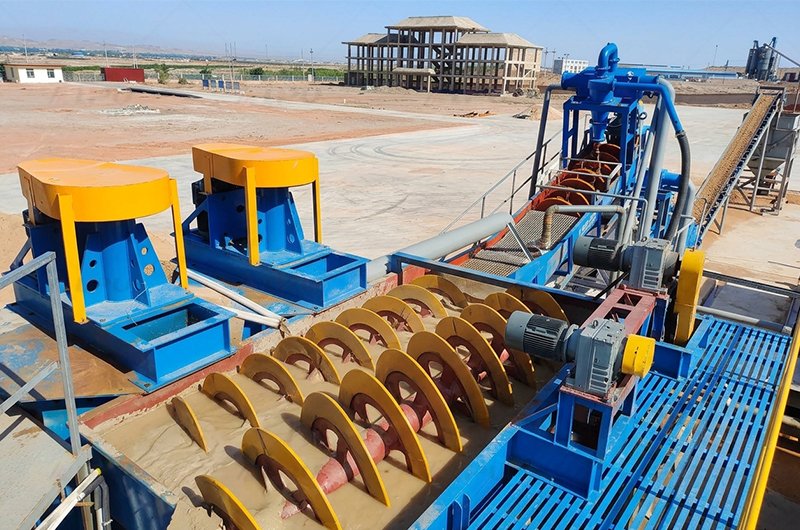
A spiral sand washer uses a rotating screw in an inclined trough. Material collected in the trough is conveyed toward an elevated discharge, while water and suspended fines leave through the overflow arrangement.
This article compares conventional bucket-wheel sand washers with screw-type machines intended for sand duty. Other spiral equipment, including coarse-material washers and mineral classifiers, should not be treated as interchangeable without checking their design.
Bucket-wheel rotation and spiral conveying shown side by side
Comparison Point
Wheel Sand Washer
Spiral Sand Washer
Main moving assembly
Bucket wheel
Screw shaft and flights
Material discharge
Lifted by buckets
Conveyed along an inclined trough
Main structure
Washing tank and wheel assembly
Inclined trough and screw assembly
Components to inspect
Buckets, drainage surfaces, shaft and drive
Flights, wear parts, shaft supports and drive
Layout checks
Wheel clearance, tank access and discharge position
Trough length, inclination and elevated discharge
Neither arrangement establishes washing performance on its own. The proposed model and operating conditions still need to match the application.
Wheel Sand Washer Selection: Buckets, Drainage and Drive Access
A wheel bucket sand washing machine is worth evaluating when a bucket-wheel arrangement fits the required sand handling duty and plant layout.
Check how the feed enters the tank, how sand reaches the wheel and how the buckets discharge onto the next conveyor or chute. A favourable footprint is useful only if these connections work at the available elevations.
Ask the supplier to explain:
The proposed wheel and bucket arrangement.
How drainage surfaces are accessed and replaced.
How feed variation affects material collection.
Where wash water enters and overflow leaves.
How the wheel shaft, bearings and transmission are serviced.
Do not assume that adding another wheel or washing stage will automatically deliver the required product. Any additional stage should have a defined purpose.
Spiral Sand Washer Selection: Screw Assembly, Trough and Shaft Supports
A spiral sand washing machine is worth evaluating where the trough arrangement, sand conveying duty and water-handling requirements suit the installation.
The screw and trough must be selected together. A machine that can mechanically convey the required sand tonnage may still be unsuitable for the incoming water volume or desired fine-sand retention.
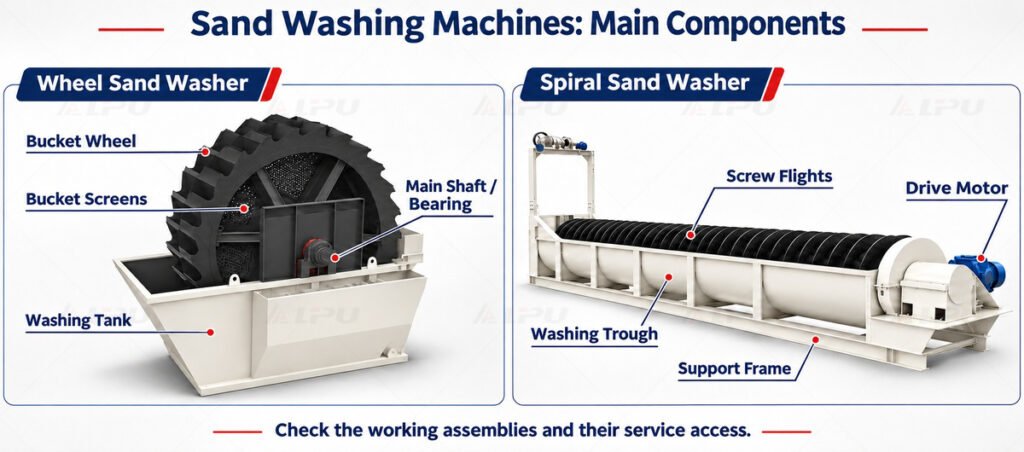
Check the working assemblies and their service access
Check the shaft supports, drive location and access to the lower end of the machine. These details can affect maintenance after the trough is installed.
For single- and twin-screw proposals, ask why the arrangement has been selected. Compare the stated duty, overall dimensions and maintenance requirements rather than assuming that a twin-screw machine is always preferable.
How Feed Rate, Particle Size and Water Flow Affect Washer Capacity
A catalogue tonnage is not enough to compare two washing machines.
Ask what feed grading, contamination level and water conditions support the quoted capacity. Also establish whether the figure refers to dry solids, wet feed or another stated basis.
Selection Input
Why It Matters
Solids feed rate
Defines the material handling duty
Particle-size distribution
Shows the proportions of coarse and fine material
Incoming water flow
Affects the hydraulic load on the installation
Clay and silt content
Helps define the washing and overflow duty
Required product grading
Establishes which material must be retained
Product moisture requirement
Helps identify downstream handling needs
Request both normal and maximum operating conditions. A proposal based only on an average feed may not explain how the installation responds to variation.
Avoid ranking machines by water consumption unless the figures use the same feed conditions, washing target and system boundary.
Water Supply, Overflow and Drainage Requirements
The washer is only one part of the water circuit.
Confirm the supply-water flow, pressure where relevant and expected water quality. Recycled water should be assessed for the proposed duty rather than assumed equivalent to fresh water.
The overflow also needs a destination. Review its route to sumps, settling facilities or treatment equipment, together with access for cleaning and inspection.
Ask for a layout that identifies:
Water entry points.
Overflow outlets and connecting channels or pipes.
Drainage and cleanout provisions.
Pumps and sumps included in the offer.
Water-treatment responsibilities outside the machine supply.
These details should be agreed before foundations and connecting equipment are finalised.
When Is Additional Fine-Sand Recovery or Dewatering Needed?
A washer should not be assumed to retain every useful fine particle or produce a product ready for every downstream application.
Fine sand may leave with the overflow. If that fraction is valuable, assess the overflow before choosing additional recovery equipment. The decision should follow sampling and a material balance rather than an assumed recovery percentage.
Where sampling identifies recoverable sand, a recovery stage incorporating a suitably selected hydrocyclone may be considered. Its suitability must be checked against the slurry flow, particle-size distribution and required separation.
Product moisture is a separate consideration. Both machine selection and downstream handling affect whether the discharged sand is suitable for conveying, stockpiling or another process.
Additional recovery or dewatering equipment should address a demonstrated requirement. Define the material stream and performance target before adding another machine.
Installation Requirements: Foundations, Conveyors and Maintenance Space
Compare the installed arrangement, including chutes, water connections and maintenance space.
For a wheel machine, allow access around the wheel, tank and drive. For a spiral machine, review the trough length, support positions and space needed to service the screw and bearings.
Review equipment interfaces before finalising the layout
Installation Detail
What to Confirm
Feed position
Conveyor or chute elevation and distribution
Product discharge
Connection to the receiving conveyor or equipment
Water and overflow
Accessible routes without obstructing maintenance
Foundations and supports
Loads, mounting details and supply responsibilities
Drive access
Room for lubrication, inspection and replacement
Major component removal
Lifting route and equipment required
A machine that fits within the available floor area may still be difficult to service. Review component removal as well as normal operation.
For a wider view of how washing connects with crushing, screening and product handling, explore LIPU’s aggregate processing solutions. The washer should be reviewed as part of the complete installation rather than as an isolated machine.
Wear Parts and Maintenance for Wheel and Spiral Sand Washers
Ask for a wear-parts list specific to the proposed model.
On a wheel washer, inspect the bucket construction, drainage surfaces and any replaceable liners. On a spiral washer, check screw flights, wear shoes or liners where fitted, and the shaft-support arrangement.
For either type, clarify:
Recommended inspection and lubrication intervals.
Access to bearings, seals and transmission components.
Replacement methods for worn working surfaces.
Spare-part identification and ordering information.
Cleaning and drainage procedures.
Do not assume that every component has the same construction across different models. Confirm the actual parts supplied and follow the manufacturer’s maintenance and isolation instructions.
What Should a Sand Washing Equipment Quotation Include?
Compare offers against the same supply boundary.
Item
Scope to Confirm
Main machine
Tank or trough, working assembly and supports
Drive equipment
Motor, gearbox, transmission and guards
Wear components
Specified liners, panels, shoes or other replaceable parts
Material interfaces
Feed and discharge items included
Water connections
Pipes, valves and distribution items supplied
Electrical equipment
Control equipment and agreed operating functions
Supporting equipment
Conveyors, pumps or other separately specified units
Documentation and services
Drawings, manuals and agreed commissioning support
Foundations, installation work and water-treatment equipment should be listed separately where they are outside the offer.
Performance commitments should state the feed conditions, water requirements and agreed product criteria.
Request a Sand Washer Selection Proposal from LIPU
Send your material description, feed rate, particle-size distribution, available water information and required product specification.
Include site photographs, installation dimensions and the elevations of connecting equipment. If replacing a washer, describe the present problem and provide sampling information where available.
LIPU can then discuss the proposed machine arrangement and the information needed to develop the quotation.
Contact LIPU to discuss your feed conditions, product requirements and sand washing equipment configuration.
Frequently Asked Questions About Wheel and Spiral Sand Washers
Which is better: a wheel sand washer or a spiral sand washer?
Neither is best for every plant. Compare the proposed machines against the same feed, water conditions, product requirements and installation constraints.
Can either machine remove all clay from sand?
Not necessarily. Loose fines and persistent clay coatings present different duties. Representative samples may be needed to establish whether additional scrubbing is required.
Will a sand washer retain all fine sand?
No universal retention level should be assumed. Check the feed and overflow grading to identify whether valuable product-sized fines are being lost.
Does washed sand always need a dewatering screen?
No. The need depends on the discharge condition and downstream moisture requirement. Additional dewatering should address a defined handling or product need.
What information is needed for a quotation?
Provide feed rate, particle size, contamination, water availability, required product quality and installation details. Material photographs and samples can support equipment selection.


We will reply to you within 24 hours