Dense medium separation (DMS), also called heavy media separation, is a gravity-based pre-concentration method. Crushed and screened ore is mixed with a controlled suspension of water and finely ground magnetite or ferrosilicon.
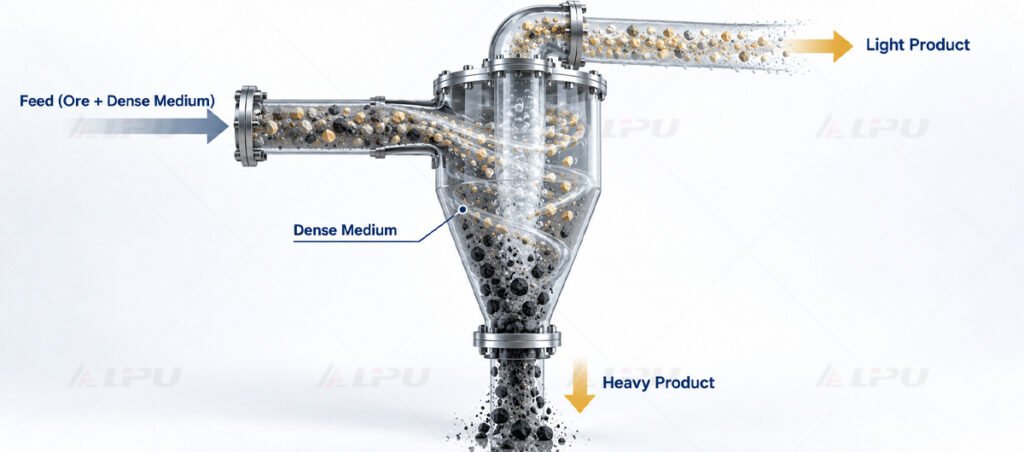
Dense medium cyclone separation principle
Particles with a density higher than the selected medium density report to the dense fraction, while lighter particles report to the light fraction. This allows suitable ore to be upgraded or waste gangue to be rejected before fine grinding.
DMS is commonly used where the target minerals and gangue have sufficient density contrast and the feed has been prepared within an appropriate size range.
When Is DMS Suitable?
DMS may be considered when:
Valuable minerals have a meaningful density contrast with gangue
Ore can be crushed and screened into a suitable feed-size range
Pre-concentration can reduce the mass sent to downstream grinding or recovery
The project requires early waste rejection or upgrading
Testwork confirms an achievable separation at a practical cut density
Typical applications may include:
Diamond-bearing ore
Coal and industrial minerals
Spodumene and other lithium-bearing ore
Tin, tungsten, tantalum, and other dense-mineral applications
Selected gold, base-metal, and polymetallic ores before downstream treatment
DMS is not normally selected for very fine feeds, heavily weathered slimes, or ore with insufficient density contrast unless testwork supports the route.
Dense Medium Separation Process Flow
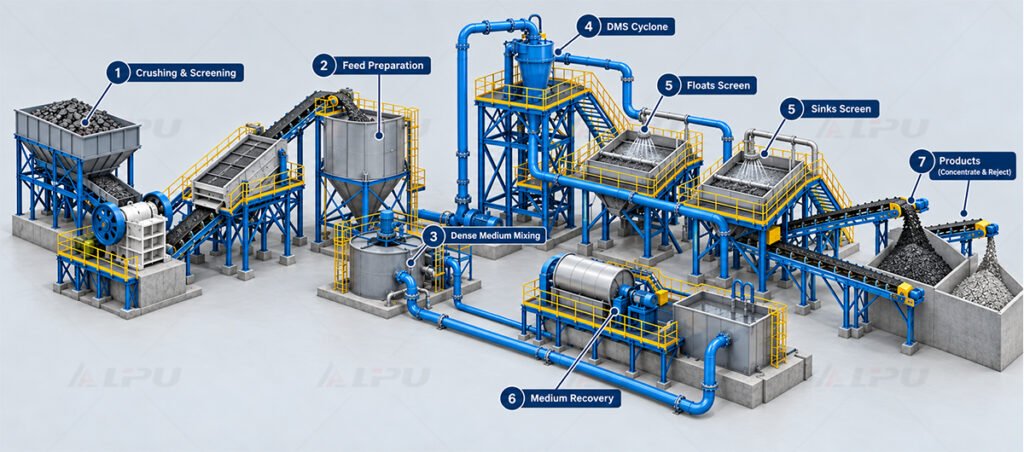
Crushing & Screening → Feed Preparation → Dense Medium Mixing → DMS Cyclone Separation → Drain & Rinse → Medium Recovery → Concentrate and Reject Handling
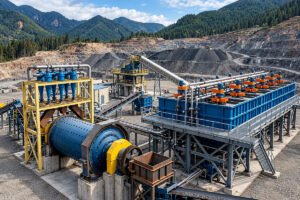
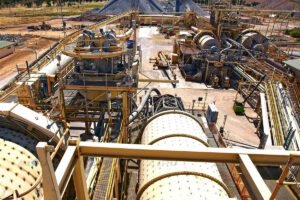
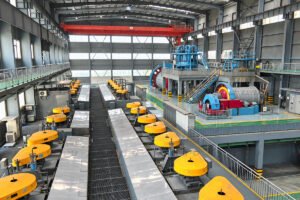
Dense medium separation plant layout and process flow
The final flowsheet is determined by testwork, material characteristics, and the required downstream recovery route.
Crushing, Screening and Feed Preparation
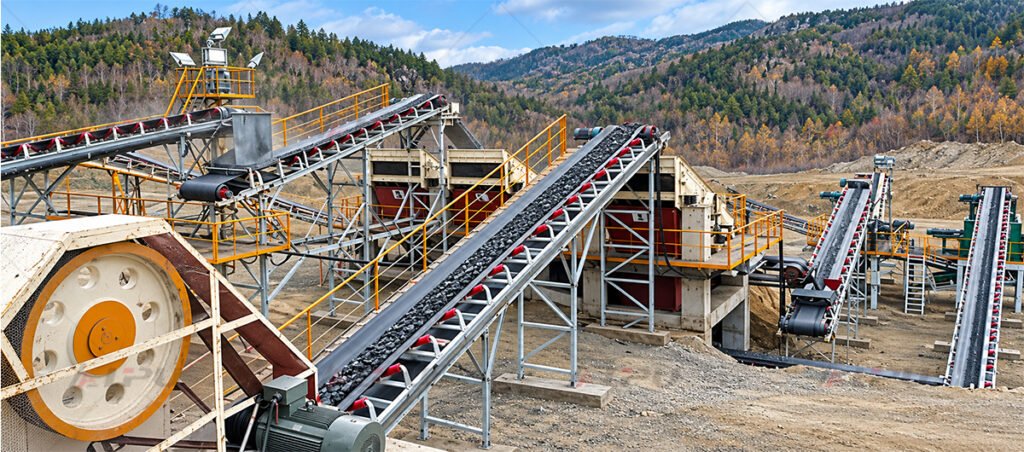
Crushing and screening prepare a controlled feed size for DMS
Run-of-mine ore is crushed and screened to produce a stable feed for DMS separation. Oversize material may return for further crushing, while undersize fines and slimes may be removed or treated separately.
Feed preparation is important because excessive fines can increase medium consumption, reduce separation efficiency, and make density control more difficult.
A practical DMS plant therefore considers:
Feed-size distribution
Clay and slime content
Moisture conditions
Ore breakage characteristics
Required throughput
Screen efficiency and circulating load
Dense Medium Cyclone Separation
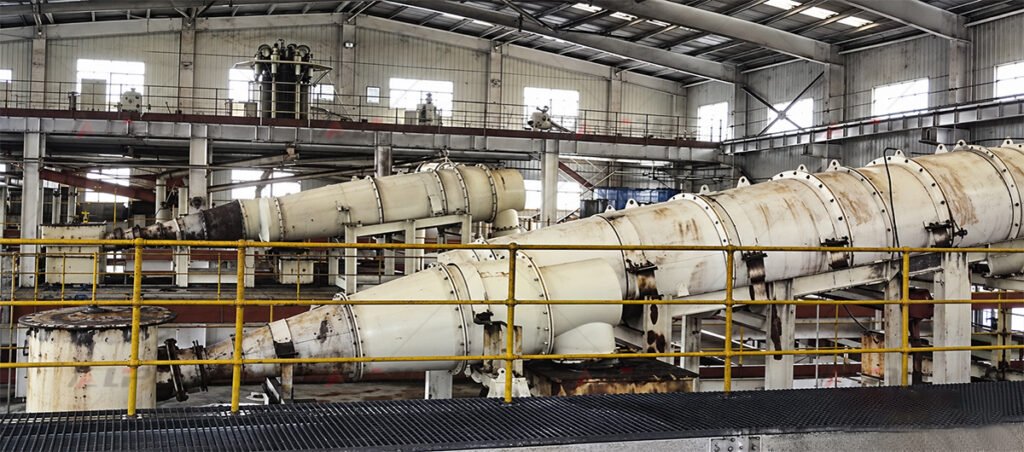
Prepared feed is mixed with the dense medium and pumped to a dense medium cyclone.
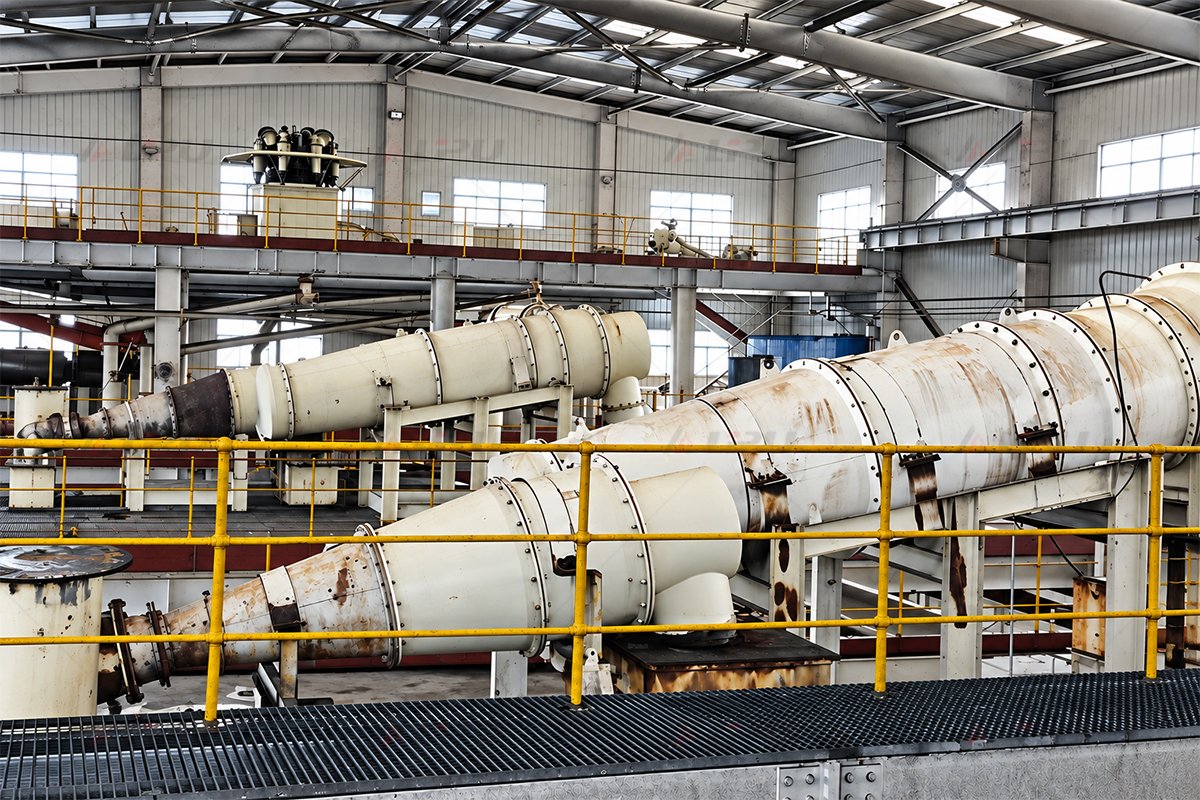
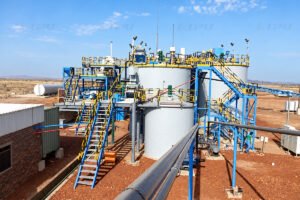
Dense medium cyclone separation equipment
Inside the cyclone, separation occurs under centrifugal force:
Higher-density particles generally report through the spigot as the dense fraction
Lower-density particles generally report through the vortex finder as the light fraction
Depending on the project objective, the dense fraction may become a pre-concentrate for further treatment, while the light fraction may be discarded, stockpiled, or processed separately.
The selected cut density is not fixed. It is determined through testwork and adjusted through medium-density control.
Medium Recovery and Density Control
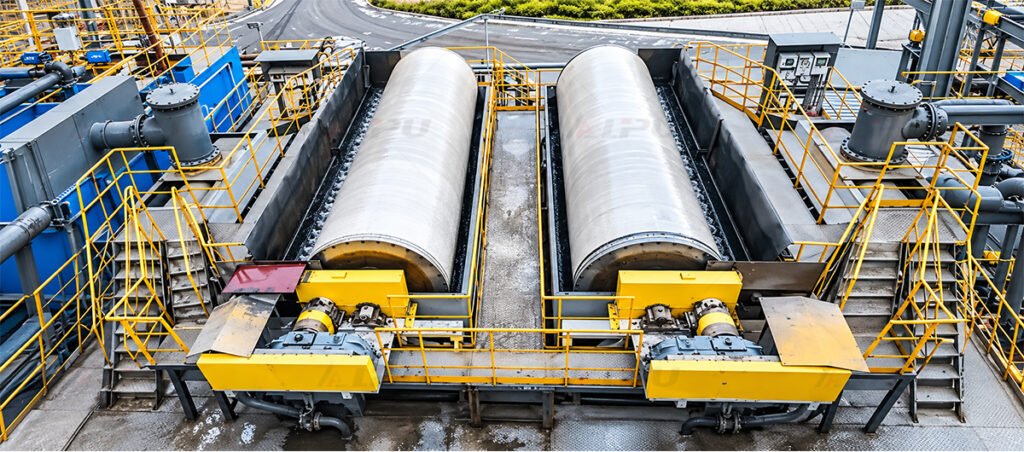
The dense medium is recovered after separation through drain-and-rinse screening. Medium adhering to the products is washed back into the medium circuit.
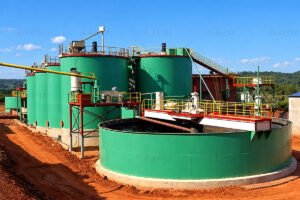
Dense medium recovery and density control system
A typical medium recovery system may include:
Drain-and-rinse screens
Dilute-medium tank
Magnetic separator
Medium storage or mixing tank
Density-control instrumentation
Pumps and piping for medium circulation
Magnetite or ferrosilicon recovery helps control operating cost and supports stable separation performance. Density, viscosity, particle-size distribution, and contamination of the circulating medium should be monitored during operation.
DMS Concentrate, Rejects and Downstream Processing
DMS concentrate can be directed to the next recovery stage according to the ore and project objective. Possible downstream routes include:
DMS rejects may be discarded, stockpiled, used as construction material where suitable, or evaluated for secondary recovery. The final decision depends on mineralogy, economics, and environmental requirements.
Storage bin, transfer conveyor, desliming or washing equipment where required
Medium preparation
Magnetite or ferrosilicon storage, mixing tank, density-control system
DMS separation
Dense medium cyclone, feed sump, slurry pump, distribution box
Drain and rinse
Drain-and-rinse screen, spray water system, product conveyors
Medium recovery
Dilute-medium tank, magnetic separator, medium circulation pumps
Product and reject handling
Dewatering screen, stockpile conveyor, bins, transport system
From Testwork to Plant Proposal
A DMS plant should be configured from representative ore data and separation testwork. LIPU can help match the circuit and equipment around:
Feed-size distribution and maximum particle size
Mineralogy and target mineral association
Density contrast between valuable minerals and gangue
DMS sink-float or pilot test results
Required cut density
Slime, clay, and moisture conditions
Capacity and operating schedule
Medium type and recovery requirements
Downstream processing route
Site water, power, and transport conditions
Why Work With LIPU
LIPU provides equipment matching and plant configuration for crushing, screening, dense medium separation, medium recovery, dewatering, and downstream mineral-processing stages.
The objective is to determine whether DMS can provide practical pre-concentration for the specific ore—not to apply a standard heavy-media circuit to every project.
Request a Dense Medium Separation Plant Proposal
Send your ore information, target capacity, feed-size range, mineral analysis, density data, testwork results, and downstream recovery requirements. Our team can help develop an appropriate DMS flowsheet and equipment configuration.
Frequently Asked Questions
What is the difference between DMS and flotation?
DMS separates particles primarily by density in a controlled medium. Flotation separates minerals according to surface properties using reagents and air bubbles. DMS is often used for pre-concentration before downstream flotation or grinding when the ore is suitable.
Can DMS process fine particles?
DMS generally performs best with a prepared size fraction. Excessive fines and slimes can reduce separation efficiency and increase medium losses. Fine material may require desliming or a separate recovery route.
Which medium is used in DMS plants?
Magnetite and ferrosilicon are common dense media. The selected medium depends on required density, feed characteristics, operating conditions, and recovery-circuit design.
What is a DMS cut density?
Cut density is the effective separation density at which particles are more likely to report to either the dense or light product. It is selected through testwork and controlled through the medium circuit.
Can DMS be used before gold or base-metal recovery?
Yes. Where testwork supports pre-concentration, DMS can reject low-density gangue before downstream grinding, gravity recovery, flotation, or leaching.
Does every ore need a DMS circuit?
No. DMS should be selected only when the ore has suitable density contrast, feed characteristics, and testwork results. It is not a universal replacement for grinding, flotation, or other recovery methods.