Gold Flotation Plant Configuration for Sulfide and Associated Gold Ores
LIPU configures gold flotation plants for sulfide and associated gold ores.Each plant is matched to ore characteristics, capacity, concentrate requirements, and site conditions.
Gold flotation is commonly considered where gold is associated with floatable sulfide minerals or occurs in a polymetallic ore. Typical applications may include:
Gold-bearing pyrite or arsenopyrite ores
Gold-copper, gold-lead-zinc, or other polymetallic sulfide ores
Sulfide gold ores requiring concentration before downstream treatment
Fine gold associated with sulfide minerals
Projects where a saleable or treatable gold-bearing concentrate is required
Flotation is not automatically the preferred route for every gold ore. Coarse liberated gold, oxidized ore, refractory ore, and complex mixed ore may require gravity recovery, cyanidation, roasting, pressure oxidation, or a combined process route. Mineralogical study and flotation testwork are important before final plant configuration.
A gold flotation plant is configured as a connected circuit rather than a fixed equipment list.
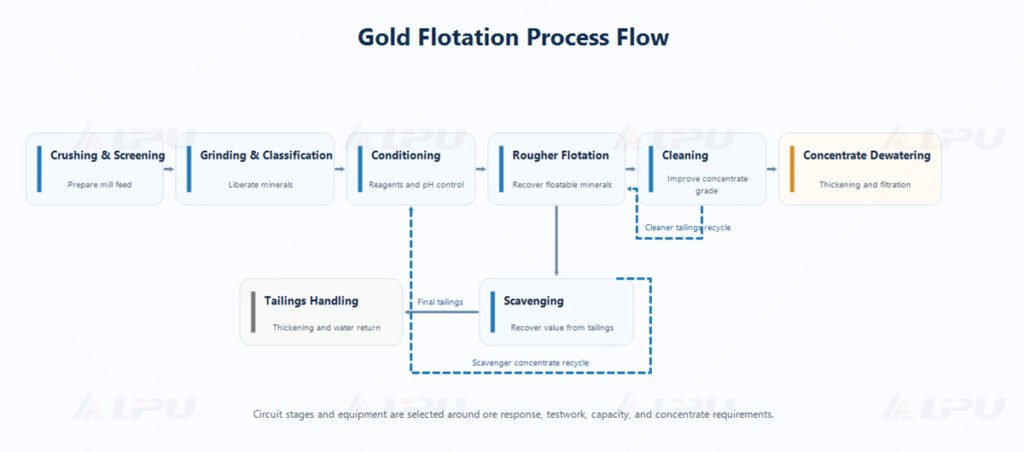
Gold flotation is configured as a connected circuit. The final arrangement depends on ore response, flotation testwork, target concentrate quality, and project requirements.
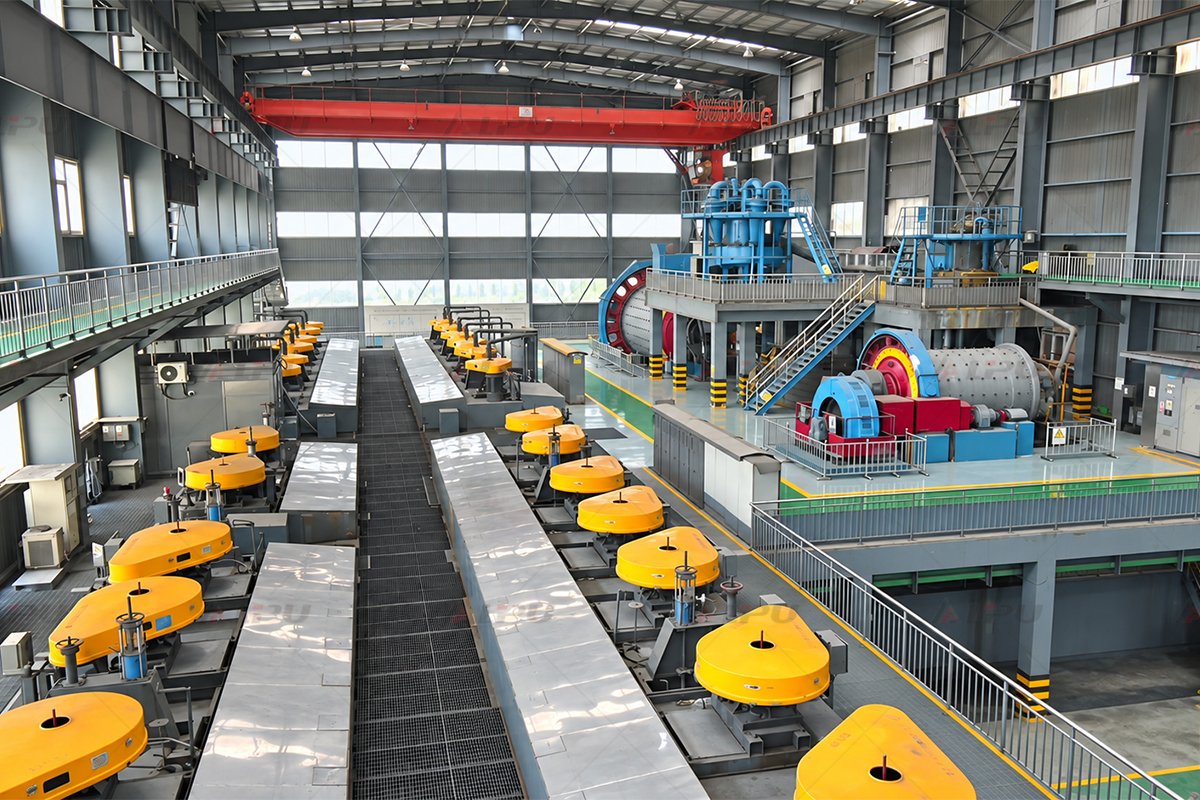
Gold flotation from roughing to concentrate recovery
Gold flotation is configured from grinding and conditioning through concentrate recovery and dewatering.
Crushing and screening Run-of-mine ore is reduced to a suitable feed size for grinding. The crushing arrangement depends on ore hardness, feed size, plant capacity, and the required mill feed size.
Grinding and classification Ore is ground to support mineral liberation. Classification returns coarse particles for further grinding while sending qualified slurry to flotation. The target grind size is determined through mineralogical assessment and flotation testing.
Conditioning and reagent addition Qualified slurry is conditioned before flotation. Reagent type, dosage, addition points, pulp density, pH, and conditioning time are selected according to ore response and circuit objectives.
Rougher flotation Rougher flotation recovers the main proportion of floatable gold-bearing minerals into a concentrate stream.
Scavenging and cleaning Scavenging treats rougher tailings to recover additional valuable minerals. Cleaning improves concentrate grade by removing unwanted gangue and non-target minerals. The number of flotation stages depends on the ore and concentrate specification.
Concentrate dewatering and handling Final concentrate can be thickened and filtered to achieve the required handling condition. The downstream destination may be smelting, further treatment, or another project-specific recovery route.
Flotation Circuit Configuration
Grinding and Classification
Grinding must provide sufficient liberation without excessive overgrinding. A typical arrangement may include a ball mill with hydrocyclones or another classification system. Equipment selection is based on ore competency, mineral liberation characteristics, throughput, slurry conditions, and testwork results.
Conditioning and Reagent Addition
Conditioning prepares the slurry for selective flotation. The system may include mixing tanks, reagent storage, dosing pumps, and pH-control equipment. Reagent schemes must be developed around ore response rather than applied as a fixed formula.
Roughing, Scavenging, and Cleaning
Flotation cells are arranged according to the selected circuit. Roughing targets recovery, scavenging treats valuable minerals remaining in the tailings stream, and cleaning targets concentrate grade. Cell type, cell volume, quantity, air supply, agitation, and froth handling are selected as part of the overall circuit design.
Concentrate Thickening and Filtration
Concentrate dewatering equipment is selected according to concentrate characteristics, water balance, transport requirements, and the final handling method. A thickener, filter, or combined arrangement may be used.
Tailings Handling and Water Return
Flotation tailings require a project-specific handling arrangement. Depending on the site, this may include tailings thickening, water return, storage, pumping, or additional treatment before final disposal.
From Flotation Testwork to Plant Configuration
Flotation performance depends on how gold occurs within the ore and how associated minerals respond to grinding, reagents, air dispersion, and froth separation.
The following information supports an effective plant configuration:
Ore mineralogy and gold association
Head grade and variability
Sulfide mineral composition
Target processing capacity
Liberation size and grinding requirements
Flotation test results
Target concentrate grade and recovery objectives
Water quality and reagent availability
Site elevation, climate, power supply, and logistics
Downstream concentrate treatment or transport requirements
LIPU uses the available project information to match crushing, grinding, classification, flotation, dewatering, and auxiliary systems into a practical plant route.
Gold Flotation Plant Equipment Configuration
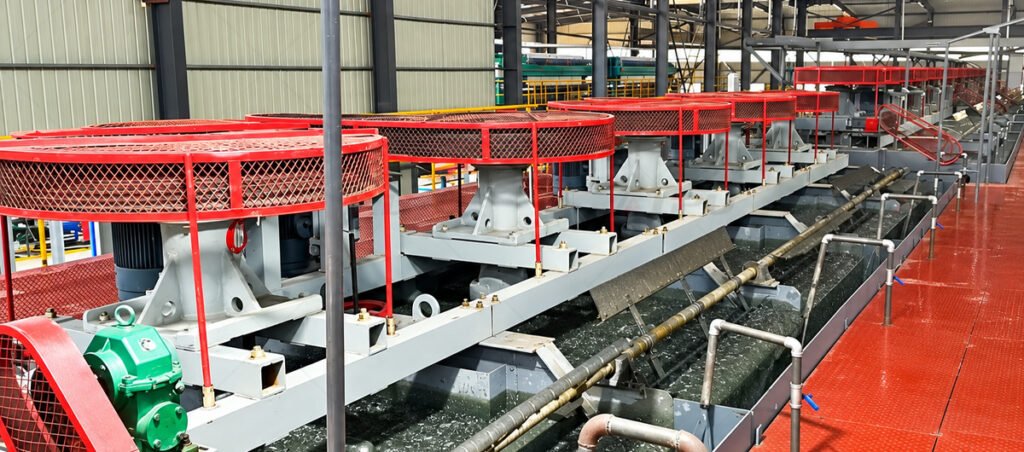
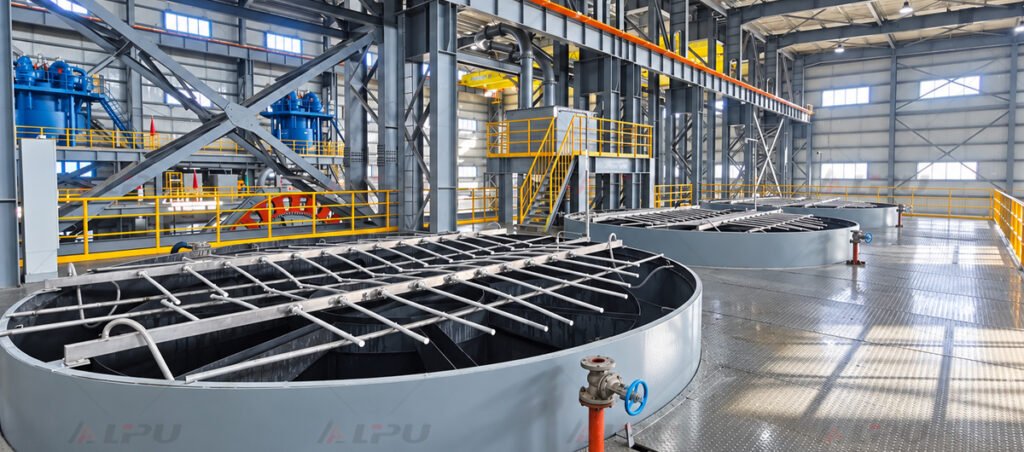
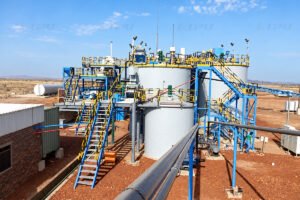
Conditioning and flotation stages in a gold flotation plant
Flotation cells and conditioning equipment are arranged around the selected roughing, scavenging, and cleaning circuit.
Gold Flotation, Gravity Recovery, and Cyanidation
Gold flotation, gravity recovery, and cyanidation serve different ore conditions and recovery objectives.
Route
Common Application
Main Output
Gravity recovery
Coarse, liberated, high-density gold
Gravity concentrate
Gold flotation
Gold associated with floatable sulfides or polymetallic minerals
Gold-bearing sulfide concentrate
Cyanidation / CIL / CIP
Suitable cyanide-leachable gold ores
Gold recovered through leaching and carbon adsorption
A combined route may be appropriate in some projects. For example, gravity recovery can be considered before flotation where coarse liberated gold is present, while flotation concentrate may require a separate downstream treatment route.
Concentrate handling should be considered during the early design stage. The selected arrangement depends on concentrate quantity, moisture requirement, transport method, storage conditions, and downstream treatment route.
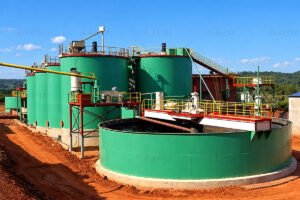
Thickening equipment for flotation slurry handling
Gold-bearing flotation concentrate can be thickened and filtered for the selected downstream handling arrangement.
Why Work With LIPU?
LIPU supports gold flotation projects with process-oriented equipment configuration. Based on available project information, we can assist with:
Flotation circuit and equipment arrangement
Crushing, grinding, and classification matching
Flotation machine selection
Reagent preparation and conditioning system layout
Concentrate thickening and filtration configuration
Tailings and water-return equipment matching
Factory inspection, delivery coordination, installation guidance, and technical support
A final process route should be confirmed through ore testing, engineering review, and project-specific operating requirements.
Frequently Asked Questions
What type of gold ore is suitable for flotation?
Flotation is commonly used for gold associated with floatable sulfide minerals, including some gold-bearing pyrite, arsenopyrite, copper-gold, and polymetallic sulfide ores. Suitability should be confirmed through mineralogical assessment and flotation testing.
Can flotation recover free gold?
Flotation may recover some floatable gold-bearing particles, but coarse liberated gold is often better evaluated for gravity recovery. A combined gravity and flotation route may be considered where ore characteristics support it.
Why are roughing, scavenging, and cleaning stages used?
Roughing targets initial recovery, scavenging treats valuable minerals remaining in the rougher tailings, and cleaning improves concentrate grade. The required stage arrangement depends on ore response and concentrate requirements.
What information is needed to configure a gold flotation plant?
Useful information includes ore mineralogy, gold association, sulfide composition, target capacity, feed size, flotation test results, target concentrate specification, water conditions, and site requirements.
Can LIPU provide a complete gold flotation plant?
LIPU can configure equipment for crushing, grinding, classification, conditioning, flotation, concentrate dewatering, and related auxiliary systems. The final scope depends on the selected process route and project requirements.
LET US REACH YOUNeed detailed customization and latest price? Chat online or leave message below!
How we use cookies
This Cookie Privacy Policy statement explains how Zoneding Machine (hereinafter referred to as "we", "our", or "this website") uses cookies and similar technologies (collectively referred to as "cookies") to identify you when you visit our website lepuu.com. It explains what these technologies are, why we use them, and your rights to control our use of them.
Privacy Policy
Leave a Message
We will reply to you within 24 hours
Hello, I am Lipu Heavy Industry, what can we do for you please?