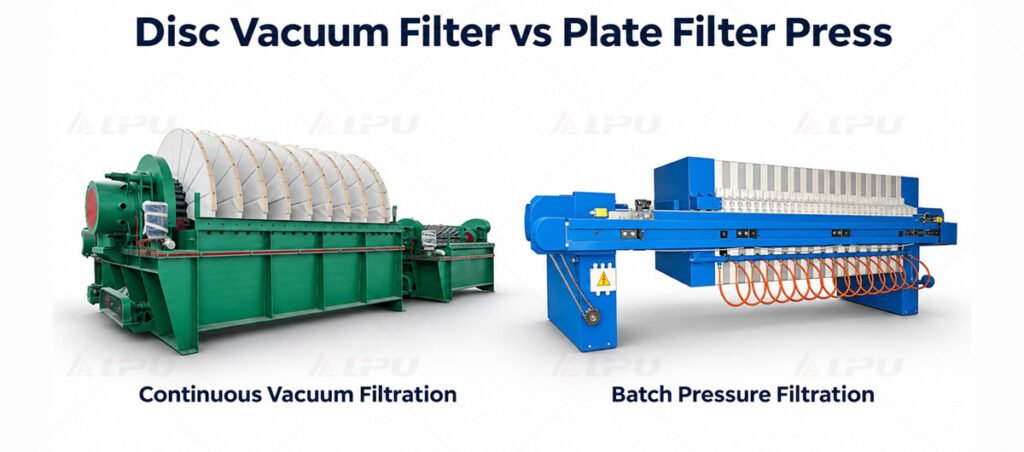
Mineral dewatering equipment should be selected according to the material stream, required operating mode, target moisture, filtration behaviour and downstream handling requirements. A disc vacuum filter and a plate filter press can both remove water from mineral slurry, but they serve different process duties.
A disc vacuum filter is normally used for continuous filtration of mineral concentrate or other relatively free-filtering slurry. A plate filter press is commonly selected when a batch process, higher filtration pressure, drier cake or more complete water recovery is required.
The correct choice should not begin with filter area alone. First define what material enters the filter, what the filtrate will be used for, and what condition the discharged cake must meet.
Define the Mineral Dewatering Duty Before Selecting a Filter
Before comparing equipment, identify the stream that needs dewatering.
A concentrate stream after flotation, magnetic separation or gravity separation may need continuous moisture removal before storage, transport or thermal drying. A tailings stream may need to recover process water and create a cake that can be stacked, transported or sent to a tailings-storage facility.
Key information to confirm includes:
Mineral type and slurry source
Required processing capacity
Feed solids concentration
Particle size distribution and clay content
Filtration behaviour from testwork
Required cake moisture
Filtrate-water quality and reuse destination
Required operating hours
Cake discharge and handling arrangement
Available installation space and maintenance access
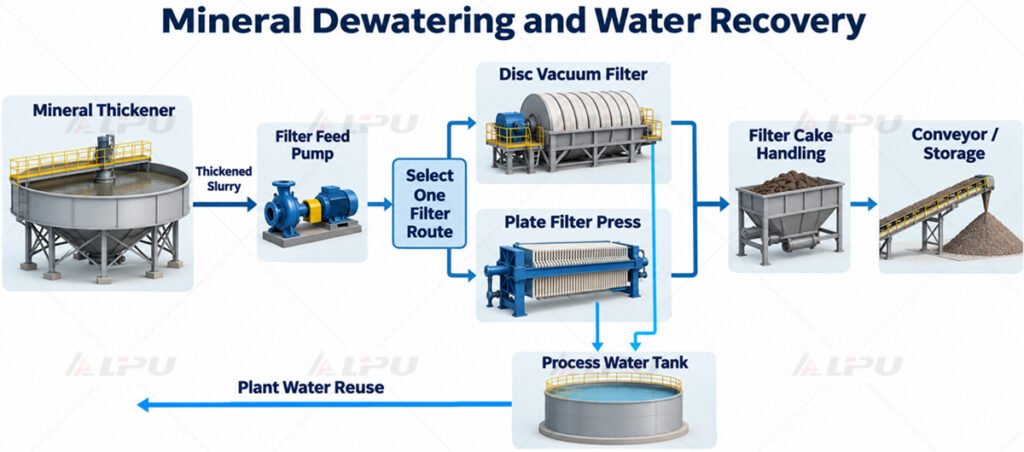
A filter cannot correct an unsuitable upstream slurry condition. In many mineral plants, a mineral thickener is installed before filtration to increase feed density and reduce the volume of water entering the filter.
Disc Vacuum Filter: Continuous Filtration for Free-Draining Slurry
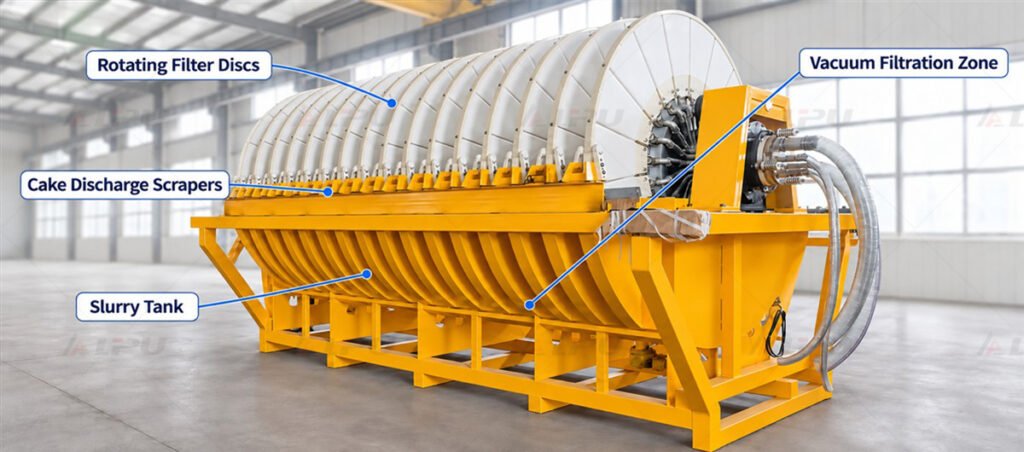
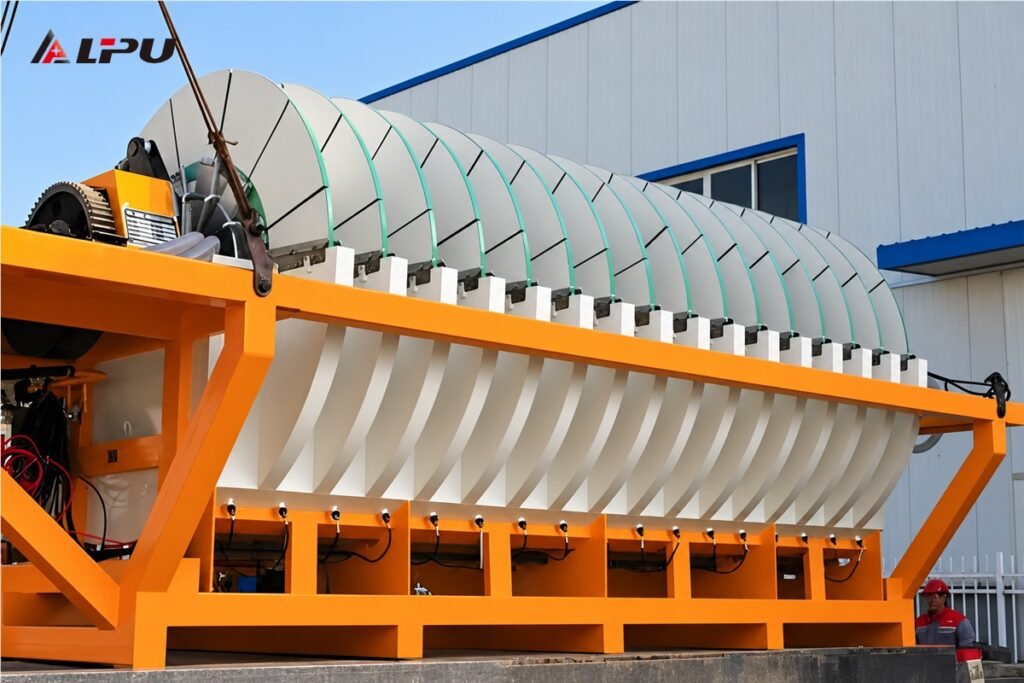
A disc vacuum filter uses several rotating filter discs partially immersed in a slurry tank. Vacuum draws liquid through the filter medium while solids form a cake on the disc surface.
As each disc rotates, the cake normally passes through filtration, washing where required, drying and discharge zones. The filtration process is continuous rather than batch-based.
A disc vacuum filter continuously forms, dewaters and discharges filter cake
Disc vacuum filters are often considered for:
Mineral concentrates with suitable filtration properties
Coal slurry and other free-draining material
Continuous concentrate dewatering
Plants that require steady material flow
Duties where the discharged cake does not need the lowest possible moisture
The main practical advantage is continuous operation. When the feed is stable and the material filters well, the machine can provide a predictable, continuous cake discharge.
However, vacuum filtration relies on the permeability of the cake. Fine particles, clay, slimes or difficult-to-filter material can reduce filtration rate and increase cake moisture. Filter-cloth condition, vacuum stability, slurry level and feed consistency must all be monitored.
Plate Filter Press: Pressure Filtration for Drier Cake
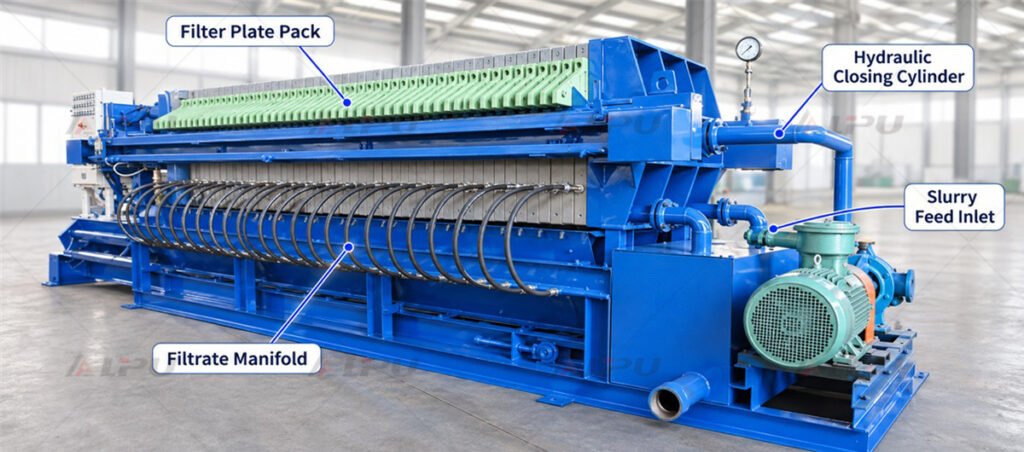
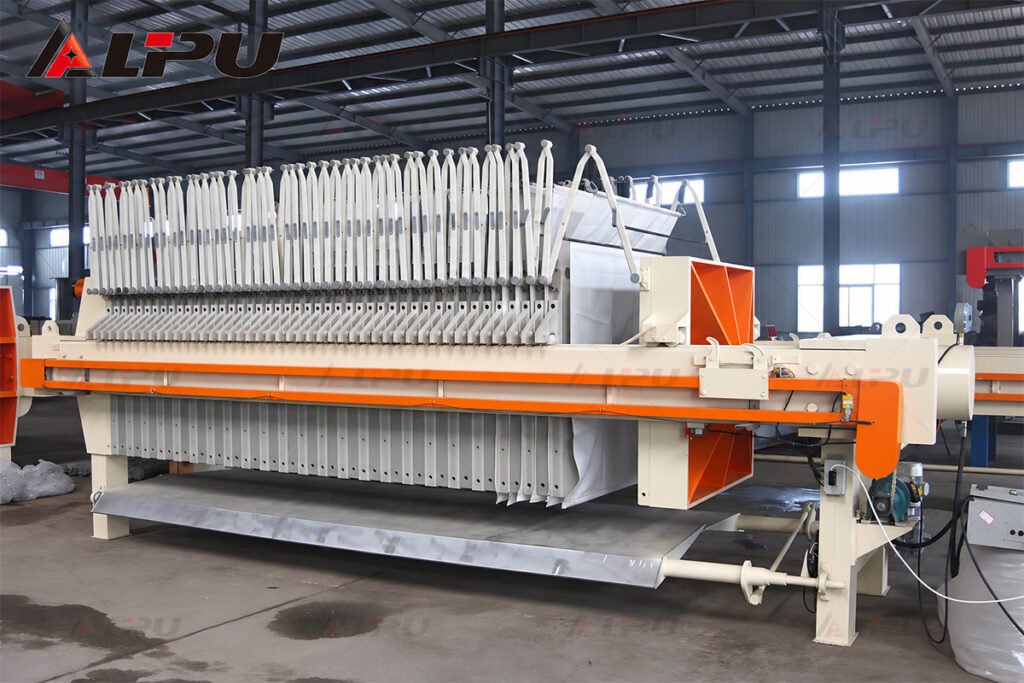
A plate filter press separates liquid and solids by pumping slurry into chambers formed between filter plates. Pressure forces liquid through the filter cloth, while solids remain inside the chambers and build into a filter cake.
When the filtration cycle is complete, the press opens and the cake is discharged. Depending on the process requirement, the cycle can also include membrane squeezing, cake washing or air blowing.
Plate filtration uses repeated filling, pressing, filtration and cake-discharge cycles
Plate filter presses are often selected for:
Fine concentrate or tailings dewatering
Slurries that require higher filtration pressure
Projects with a strict cake-moisture requirement
Water-recovery duties
Tailings dry stacking or controlled cake handling
Batch filtration where cycle time is acceptable
A filter press does not operate continuously in the same way as a disc vacuum filter. It works by repeated filling, pressing, filtration and cake-discharge cycles. The design must therefore include sufficient feed buffering, cake-conveying capacity and operating space for plate opening and cloth maintenance.
Disc Vacuum Filter vs Plate Filter Press: Key Selection Differences
Disc Vacuum Filter
Plate Filter Press
Selection point
Disc vacuum filter
Plate filter press
Operating mode
Continuous
Batch cycle
Driving force
Vacuum
Pressure
Typical duty
Continuous concentrate dewatering
Concentrate or tailings dewatering with stricter cake requirements
Feed behaviour
Best for relatively free-filtering slurry
Can suit more demanding fine-slurry duties, subject to testwork
Cake moisture
Depends strongly on material permeability and vacuum performance
Can achieve lower moisture when the process and press configuration are suitable
Water recovery
Continuous filtrate stream
Filtrate recovery by filtration cycle
Cake discharge
Continuous or near-continuous
Intermittent after each filtration cycle
Space and handling
Requires disc, tank and filtrate arrangement
Requires plate-opening space, cake discharge zone and handling equipment
Main operating focus
Vacuum, cloth condition, slurry level and rotation
Cycle time, feed pressure, plate condition, cloth condition and cake release
Neither filter is universally better. The best option depends on whether the plant values continuous operation, drier cake, water recovery, filtration pressure or tailings handling.
When a Disc Vacuum Filter Is the Better Fit
A disc vacuum filter is usually the stronger option when the process requires a steady concentrate discharge and the slurry has suitable filtration characteristics.
For example, a concentrator may need to dewater a stable concentrate stream before stockpiling, conveying or final drying. In this case, continuous operation can simplify the connection between the thickener, filter and downstream material handling equipment.
Check the following before selecting a disc vacuum filter:
Does filtration testwork show a stable cake formation rate?
Can the slurry remain sufficiently uniform in the filter tank?
Is cake moisture acceptable for the next handling or drying step?
Is the required capacity compatible with the available disc area and operating time?
Can filtrate be collected and returned to the process?
Is there safe access for cloth inspection, valve maintenance and disc cleaning?
Do not assume that a disc vacuum filter will handle all concentrate or tailings streams in the same way. Fine particle content, clay minerals, oxidation products and slurry chemistry can change cake permeability significantly.
When a Plate Filter Press Is the Better Fit
A plate filter press is commonly considered when the project needs more intensive dewatering or controlled cake handling.
This can apply to tailings, fine concentrates and other streams where water recovery is important or where the cake must be suitable for transport, storage, dry stacking or further treatment.
Check the following before selecting a plate filter press:
What cake moisture is required for the next process step?
Can the slurry be thickened to a suitable feed density before pressing?
Is cycle-based filtration acceptable for the planned capacity?
Is sufficient buffer capacity available during cake discharge?
Can the site accommodate plate opening, cloth washing and maintenance work?
How will discharged cake be transferred to conveyors, stockpiles or trucks?
Is membrane squeezing required, and does it provide a measurable benefit for the material?
For tailings applications, the filter press should be designed as part of the complete tailings processing system. This includes thickening, feed pumping, filtrate return, cake conveying, water balance and final disposal or storage.
Balance Cake Moisture Against Total Dewatering Cost
Drier cake is valuable only when it supports the actual process objective. A lower moisture result may not justify a more complex batch system if the material can already be handled safely after continuous vacuum filtration.
Likewise, continuous operation does not automatically make a disc vacuum filter the correct choice. If the slurry contains difficult fine material and the project requires high water recovery or stable dry stacking, pressure filtration may be more suitable.
The decision should balance:
Total installed equipment
Operating availability
Power use
Filter-cloth consumption
Water recovery value
Cake transport requirements
Maintenance access
Required labour and automation level
Variation in feed properties
Future capacity expansion
Design the Complete Dewatering and Water-Recovery System
The filter is only one part of the dewatering section. Its performance depends on the equipment before and after it.
Upstream equipment may include a thickener, slurry tank, agitator, pump, flocculant system, cyclone or concentrate storage tank. Downstream equipment may include conveyors, cake hoppers, stockpiles, dryers, trucks or a tailings-storage system.
Filtration should be designed with thickening, cake handling and process-water recovery
For a reliable layout, confirm:
The thickener underflow density and flow rate.
The feed-pump duty, standby arrangement and pressure range.
Filtrate piping and process-water return point.
Cake-discharge route and conveyor capacity.
Access around filter cloths, valves, drives and plate packs.
Drainage, cleaning-water and spill-containment arrangements.
Automation signals between upstream thickening and filter operation.
A well-matched beneficiation equipment package considers the entire slurry and water circuit instead of treating filtration as an isolated purchase.
Data Required for Mineral Filter Selection
To select the right dewatering equipment, provide the supplier with:
Mineral and processing application
Feed flow rate and solids concentration
Particle-size distribution
Feed temperature and slurry chemistry
Filtration test results, if available
Required cake moisture
Required filtrate clarity and reuse purpose
Daily operating hours
Required capacity and future expansion requirement
Available installation area and elevation
Cake-discharge method
Power supply, water supply and automation requirements
A representative slurry sample and filtration test are especially valuable when the material contains fines, clay, oxidation products or variable mineral composition.
Select the Filter Around the Full Process, Not One Metric
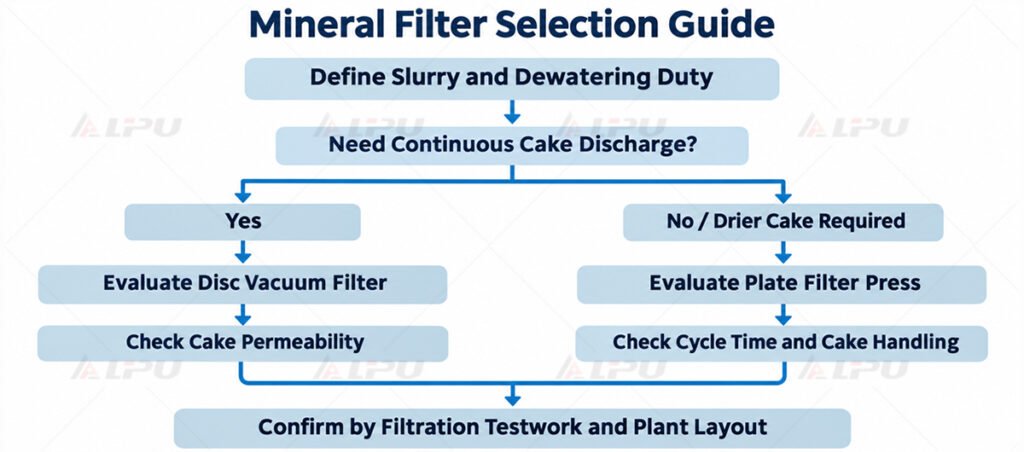
Select filtration equipment from the complete process duty, not cake moisture alone
Choose a disc vacuum filter when the material filters well and the plant needs continuous concentrate dewatering. Choose a plate filter press when higher-pressure filtration, lower cake moisture, stronger water recovery or controlled tailings cake handling is the priority.
The final selection should be based on slurry testing, process duty, water balance and the complete upstream-to-downstream layout. LIPU can help match dewatering equipment with thickening, pumping, conveying and mineral-processing requirements for the complete plant.
Frequently Asked Questions
Is a disc vacuum filter continuous?
Yes. A disc vacuum filter normally operates continuously, forming and discharging filter cake as the discs rotate through the slurry and drying zones.
Can a plate filter press be used for mineral tailings?
Yes. A plate filter press can be used for tailings dewatering when the required cake moisture, water recovery and handling arrangement justify pressure filtration.
Which filter usually produces a drier cake?
A plate filter press can often produce a drier cake because it uses pressure filtration and may include membrane squeezing. Actual performance depends on mineral characteristics and filtration testwork.
Does every filter need a thickener before it?
Not always, but thickening commonly improves filter-feed density, reduces water volume and helps stabilise filtration duty.
What test data is needed before selecting a mineral filter?
Useful information includes slurry density, particle-size distribution, filtration rate, cake moisture, filtrate clarity, mineral composition and variation in feed conditions.


We will reply to you within 24 hours