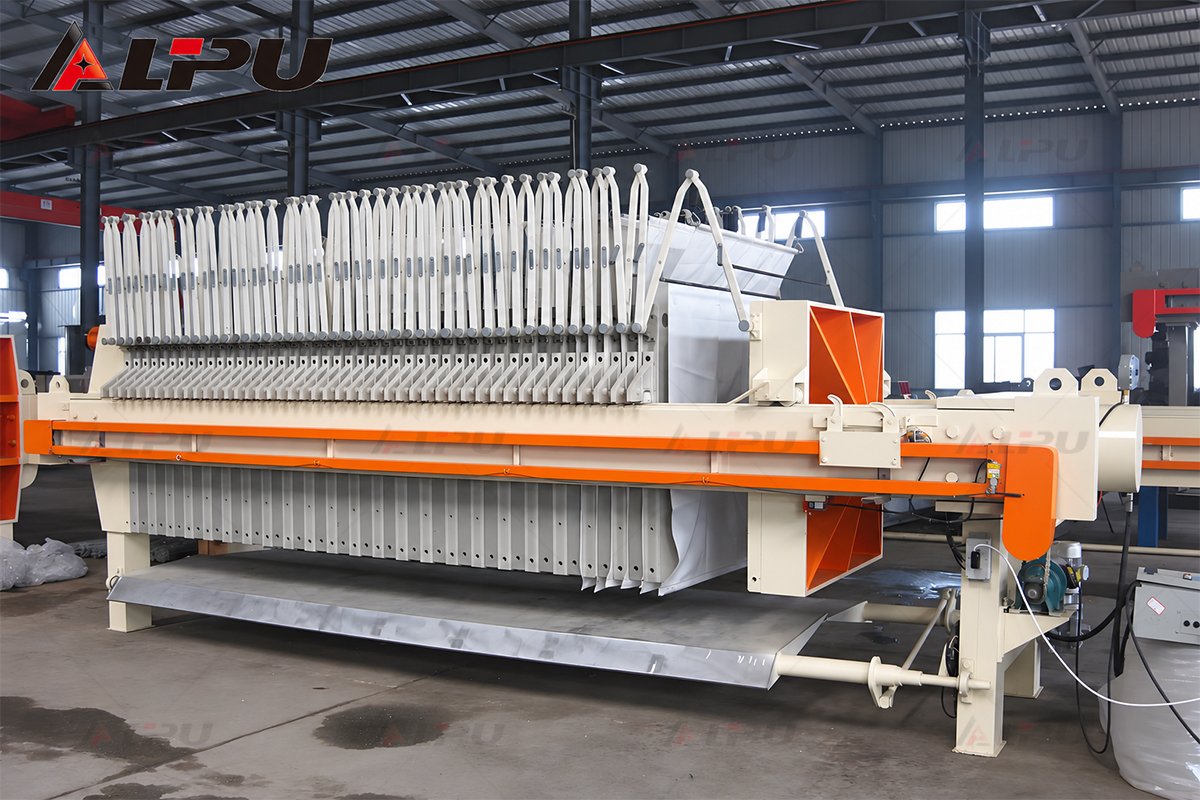
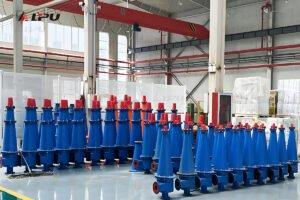
The LEPUU plate filter press provides batch solid–liquid separation for mineral concentrates, tailings, sand washing sludge, and compatible industrial slurries. It separates slurry into filter cake and filtrate, supporting solids handling and process water recovery.
Filter cloth, feed pumps, and automation options are selected to suit your material and operating requirements.
Filter Area: 50–500 m²
Cake Thickness: 30 mm
Applications: Concentrate, tailings, and sludge dewatering
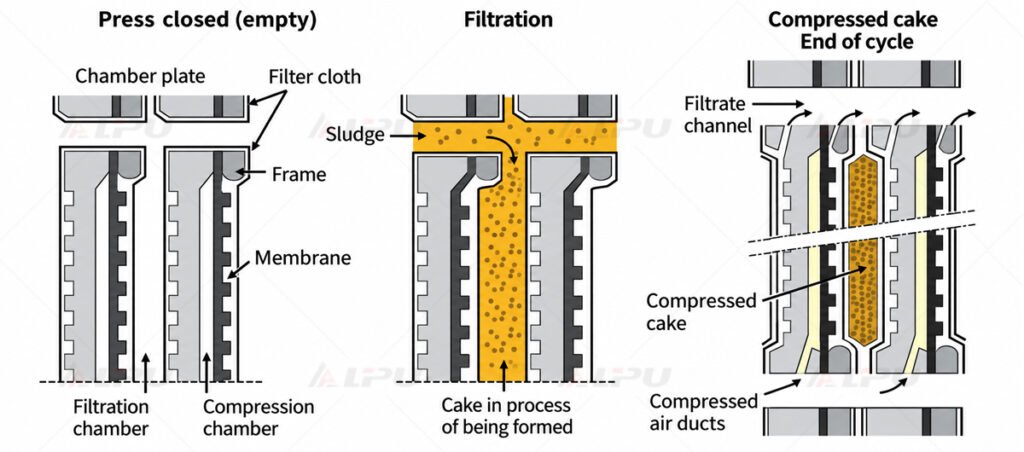
A plate filter press uses a series of cloth-lined filter chambers to separate solids from liquids. A feed pump delivers slurry into the closed chambers. Liquid passes through the filter cloth and flows out through drainage channels, while solids remain inside and gradually form a filter cake.
The press operates in batches. After filtration, feeding stops, pressure is safely released, and the plates open for cake discharge. The filter cloth and sealing surfaces are then checked before the next cycle.
Selecting a filter press requires more than choosing a filter area. Feed solids concentration, particle size, filtration resistance, chamber volume, and cycle time all influence processing capacity.
What Is a Plate Filter Press Used For?
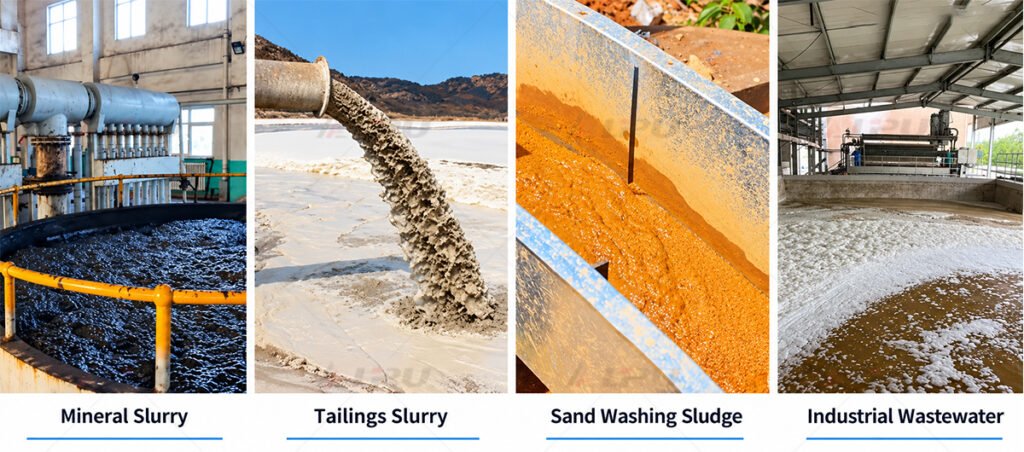
Typical plate filter press applications include mineral slurry, tailings slurry, sand washing sludge and solids-bearing industrial wastewater
Mineral Concentrate Dewatering
Remove water from mineral concentrate before downstream storage, transport, or processing. Filter cloth and operating conditions should be selected according to the concentrate’s filtration characteristics.
Tailings Dewatering
Separate tailings slurry into filter cake and filtrate as part of a tailings management system. Cake handling and water recovery arrangements depend on the project requirements.
Sand Washing Sludge Treatment
Dewater fine solids collected from sand washing and clarification processes. The filter press can be integrated with a thickener, slurry tank, and feed pump.
Industrial Sludge Treatment
Separate solids from compatible industrial process slurries and wastewater sludge. Material compatibility and filtration performance should be evaluated before equipment selection.
How a Plate Filter Press Fits into a Slurry Dewatering System
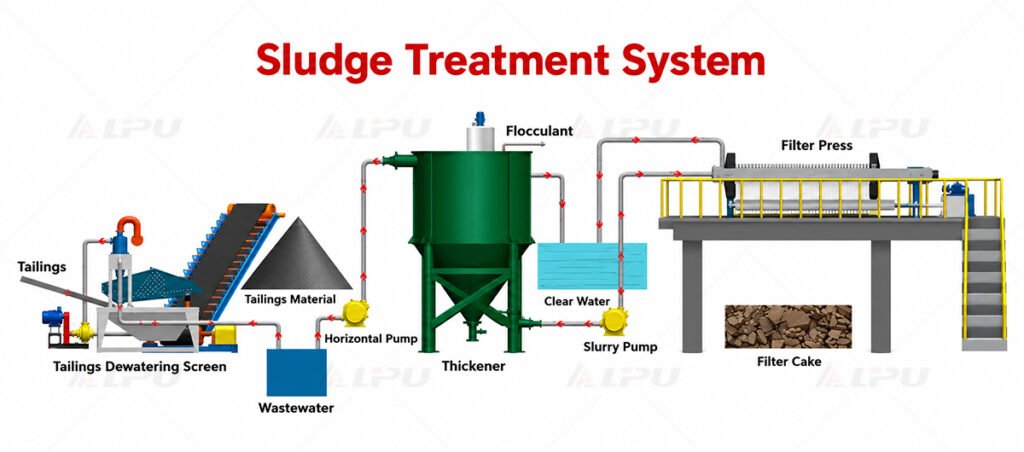
Slurry Collection → Thickening or Conditioning → Feed Pumping → Pressure Filtration → Cake Discharge and Filtrate Collection
Typical sludge treatment system combining screening, thickening, pressure filtration and water collection
Process Stage
Purpose
Slurry collection
Collect slurry from the upstream process
Thickening or conditioning
Prepare the feed where required by the application
Feed pumping
Deliver slurry into the filter chambers
Pressure filtration
Retain solids and separate liquid through the filter cloth
Cake handling
Collect or transfer the dewatered solids
Filtrate collection
Direct separated liquid to treatment or reuse
A thickener can increase feed solids concentration before filtration. A buffer tank can help coordinate the incoming slurry supply with the filter press’s batch cycle.
After filtration, cake is collected below the press or transferred by a suitable conveyor. Filtrate flows to a collection tank for further treatment or reuse, depending on its quality.
How Does a Plate Filter Press Work?
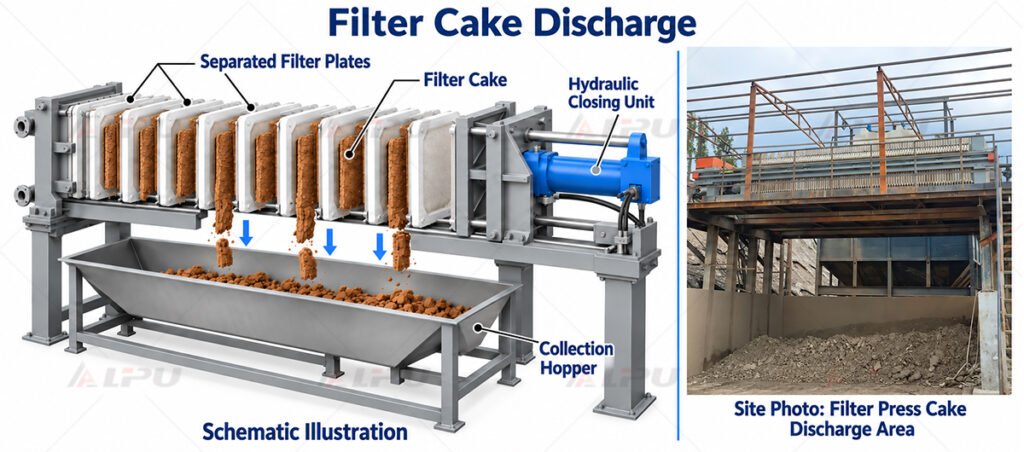
Schematic of filter cake discharge from separated plates, alongside a site view of the filter press platform and cake collection area
1. Close and Clamp the Plates
The closing mechanism brings the filter plates together and maintains the clamping force needed to keep the chambers sealed during filtration.
2. Feed the Slurry
The feed pump delivers slurry into the closed chambers. Feed pressure drives liquid through the filter cloth while suspended solids remain inside.
3. Form the Filter Cake
Solids accumulate in the chambers and form a filter cake. As the cake becomes thicker, filtration resistance increases. Filtration ends according to the operating criteria established for the material and equipment.
4. Release Pressure and Discharge
Feeding stops and pressure is safely released before the plates open. The cake is discharged using the arrangement supplied with the press. Plate shifting may be manual or automatic, depending on the configuration.
5. Prepare for the Next Cycle
The filter cloth and plate sealing surfaces are inspected. Remaining solids are removed, and cleaning is carried out as required before the press closes again.
Optional membrane squeezing: A secondary squeezing stage is available only on equipment fitted with membrane plates and a compatible squeeze system. Availability must be confirmed for the selected model.
Benefits of Using a Plate Filter Press for Slurry Dewatering
Separate Slurry into Cake and Filtrate
Pressure filtration produces two streams that can be handled separately: retained solids and collected liquid.
Support Process Water Recovery
Filtrate can be directed to a treatment or reuse circuit according to its quality and the plant’s water requirements.
Improve Solids Handling
Dewatered cake can simplify solids collection, transfer, and storage compared with handling the original slurry. Final cake moisture and consistency depend on the material and operating conditions.
Match the Equipment to the Material
Plate size, chamber volume, filter cloth, and feed pump duty are evaluated together to suit the required solids load and filtration cycle.
Select the Required Automation Level
Automatic plate shifting, cloth washing, and other control functions may be available for specified configurations. Included features should be confirmed in the equipment proposal.
Main Components of a Plate Filter Press
Filter chamber structure and operating stages of a membrane-equipped plate filter press
Component
Function
Main frame
Supports the filter plate pack and closing assembly
Filter plates
Form the filtration chambers and drainage paths
Filter cloth
Retains solids while allowing liquid to pass
Closing and clamping system
Holds the plates together during filtration
Feed connection and pump
Delivers slurry at the required flow and pressure
Filtrate outlets
Direct separated liquid to collection piping
Plate opening arrangement
Opens the plate pack for cake removal
Cake discharge arrangement
Supports collection or transfer of discharged solids
Control system
Controls the functions included in the selected configuration
How to Select a Plate Filter Press
A suitable filter press configuration depends on the slurry characteristics, required operating capacity, and installation conditions.
Selection Factor
Information Required
Material
Slurry type and source
Feed quantity
Slurry flow rate and daily operating hours
Solids content
Feed solids concentration and dry solids load
Particle characteristics
Particle size distribution and filtration behavior
Cake requirements
Target moisture or required handling condition
Liquid properties
Temperature, pH, and material compatibility requirements
Operating cycle
Required batch frequency and available discharge time
Automation
Required feeding, plate shifting, washing, and control functions
Installation
Available space and cake handling arrangement
Representative slurry testing is recommended when filtration behavior, cake release, or the required cake condition is uncertain.
Plate Filter Press Technical Specifications
Specification Model
Filter area
m²
Outside
dimensionsof theboard(mm)
Cake thickness
(mm)
Filter
chambervolume(L)
Number
of filterplates(pcs)
Filter
pressure(Mpa)
Overall
quality(Kg)
Dimensions
(L*W*H)(mm)
Foundation size
L
B
C
XAMZ50/1000-30UBK
50
1000*1000
30
750
28
≤ 0.6
4128
4040*1500*1400
3120
560
1100
XAMZ60/1000-30UBK
60
900
34
4636
4460*1500*1400
3540
XAMZ70/1000-30UBK
80
1303
40
3740
4760*1500*1400
3840
XAMZ80/1000-30UBK
90
1468
46
4040
5120*1500*1400
4100
XAMZ100/1000-30UBK
100
1635
57
4360
5780*1500*1400
4750
XAMZ120/1000-30UBK
120
1966
69
4960
6500*1500*1400
5480
XAMZ100/1250-30UBK
100
1250*1250
1500
36
≤ 0.6
8307
5170*1850*1600
3990
900
1360
XAMZ120/1250-30UBK
120
1800
43
6600
5625*1850*1600
4350
XAMZ140/1250-30UBK
140
2120
51
7200
6145*1850*1600
4820
XAMZ160/1250-30UBK
160
2280
58
7500
6600*1850*1600
5250
XAMZ180/1250-30UBK
180
2400
65
7750
7055*1850*1600
5870
XAMZ200/1250-30UBK
200
2720
72
8500
7510*1850*1600
6330
XAMZ220/1250-30UBK
220
3000
80
9000
8030*1850*1600
6850
XAMZ250/1250-30UBK
250
3800
91
10500
8745*1850*1600
7560
XAMZ200/1500-30UBK
200
1500*1500
3000
49
≤ 0.6
20030
6640*2100*1820
5360
1150
1700
XAMZ250/1500-30UBK
250
3760
61
17680
7480*2100*1820
6200
XAMZ300/1500-30UBK
300
4480
74
19200
8390*2100*1820
7110
XAMZ350/1500-30UBK
350
5250
86
21300
9230*2100*1820
7950
XAMZ400/1500-30UBK
400
5960
99
23300
10140*2100*1820
8860
XAMZ450/1500-30UBK
450
6740
111
25400
10980*2100*1820
9700
XAMZ500/1500-30UBK
500
7510
123
27500
11820*2100*1820
10540
Plate Filter Press Installations
A filter press installation must coordinate slurry feeding, filtrate collection, cake discharge, and maintenance access.
Depending on the application, the press can be connected to upstream thickening equipment and downstream cake collection or conveying equipment. The installation layout should allow sufficient space for plate opening and filter cloth replacement.
Plate Filter Press Technical Specifications
The following parameters should be confirmed for the selected model.
Parameter
Unit / Description
Model
Selected model designation
Filter area
m²
Filter plate dimensions
Width × height, mm
Cake thickness
mm
Chamber volume
L
Number of filter plates
pcs
Rated filtration pressure
MPa
Overall dimensions
Length × width × height, mm
Equipment weight
kg
Automation configuration
Included control and handling functions
Processing capacity and final cake moisture depend on the feed material and the complete filtration cycle. Installation dimensions and equipment weight should be checked against the final approved drawing.
Plate Filter Press Installation and Operation
Provide sufficient space for plate opening, cake discharge, filter cloth maintenance, and access to the closing assembly.
The feed pump, piping, filtrate collection system, and cake handling equipment should be coordinated with the filter press configuration.
Routine operation includes:
Checking filter cloth condition and plate sealing surfaces.
Monitoring feed pressure and filtration progress.
Releasing pressure before opening the plate pack.
Removing residual cake and cleaning as required.
Inspecting feed connections and the closing system.
Operating procedures and maintenance intervals should follow the instructions supplied with the equipment.
Installation, Maintenance and Spare Parts Support
Contact LEPUU to confirm the services included in your equipment proposal.
Installation guidance.
Commissioning assistance.
Operator training.
Maintenance recommendations.
Replacement filter cloth and component support.
Service scope and delivery arrangements are confirmed according to the supplied equipment and project agreement.
Plate Filter Press FAQs
What information is needed to select a plate filter press?
Provide the material type, slurry flow rate, solids concentration, daily operating hours, and required cake condition. Particle size, temperature, pH, and material compatibility requirements also help determine a suitable configuration.
Can filter area be converted directly into processing capacity?
No. Different slurries require different filtration times on the same filter area. Processing capacity depends on the dry solids load, chamber volume, filtration behavior, and total cycle time, including cake discharge and cleaning.
Does every plate filter press include membrane squeezing?
No. Membrane squeezing requires membrane plates and a compatible squeeze system. Confirm whether this function is included in the proposed equipment configuration.
Can the filtrate be reused directly?
This depends on the filtrate quality and the plant’s process water requirements. Further clarification or treatment may be needed before reuse.
Can a plate filter press operate automatically?
The automation level depends on the selected configuration. Automatic plate shifting, cloth washing, and other control functions should be confirmed in the equipment proposal.
What affects the final filter cake moisture?
Material properties, particle size, feed solids concentration, filtration pressure, cycle duration, and equipment configuration all affect cake moisture. Testing with representative slurry helps evaluate the achievable result.