Magnetite is strongly magnetic, but a reliable magnetite processing plant still depends on much more than selecting a wet drum magnetic separator. The ore must be crushed to a suitable size, ground sufficiently to liberate magnetite, classified before separation, and then handled through concentrate dewatering, tailings disposal, and water recovery.
This article focuses on conventional wet magnetic separation for magnetite. It does not treat wet drum separators as a substitute for high-intensity separators used for weakly magnetic minerals.
Start with Ore Data Before Selecting Any Magnetic Separator
A wet magnetic separation circuit should begin with the ore, not with a separator model. Magnetite may occur as liberated grains, fine intergrowths with gangue, or particles associated with non-magnetic minerals. These differences determine how much crushing and grinding are needed before magnetic recovery can be effective.
Useful information for preliminary circuit design includes:
Magnetite content and total iron grade;
Mineral liberation size;
Maximum run-of-mine feed size;
Clay, moisture, and slime content;
Required processing capacity;
Target concentrate grade and recovery objective;
Available process water and tailings-handling conditions;
Existing mineral analysis or beneficiation test results.
A wet drum magnetic separator can recover strongly magnetic particles from slurry, but it cannot compensate for insufficient liberation upstream. If magnetite remains locked with gangue, the concentrate may contain excessive impurities even when the separator itself operates normally.
Build a Closed Crushing Circuit Before Sending Ore to Grinding
The crushing section reduces run-of-mine ore to a controlled mill feed. A typical magnetite plant may use primary crushing followed by secondary crushing and screening, depending on feed size, plant capacity, and the ball mill feed requirement.
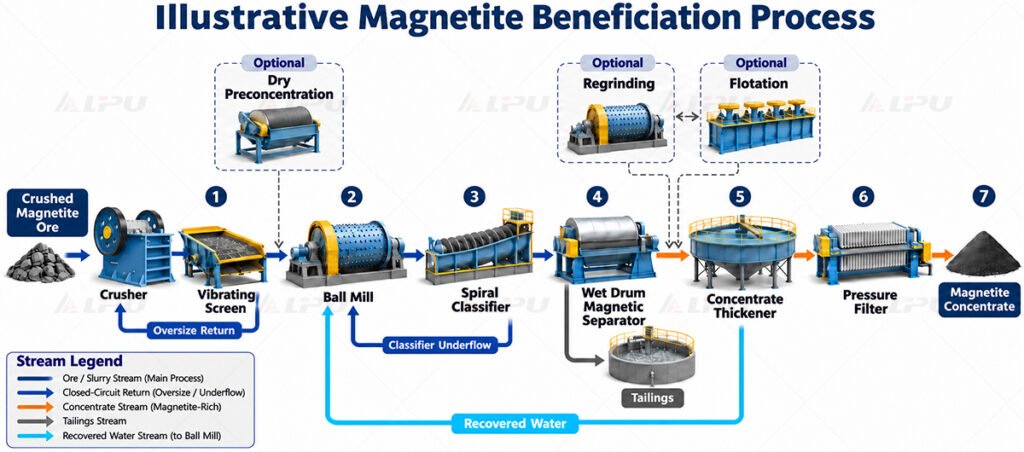
Screening is important because it controls what enters the grinding circuit. Material passing the screen proceeds toward milling, while oversize material returns to the crushing stage for further size reduction. This closed loop avoids sending oversized rock to the ball mill and helps stabilise the mill feed.
The crushing equipment should be selected as part of the complete plant rather than as an isolated machine. Feed size, ore hardness, abrasiveness, capacity, and maintenance access all affect the preferred crusher arrangement.
Match the Ball Mill and Classifier to Magnetite Liberation
In a conventional magnetite circuit, a ball mill is commonly paired with a spiral classifier or hydrocyclone. The purpose is to control the particle size delivered to wet magnetic separation.
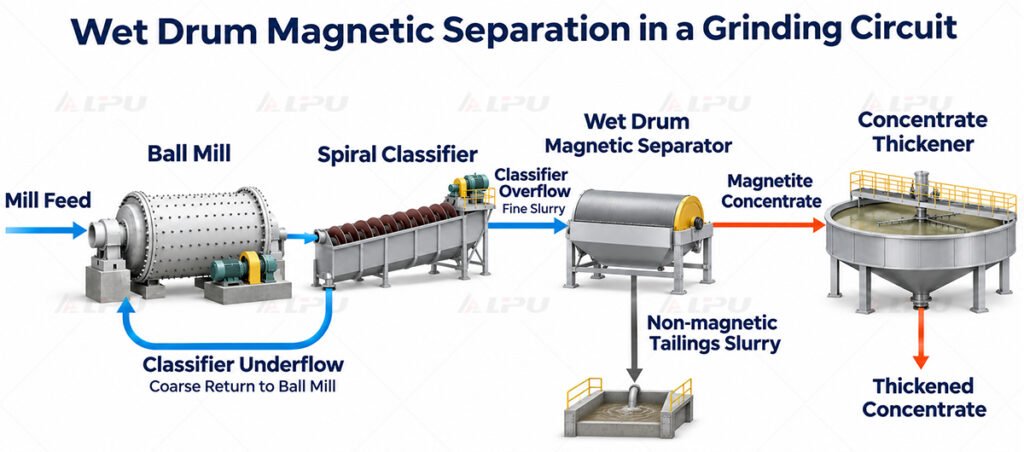
Classification controls the feed delivered to wet magnetic separation
The ball mill reduces particle size through grinding. The classifier then separates fine material from coarse material:
Fine overflow moves forward to magnetic separation;
Coarse underflow or returned sand goes back to the ball mill;
The circulating load keeps insufficiently ground material within the grinding circuit.
This loop is essential because particles should not enter the wet magnetic separator before enough magnetite has been liberated from non-magnetic gangue. At the same time, excessive grinding should be avoided because unnecessary fines can increase slurry-handling demand and complicate downstream dewatering.
Select the Wet Drum Magnetic Separator for Its Process Duty
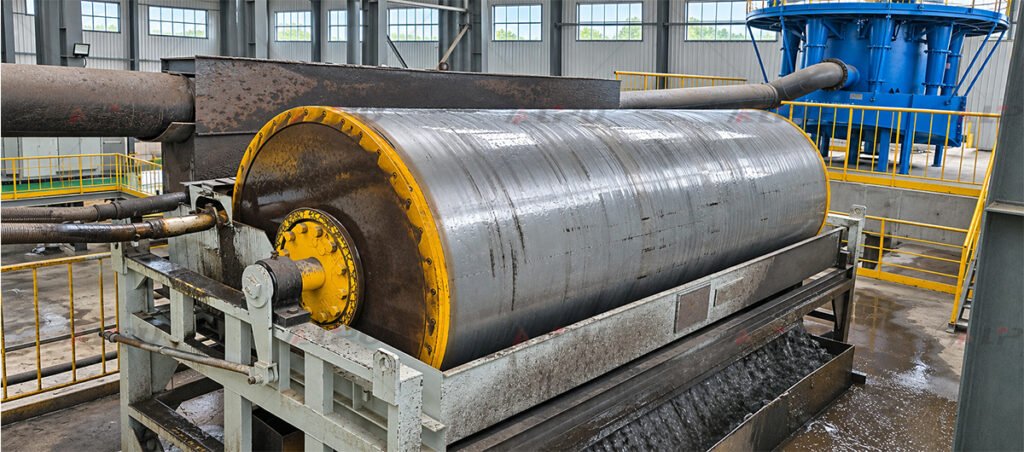
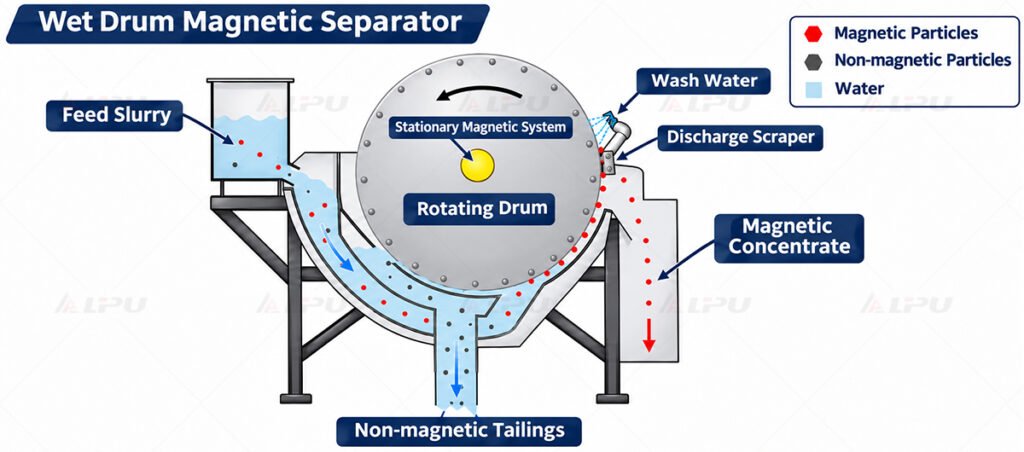
A wet drum magnetic separator treats magnetite slurry after suitable grinding and classification. Inside the separator, a stationary magnetic system attracts magnetic particles to the rotating drum surface. The drum carries magnetite away from the feed zone, while non-magnetic material follows a separate path toward tailings discharge.
The machine should be selected according to its duty within the circuit. Depending on ore characteristics and product requirements, wet drum separators may be arranged as roughers, cleaners, scavengers, or in multiple stages.
The rotating drum carries magnetic particles to a separate discharge while non-magnetic slurry exits as tailings
Selection factor
Why it matters
Feed particle size
The feed should match the liberation and slurry conditions required for separation.
Slurry concentration
Excessively dilute or dense slurry can affect material distribution in the tank.
Required processing capacity
Drum diameter, length, and quantity must match the planned throughput.
Magnetic mineral content
Higher or lower magnetic loading may require different circuit arrangements.
Product requirement
A rougher stage prioritises initial recovery, while cleaning stages focus on concentrate quality.
Installation arrangement
Feed boxes, discharge launders, flushing water, access platforms, and maintenance space must be planned together.
Wet drum separators are generally suitable for strongly magnetic minerals such as magnetite. They should not be presented as universal equipment for every iron-bearing or weakly magnetic mineral. Hematite, limonite, ilmenite, and mixed ores may require a different separation approach based on mineral analysis and testwork.
Keep Coarse Material Returning to the Grinding Circuit
The classifier return is one of the most important connections in a magnetite plant. Coarse particles that settle in the classifier should return to the ball mill rather than bypass directly to magnetic separation.
This arrangement provides two practical benefits:
It prevents coarse, insufficiently liberated material from reaching the wet drum separator too early.
It keeps the grinding circuit working toward a stable target particle size.
A poorly controlled classifier return can affect circulating load, mill power demand, slurry density, and magnetic separation feed conditions. When reviewing a plant layout, check the classifier overflow launder, returned-sand discharge, pumps, piping, and maintenance access together with the mill itself.
Separate Concentrate, Tailings, and Recovered Water Streams Clearly
Wet magnetic separation produces more than one material stream. The magnetic concentrate, non-magnetic tailings, and process water should be treated as separate flows in the plant design.
An illustrative magnetite circuit separates concentrate, tailings and recovered-water streams while maintaining closed crushing and grinding loops
Magnetic concentrate may require thickening, filtration, storage, or transfer to the next processing stage. Tailings may be sent to a thickener, tailings facility, or another recovery stage. Clarified water can be returned to grinding, classification, or magnetic separation where suitable.
A mineral thickener can support concentrate thickening, tailings treatment, and water recovery. The final layout should consider pump duty, pipe routing, slurry level, drainage, emergency overflow, and the site’s water-balance requirements.
Add Dry Preconcentration Only When the Ore Supports It
Dry preconcentration can be useful before wet grinding when the ore characteristics and project conditions support early rejection of low-value material. It may reduce the amount of material sent to downstream grinding and wet processing.
However, dry preconcentration is not a mandatory step in every magnetite project. Its value depends on feed size, ore moisture, magnetite distribution, gangue characteristics, and the expected mass rejection. It should be evaluated through ore testing rather than added automatically to a process diagram.
If dry separation is included, the arrangement must still match the crushing product size, feed moisture, dust-control requirements, and downstream wet-processing plan.
Use Regrinding and Flotation Only for a Clear Process Need
Some magnetite circuits include regrinding, flotation, or additional magnetic cleaning stages. These additions can improve product quality in suitable applications, but they also increase equipment quantity, water demand, control requirements, and operating complexity.
Regrinding may be considered when intermediate magnetic concentrate still contains locked gangue particles. Flotation may be considered when the required concentrate specification cannot be achieved through magnetic separation alone. The decision should be supported by mineral liberation information and beneficiation testwork.
The objective is not to add more equipment by default. It is to use the minimum practical process stages needed to achieve the required product result.
Check Equipment Interfaces Before Finalising the Layout
A complete magnetite wet magnetic separation line includes more than crushers, mills, classifiers, and separators. Each machine must connect correctly to the next stage.
Before confirming a layout, review:
Crusher discharge and screening connections;
Ball mill feed arrangement and mill discharge;
Classifier overflow and coarse-return route;
Magnetic separator feed distribution and tailings discharge;
Concentrate collection and dewatering connections;
Thickener underflow, overflow, and recovered-water routing;
Pumps, slurry pipelines, drainage, and flush-water points;
Electrical supply, control equipment, platforms, and maintenance access.
Poor interface design can limit plant performance even when the individual machines are correctly sized.
Information Needed for a Magnetite Plant Proposal
To prepare an initial equipment recommendation, provide the following information:
Ore type and available mineral analysis;
Magnetite grade and target concentrate requirement;
Maximum feed size and planned product size;
Required plant capacity and operating hours;
Mineral liberation or testwork information;
Available process water and water-recovery requirements;
Site elevation, power supply, and installation conditions;
Existing equipment that must be included in the new line.
LIPU can assist with matching crushing, grinding, classification, magnetic separation, thickening, dewatering, feeding, and conveying equipment according to the complete process requirement.
For project discussion or equipment selection support, contact LIPU.
Frequently Asked Questions
What is the main purpose of wet magnetic separation in magnetite processing?
Wet magnetic separation recovers strongly magnetic magnetite from slurry after the ore has been prepared to a suitable particle size and liberation condition.
Can magnetite go directly from crushing to a wet drum magnetic separator?
Usually, no. Many magnetite ores require grinding and classification before wet separation so that magnetite is sufficiently liberated from non-magnetic gangue.
Why does classifier coarse material return to the ball mill?
The coarse fraction has not yet reached the required grinding size. Returning it to the ball mill prevents insufficiently liberated particles from entering magnetic separation prematurely.
Is a wet drum magnetic separator suitable for hematite?
Not necessarily. Hematite is generally more weakly magnetic than magnetite and may require a different high-intensity magnetic separation configuration or another beneficiation method.
Can recovered water be reused in a magnetite plant?
In many layouts, clarified water from concentrate or tailings treatment can be returned to suitable wet-process stages. The final arrangement depends on water quality, slurry balance, and project conditions.

We will reply to you within 24 hours