Single-cylinder and multi-cylinder hydraulic cone crushers can both serve as secondary or tertiary crushers in hard rock mining and aggregate plants, but their main shaft support, hydraulic systems, crushing force capacity, and maintenance workflows differ significantly.
Choosing between them involves more than comparing hourly throughput ratings. The crusher must match your rock compressive strength, abrasion index, maximum feed size, required reduction ratio, and downstream product shape or grinding feed specifications.
This guide compares the two hydraulic cone crusher designs across structural mechanics, chamber kinematics, closed-side setting (CSS) control, wear part replacement, operating costs, and circuit placement.
What Feed and Circuit Information Is Needed to Select a Hydraulic Cone Crusher?
Before selecting a cone crusher model or chamber profile, define the crushing stage and material characteristics.
Crushing medium-hard limestone for road base requires a different mechanical configuration than fine crushing abrasive granite, basalt, or iron ore ahead of a Ball Mill.
Provide the equipment supplier with:
Normal and maximum feed rate (TPH) required for the circuit.
Maximum feed size (F80 / F100) discharged from the upstream primary crusher.
Incoming particle-size distribution, including natural fines (-10 mm) and moisture/clay content.
Rock or ore type, unconfined compressive strength (UCS in MPa), and Bond abrasion index (Ai).
Crushing stage duty (secondary crushing after a jaw crusher, or tertiary/quaternary fine crushing).
Target discharge gradation, closed-side setting (CSS), and aggregate cubicity requirements.
Closed-circuit vibrating screen aperture and allowable circulating load percentage.
Structural Design and Hydraulic System Differences
The fundamental engineering distinction lies in how the main shaft is supported and how crushing forces are absorbed during continuous operation.
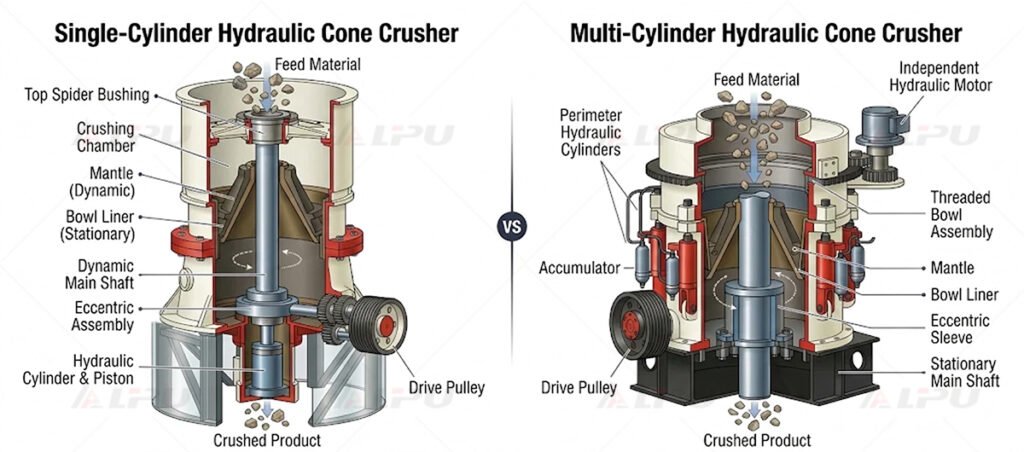
Cross-section diagram comparing dynamic main shaft with bottom cylinder versus fixed main shaft with perimeter cylinders
Single-Cylinder Hydraulic Cone Crusher
A Single-Cylinder Cone Crusher uses a dynamic main shaft supported at the top by a spider bushing and at the bottom by a single large hydraulic cylinder.
One Multi-Function Bottom Cylinder: The bottom hydraulic piston performs three functions simultaneously—adjusting the closed-side setting (CSS), providing tramp iron overload release, and lowering the shaft to clear a stalled chamber.
Simpler Internal Layout: With only one hydraulic cylinder and fewer external hoses, seals, and accumulators, the machine has fewer routine hydraulic inspection points.
Steeper Crushing Chamber: The geometry promotes smooth, high-volume material flow when accepting coarser feed in secondary crushing applications.
Multi-Cylinder Hydraulic Cone Crusher
A Multi-Cylinder Hydraulic Cone Crusher features a heavy, stationary main shaft mounted solidly in the lower mainframe, with an eccentric sleeve rotating around it.
Perimeter Clamping Cylinders: Multiple hydraulic cylinders (typically 8 to 16) arranged around the upper frame clamp the adjustment ring down, provide hydraulic tramp iron release, and lift the upper assembly for cavity clearing.
Independent Hydraulic CSS Adjustment: A separate hydraulic drive motor engages gear teeth on the adjustment ring to rotate the bowl liner assembly and set the discharge opening.
Higher Structural Rigidity: Because the main shaft is fixed at the base with a larger diameter, the crusher resists bending moments under extreme crushing loads.
Crushing Force, Reduction Ratio, and Aggregate Particle Shape
When processing hard, abrasive rock such as granite, basalt, quartzite, or metallic ores, crushing force and chamber kinematics govern both throughput and finished product quality.
Hard Rock Crushing Force and Reduction Ratio
Multi-Cylinder Advantage on Ultra-Hard Ores: The fixed main shaft design allows higher installed motor power, greater crushing force, and higher eccentric rotational speed. This enables a larger single-stage reduction ratio when crushing high-compressive-strength ores (up to 300–350 MPa) or producing fine mill feed.
Single-Cylinder Volumetric Capacity: In secondary crushing circuits where feed size is relatively large (e.g., 150–250 mm from a primary jaw crusher) and rock hardness is medium-hard to hard (up to ~250–300 MPa), a single-cylinder crusher provides high volumetric throughput with lower power draw per ton.
Inter-Particle Lamination and Product Shape
Both designs rely on laminated crushing—compressing multiple layers of rock against each other inside a choked crushing chamber—rather than single-particle impact.
Multi-Cylinder Fine Crushing & Cubicity: Combining high eccentric speed, an optimized eccentric throw, and a dedicated fine-crushing cavity, a multi-cylinder hydraulic cone crusher generates a higher proportion of cubic particles with low flakiness. It is widely selected for tertiary crushing and pre-sand-making ahead of a VSI Sand Maker.
Single-Cylinder Gradation: Produces uniform gradation suitable for road base aggregates and standard concrete stone, though pushing a single-cylinder unit to ultra-tight fine settings on extremely hard rock places higher axial stress on the bottom thrust bearing and hydraulic piston.
Chamber Selection and Feed Gradation Requirements
Both single-cylinder and multi-cylinder cone crushers offer interchangeable chamber liners—commonly categorized as Coarse (C), Medium (M), Fine (F), and Extra-Fine (EF)—to adapt to different feed sizes and discharge targets.
Matching Feed Opening to Top Size: The maximum feed size must never exceed 80–85% of the crusher’s closed-side feed opening. Feeding oversized slabs causes bridging at the top of the chamber and accelerates upper mantle wear.
Choke Feeding Requirement: To achieve true inter-particle crushing and prevent uneven liner wear, both crusher types should operate under choke-fed conditions using a surge bin and variable-speed feeder.
Fines Removal Before Crushing: Incoming feed containing excessive sticky clay or high percentages of material already smaller than the target CSS should be scalped on a vibrating screen beforehand to prevent packing and hydraulic pressure spikes.
CSS Adjustment, Overload Protection, and Lubrication Systems
Modern hydraulic cone crushers integrate automated control systems, yet their mechanical execution differs in daily operation.
Closed-Side Setting (CSS) Control
Single-Cylinder CSS Adjustment: Raising or lowering the main shaft via the bottom cylinder provides rapid, continuous CSS adjustment under load. Automated PLC systems can automatically compensate for liner wear to maintain consistent product gradation throughout a shift.
Multi-Cylinder CSS Adjustment: Hydraulic motors rotate the threaded bowl assembly to raise or lower the stationary liner. While fully automated on modern plants, operators must keep the adjustment ring threads clean and properly lubricated in high-dust quarry environments.
Tramp Iron Release and Cavity Clearing
Single-Cylinder Release: When uncrushable metal enters the chamber, hydraulic oil from the bottom cylinder is forced into an accumulator, allowing the main shaft to drop and pass the tramp iron before returning to its preset height.
Multi-Cylinder Release: Perimeter double-acting cylinders lift the entire upper frame and bowl assembly smoothly when overload pressure is reached, providing large clearance strokes and fast cavity clearing after a power outage.
Lubrication and Cooling Systems
Single-Cylinder Lubrication: Hydraulic oil and lubricating oil often share a unified or tightly integrated station, simplifying piping and requiring fewer external components.
Multi-Cylinder Lubrication: Uses a dedicated high-flow thin-oil lubrication station with air-cooled or water-cooled heat exchangers to protect high-speed bronze eccentric bushings under heavy continuous loads.
Maintenance Access and Operating Cost Considerations
Total cost of ownership depends on initial capital expenditure, manganese wear life, hydraulic maintenance, and downtime during liner changeouts.
Routine Maintenance Points: Single-cylinder crushers have fewer hydraulic cylinders, hoses, and seals, reducing daily leak checks and seal replacements. Multi-cylinder crushers have more hydraulic actuators around the frame perimeter that require periodic pressure and accumulator checks.
Wear Part Replacement Workflow: Multi-cylinder cone crushers allow technicians to remove the bowl assembly, mantle, and eccentric bushings from the top of the machine without dismantling the lower frame or main shaft. On a single-cylinder crusher, replacing the upper spider bushing or inspecting the bottom thrust assembly requires overhead crane clearance to lift the main shaft assembly.
Capital vs. Fine-Crushing Efficiency: Single-cylinder crushers generally carry a lower initial purchase price for equivalent secondary throughput, whereas multi-cylinder crushers deliver higher fine-fraction yield per pass in tertiary circuits, reducing circulating load on downstream vibrating screens.
Side-by-Side Comparison: Single-Cylinder vs Multi-Cylinder Cone Crusher
Comparison Factor
Single-Cylinder Hydraulic Cone Crusher
Multi-Cylinder Hydraulic Cone Crusher
Main Shaft Structure
Dynamic main shaft supported at top spider & bottom piston
Fixed main shaft supported by lower frame with rotating eccentric sleeve
Hydraulic System
1 bottom cylinder (CSS, tramp release & clearing)
Multiple perimeter cylinders + hydraulic adjustment motor
Primary Circuit Position
Secondary crushing with larger feed size
Secondary & tertiary fine crushing of hard rock
Rock Hardness Suitability
Medium-hard to hard rock (up to ~250–300 MPa)
Hard to ultra-hard abrasive rock & ore (up to ~350 MPa)
Reduction Ratio
Moderate reduction ratio with high throughput
High reduction ratio with greater fine-material yield
Aggregate Particle Shape
Uniform gradation for standard aggregates
High cubicity, low flakiness, ideal for concrete & sand making
Maintenance Profile
Fewer hydraulic components; top spider & bottom piston service
Top-access liner and bushing replacement; more hydraulic cylinders
Which Hydraulic Cone Crusher Fits Your Plant?
Match the crusher design to your position in the crushing circuit and material characteristics:
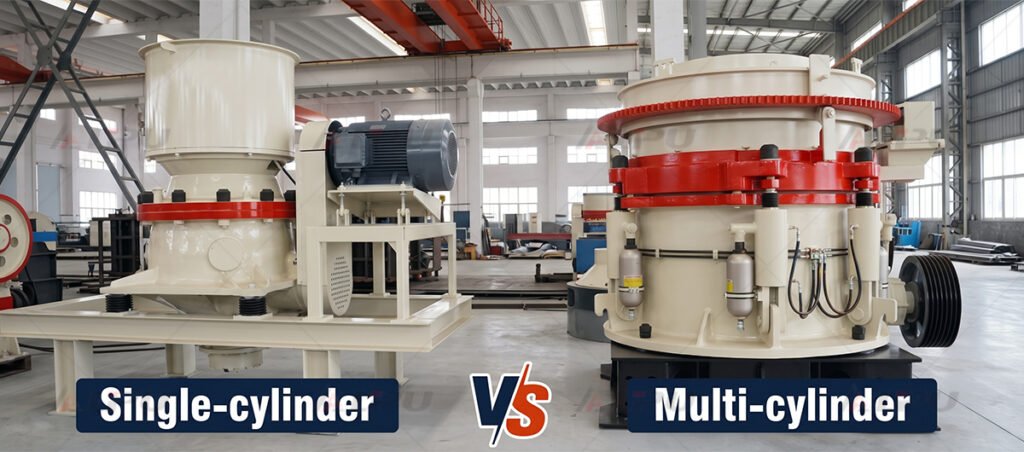
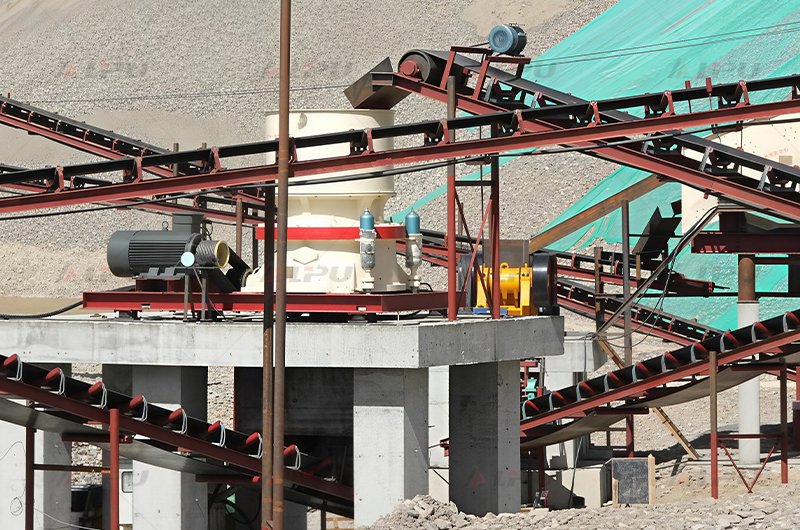
Single-cylinder hydraulic cone crusher on-site
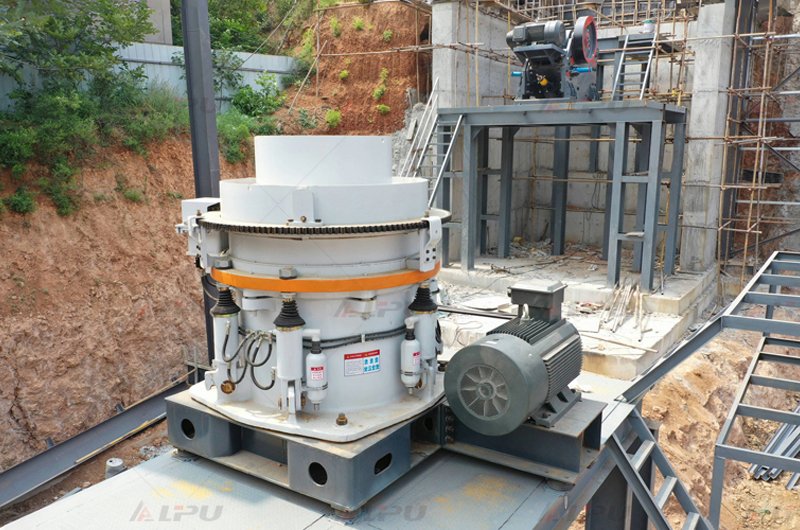
Multi-cylinder hydraulic cone crusher on-site
Choose a Single-Cylinder Hydraulic Cone Crusher when you need a high-throughput secondary crusher after a primary Jaw Crusher, your feed size is relatively coarse, and you want simpler hydraulic controls with lower initial capital cost.
Choose a Multi-Cylinder Hydraulic Cone Crusher when processing ultra-hard or highly abrasive ores, operating in a tertiary fine-crushing stage, or producing high-specification cubic aggregates with tight gradation tolerances.
Combine Both in a Three-Stage Plant: Large hard-rock quarries and mining concentrators frequently install a jaw crusher for primary crushing, a single-cylinder cone crusher for secondary crushing, and a multi-cylinder hydraulic cone crusher for tertiary fine crushing in closed circuit with a multi-deck vibrating screen.
Consider a Mechanical Spring Cone Alternative: For smaller-scale operations or budget-sensitive projects that still require reliable hard-rock crushing without complex hydraulics, a Simmons Cone Crusher remains a proven, straightforward option.
Configure Your Hard Rock Crushing Circuit with LIPU
Selecting the right cone crusher requires matching chamber geometry, eccentric throw, and motor power to your feed gradation, rock hardness, and target output. Whether you are designing a stationary Stone Crushing Production Line or preparing fine ore feed for a mineral processing plant, LIPU engineers configure complete crushing and screening circuits based on your project data.
Contact our engineering team with your rock type, feed size, and required hourly capacity (TPH) to receive a tailored equipment selection and circuit layout proposal.
Frequently Asked Questions
Can a single-cylinder hydraulic cone crusher be used for tertiary fine crushing? Yes, when fitted with a fine (F) or extra-fine (EF) cavity, a single-cylinder cone crusher can perform fine crushing on medium-hard rock. However, for ultra-hard, abrasive rock or strict cubic aggregate specifications at tight closed-side settings, a multi-cylinder hydraulic cone crusher provides higher structural rigidity and better fine-fraction yield.
Which hydraulic cone crusher produces better aggregate shape for concrete and asphalt? A multi-cylinder hydraulic cone crusher generally produces better cubicity and fewer flaky or elongated particles. Its fixed main shaft supports higher eccentric speed and optimized laminated crushing inside the chamber, making it ideal for high-grade concrete aggregates and pre-sand-making stages.
Why is choke feeding important for both single-cylinder and multi-cylinder cone crushers? Choke feeding keeps the crushing chamber full of rock so particles crush against each other (rock-on-rock lamination) rather than only against the manganese liners. This improves product cubicity, maximizes throughput, and ensures even wear across the mantle and bowl liner.
How often do manganese liners need to be replaced on a hydraulic cone crusher? Liner service life depends heavily on rock silica content (abrasion index), feed moisture, and choke-feeding consistency. On abrasive granite or basalt, manganese liners typically last between 800 and 2,000 operating hours, whereas on less abrasive limestone they can exceed 3,000 to 5,000 hours.
What is the difference between a multi-cylinder hydraulic cone crusher and a Simmons cone crusher? A Simmons (spring) cone crusher uses mechanical coil springs for overload protection and manual or hydraulic jack adjustment for the discharge setting. A multi-cylinder hydraulic cone crusher replaces heavy springs with perimeter hydraulic cylinders and accumulators, offering faster tramp iron release, automated hydraulic CSS adjustment, and higher crushing power.

We will reply to you within 24 hours