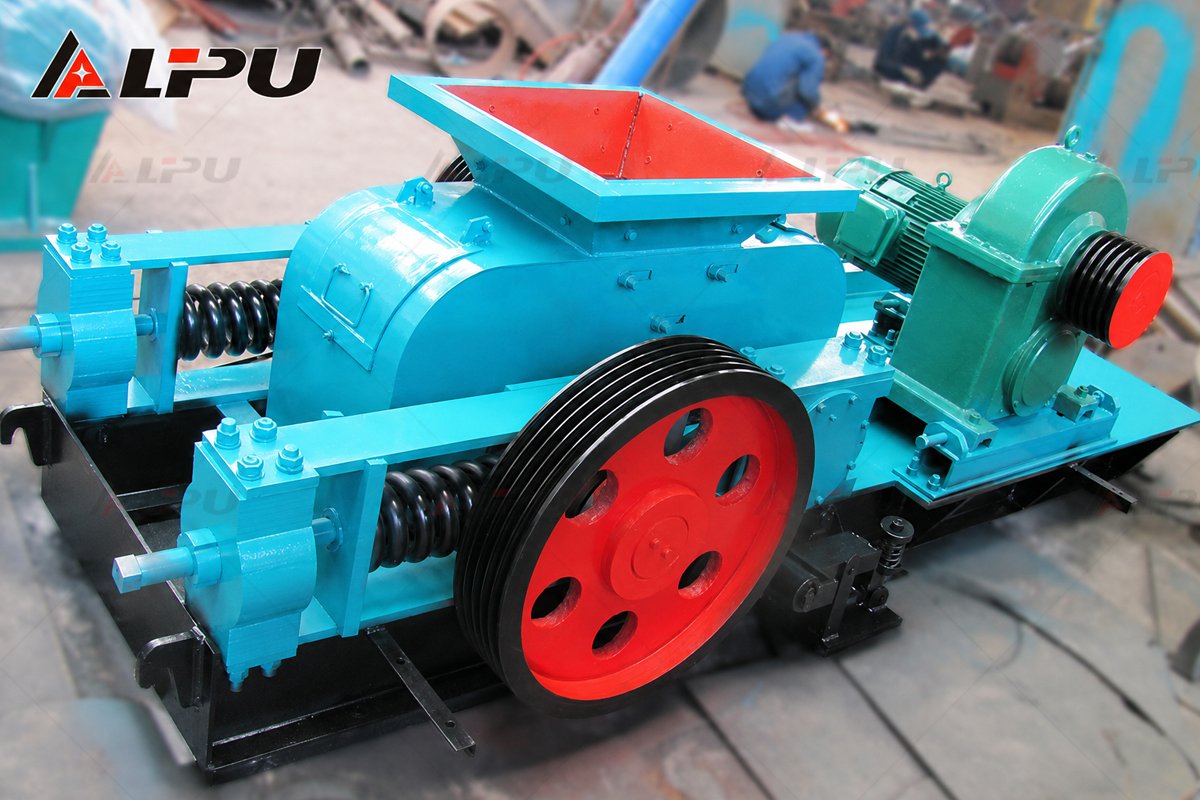
LIPU roll crushers are designed for controlled crushing of brittle and medium-hard materials through compression between two rotating rolls.
They are commonly used where relatively uniform product size, adjustable discharge and reduced over-crushing are important. Typical applications include limestone, coal, dolomite, clinker, coal gangue, river pebble and other suitable materials.
LIPU provides double roll, toothed roll and hydraulic roll crusher configurations for different feed characteristics and product size requirements.
A roll crusher reduces material by passing it between two counter-rotating rolls.
As the rolls rotate toward each other, material entering the crushing chamber is gripped, compressed and broken before passing through the adjustable gap between the rolls.
Compared with impact-based crushing, roll crushing is better suited to applications where:
Product size control is important
Excessive fines should be limited
Feed material is brittle or medium-hard
A compact crushing stage is required
Adjustable discharge size is needed
Roll crushers can be used for primary, secondary or fine crushing depending on roll diameter, tooth profile, feed size and gap setting.
Main Roll Crusher Types
Different roll surfaces and adjustment systems are used for different materials and crushing duties.
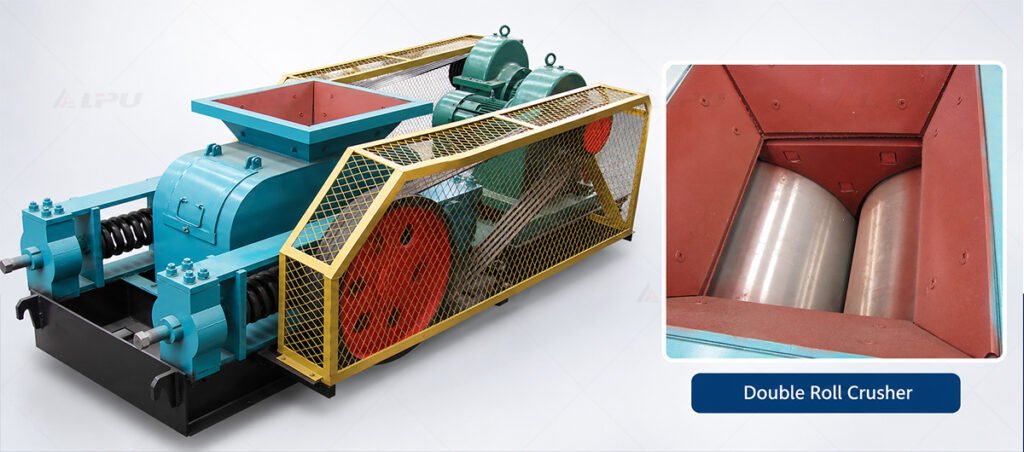
Double Roll Crusher
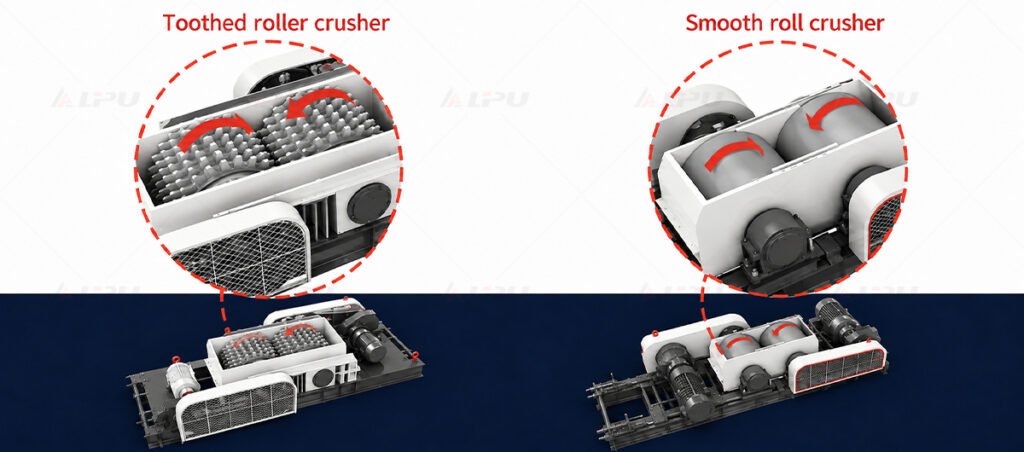
A double roll crusher uses two smooth or lightly profiled rolls rotating toward each other.
Double Roll Crusher
It is suitable for:
Limestone
Coal
Dolomite
Cement clinker
Coal gangue
Medium-hard brittle materials
The discharge size is mainly controlled by the gap between the two rolls.
Double roll crushers are commonly used where a relatively consistent product size is required.
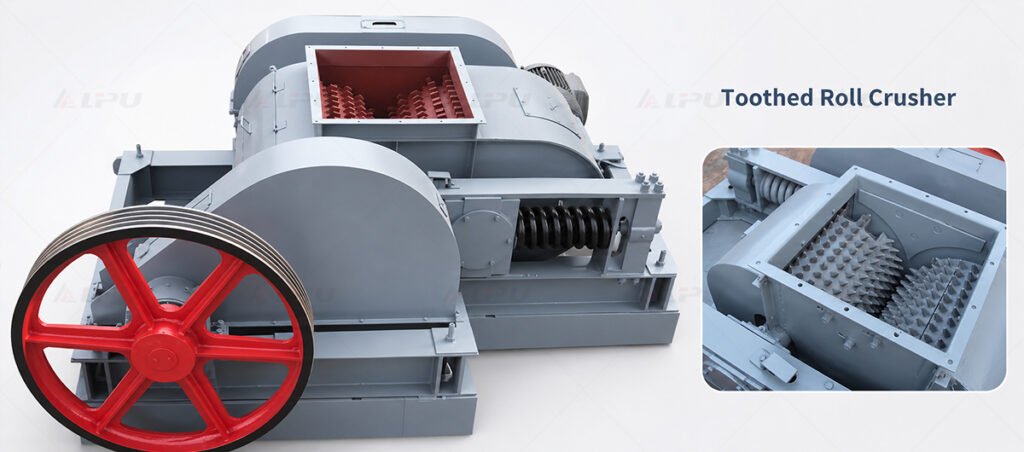
Toothed Roll Crusher
Toothed Roll Crusher
A toothed roll crusher uses rolls equipped with teeth or crushing segments.
The tooth profile improves material gripping and allows the crusher to handle larger or more irregular feed.
Typical applications include:
Coal
Coal gangue
Soft mineral rock
Brittle lump materials
Materials requiring stronger gripping action
The tooth shape and spacing should be selected according to feed characteristics and required discharge size.
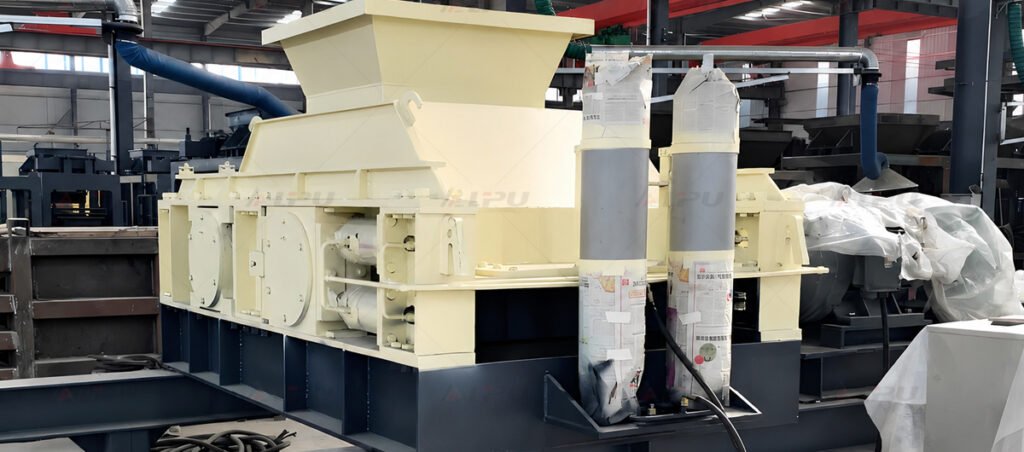
Hydraulic Roll Crusher
Hydraulic roll crusher in factory assembly
A hydraulic roll crusher uses a hydraulic adjustment or protection system to control the roll gap and respond to overload conditions.
Compared with a purely mechanical adjustment system, hydraulic control can simplify discharge adjustment and provide more flexible operating control.
It is suitable where:
Product size needs frequent adjustment
Stable roll gap control is important
Overload protection is required
Operating conditions change between different materials
The final configuration depends on crusher size and project requirements.
Materials and Applications
Roll crushers can process a wide range of brittle and medium-hard materials.
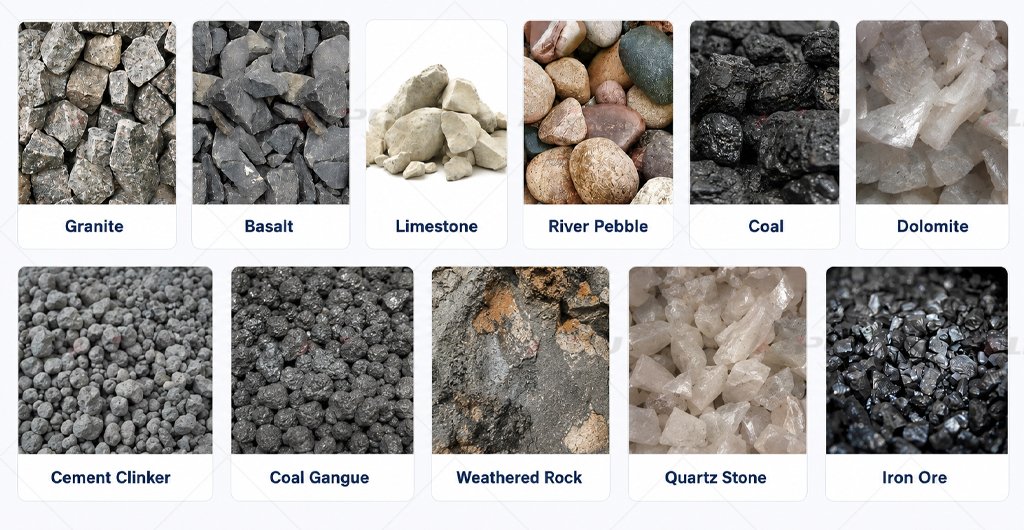
Materials suitable for roll crushers
Typical materials include:
Limestone
Coal
Dolomite
Cement clinker
Coal gangue
River pebble
Weathered rock
Quartz stone
Iron ore
Basalt
Granite
Other suitable medium-hard materials
Not every material is equally suitable for every roll crusher configuration.
For example:
Coal and coal gangue: toothed or double roll configurations are commonly used.
Limestone and clinker: smooth or double roll crushing can provide controlled product size.
River pebble and harder rock: crusher selection should consider abrasiveness, feed size and required capacity.
Iron ore and harder minerals: suitability depends on hardness, abrasiveness and the selected roll surface.
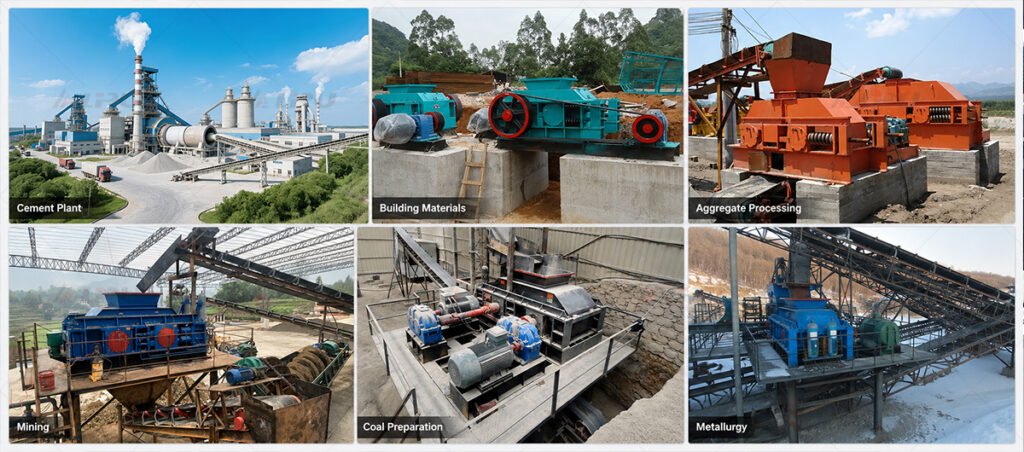
Typical applications include:
Typical application fields for roll crushers in industrial material processing
Cement plants
Coal preparation
Mining
Metallurgy
Chemical processing
Building materials
Refractory materials
Aggregate processing
For larger primary feed, a Jaw Crusher may be used upstream before the roll crusher.
How Does a Roll Crusher Work?
Material is fed into the space between two rotating rolls.
The rolls rotate inward and draw the material into the crushing zone.
Working principle of toothed and smooth roll crushers
The working process can be summarized as:
Material enters the feed opening.
The rotating rolls grip the material.
Compression force breaks the material.
Crushed material moves toward the roll gap.
Particles smaller than the set gap are discharged.
Larger particles remain in the crushing zone until reduced sufficiently.
The final product size is influenced by:
Roll gap
Roll diameter
Roll speed
Roll surface profile
Feed size
Material hardness
Material moisture
Feed distribution
Stable and even feeding helps improve product consistency.
Main Components
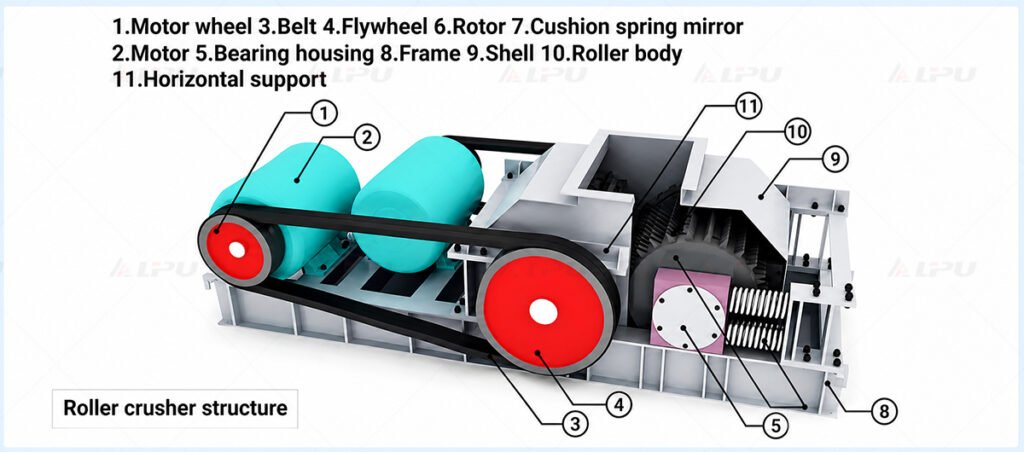
A typical roll crusher includes:
Main components and structural layout of a roll crusher
Main frame
Fixed roll
Movable roll
Roll shafts
Roll shells or toothed segments
Bearings
Drive motor
Reducer
Coupling
Belt or gear transmission
Gap adjustment mechanism
Spring or hydraulic protection system
Feed opening
Discharge opening
The exact structure varies between double roll, toothed roll and hydraulic roll crusher designs.
Roll Gap Adjustment and Product Size Control
Roll gap adjustment is one of the most important features of a roll crusher.
The distance between the two rolls determines the minimum passage size through the crushing chamber.
A smaller gap generally produces a finer product, while a larger gap allows coarser discharge.
However, the actual finished size also depends on:
Feed gradation
Material shape
Material hardness
Roll surface
Roll wear
Operating load
For stable product size, the roll gap should be checked regularly because wear on the roll surface can gradually change the effective discharge opening.
Hydraulic or mechanical adjustment systems can be used depending on the crusher configuration.
Roll Crusher Technical Parameters
2PG Series Double Roll Crusher
Model
Feed Size (mm)
Discharge Size (mm)
Capacity (t/h)
2PG400×250
<35
2–8
2–10
2PG400×400
<35
2–8
5–12
2PG610×400
<65
2–20
5–20
2PG750×500
<75
2–25
10–40
2PG800×600
<80
2–25
12–45
2PG1000×700
<100
3–30
20–65
2PG1200×800
<120
3–35
35–80
2PG1500×800
<130
3–45
50–120
2PG1600×1000
<150
3–50
60–140
Actual production capacity depends on material properties, feed distribution, roll gap and operating conditions.
For project selection, LIPU should confirm the complete parameter set including motor power, equipment weight and installation dimensions.
How to Select the Right Roll Crusher
A roll crusher should be selected according to material characteristics and the required final product rather than capacity alone.
Important project information includes:
Material type
Material hardness
Material abrasiveness
Maximum feed size
Required discharge size
Required capacity
Moisture content
Percentage of fines in the feed
Required product shape
Continuous or intermittent operation
For Fine Product Size Control
A smaller roll gap and suitable smooth-roll configuration may be preferred.
For Larger Lump Material
A toothed roll crusher can provide better gripping performance.
For Frequent Product Size Adjustment
A hydraulic adjustment system can provide more convenient roll gap control.
For Abrasive Materials
Roll surface wear should be considered carefully because wear can affect both operating cost and discharge size stability.
The final selection should balance capacity, wear resistance, feed size and product size requirements.
Why Choose LIPU?
LIPU Heavy Industry provides crushing, screening and mineral processing equipment for mining, aggregate, cement and industrial material processing projects.
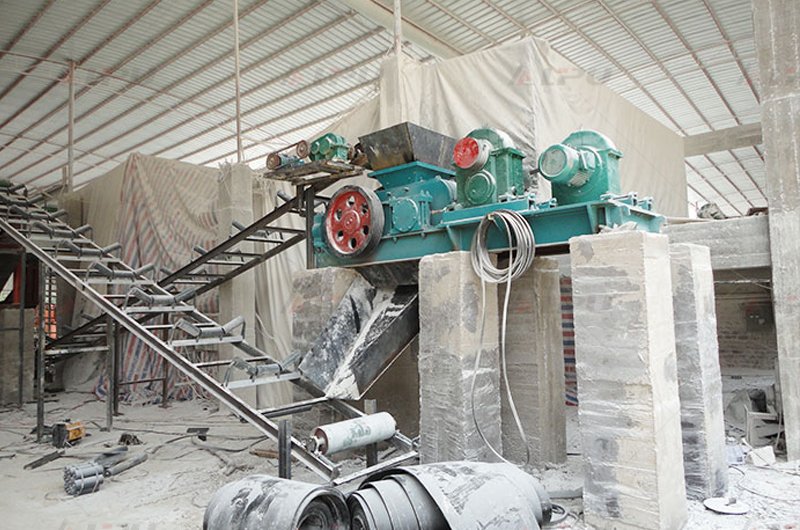
Double roll crusher used for limestone processing
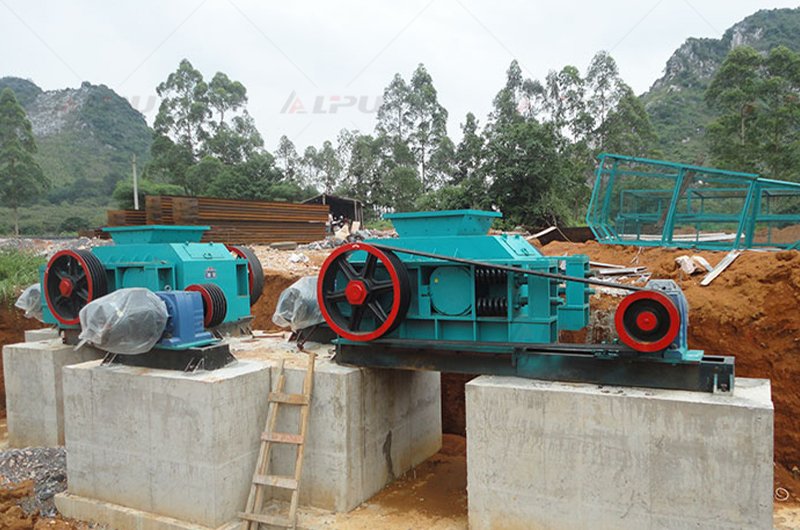
Double roll crusher operating at an outdoor mining site
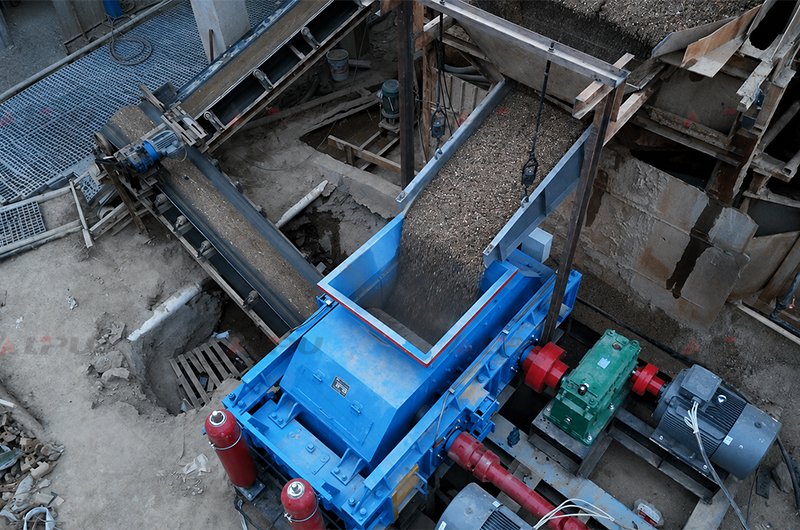
Double roll crusher processing coal gangue at a customer site
For roll crusher projects, LIPU can assist with:
Material analysis
Crusher type selection
Roll surface selection
Capacity matching
Roll gap configuration
Equipment manufacturing
Factory testing
Installation guidance
Commissioning support
Wear parts supply
Spare parts supply
After-sales technical support
Roll crushers can also be integrated with feeders, conveyors, screens and other crushing equipment to form a complete material processing system.
Frequently Asked Questions
What materials are suitable for a roll crusher?
Roll crushers are mainly suitable for brittle and medium-hard materials such as limestone, coal, dolomite, clinker and coal gangue. Suitability for harder and more abrasive materials depends on the specific roll crusher design.
What controls the discharge size of a roll crusher?
The main factor is the gap between the two rolls. Roll surface profile, feed size, material hardness and roll wear also affect the final product size.
What is the difference between a smooth roll crusher and a toothed roll crusher?
A smooth roll crusher mainly uses compression and is suitable for controlled crushing of brittle materials. A toothed roll crusher provides stronger gripping action and can handle larger or more irregular feed.
Can a roll crusher produce fine material?
Yes. Fine discharge can be achieved by reducing the roll gap, but the practical product size depends on crusher model, material properties and roll surface condition.
What information is needed to select a roll crusher?
Provide the material type, maximum feed size, required capacity, target discharge size, hardness, abrasiveness and moisture condition. These factors determine the roll diameter, roll surface and crusher configuration.
LET US REACH YOUNeed detailed customization and latest price? Chat online or leave message below!
How we use cookies
This Cookie Privacy Policy statement explains how Zoneding Machine (hereinafter referred to as "we", "our", or "this website") uses cookies and similar technologies (collectively referred to as "cookies") to identify you when you visit our website lepuu.com. It explains what these technologies are, why we use them, and your rights to control our use of them.
Privacy Policy
Leave a Message
We will reply to you within 24 hours
Hello, I am Lipu Heavy Industry, what can we do for you please?