A mineral processing flowsheet should reflect how an ore actually responds to processing rather than follow a standard sequence of machines.
Ore mineralogy, liberation behavior, grinding response, separation performance, and product characteristics all influence the circuit. Even deposits containing the same valuable mineral may require different processing routes because their mineral associations and metallurgical responses differ.
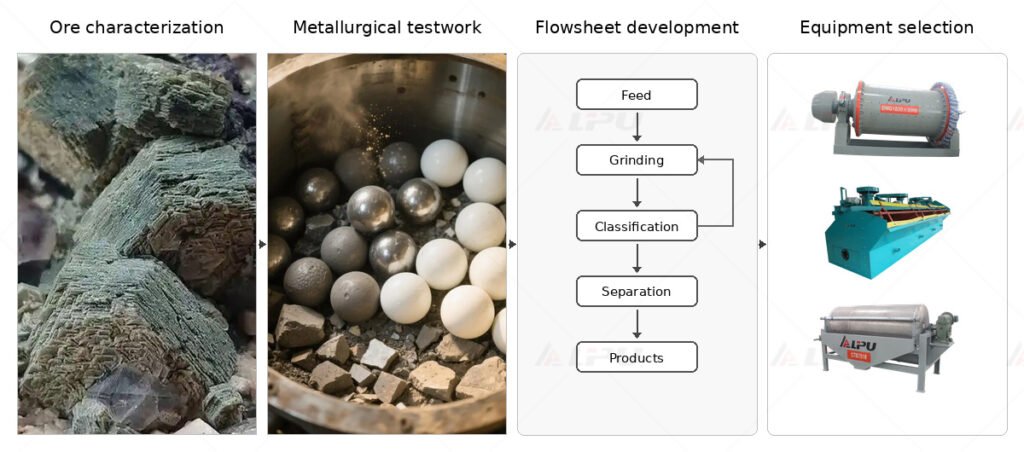
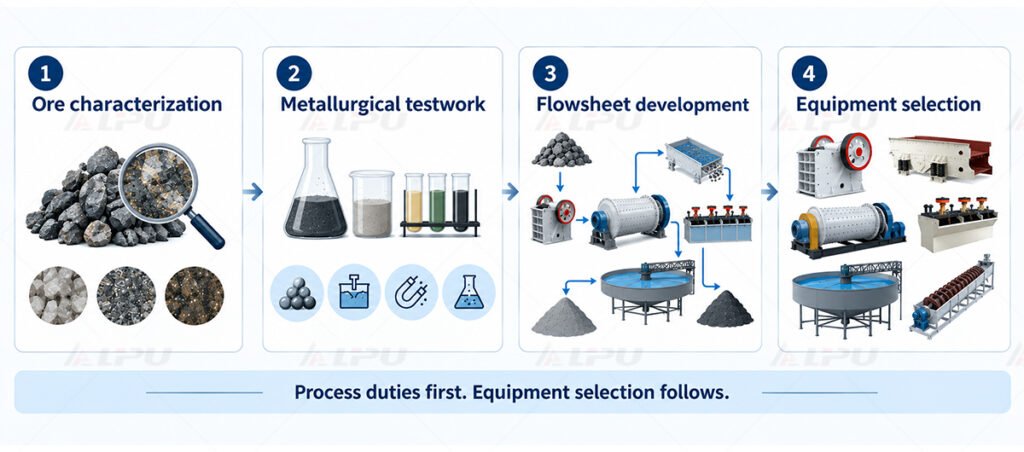
For this reason, flowsheet development usually follows a clear engineering logic:
The objective is not to create the most complicated circuit. It is to identify the processing stages, stream relationships, and equipment duties needed to treat the ore effectively.
A mineral processing flowsheet describes how ore and process streams move through a plant.
It identifies the main unit operations and, more importantly, the relationships between them. Depending on the ore, these operations may include crushing, grinding, classification, gravity separation, magnetic separation, flotation, thickening, filtration, and other stages.
A useful flowsheet should answer several practical questions:
What preparation is required before separation?
At what condition are valuable minerals sufficiently liberated?
Which streams become final products or tailings?
Does an intermediate product require further treatment?
Which material should return to an earlier stage?
How does one operation affect the next?
This makes the flowsheet more than an equipment arrangement. It becomes a process model showing how material conditions change as the ore moves through the circuit.
Complexity should only be added when the ore response justifies it. A simple circuit supported by testwork is generally preferable to unnecessary stages that increase operating and control requirements.
What Information Is Used to Develop the Flowsheet?
Flowsheet development starts with reliable information about the ore.
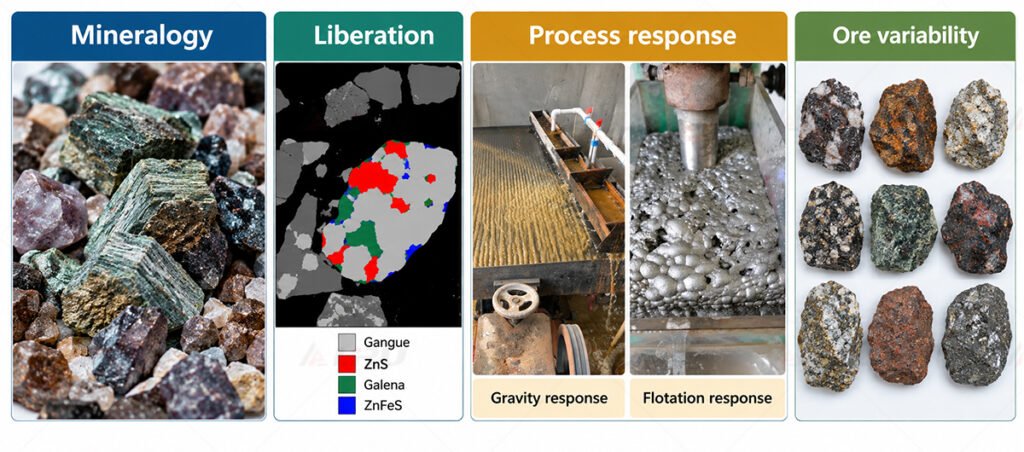
Mineralogy identifies the valuable and gangue minerals present. Texture and mineral associations indicate how those minerals occur together, while liberation studies show how their associations change with particle size.
This relationship between mineral liberation and mineral processing is especially important. Separation performance cannot be considered independently from the particles entering the process.
Metallurgical testwork then shows how the ore responds under controlled processing conditions.
Key ore data used for flowsheet development
Information
Main flowsheet question
Mineral composition
Which separation principles may be applicable?
Mineral association
How difficult may liberation be?
Breakage behavior
What grinding strategy should be investigated?
Liberation by size
Where may additional grinding be useful?
Separation response
Which process route deserves further evaluation?
Product characteristics
Does an intermediate stream need further treatment?
Solid-liquid behavior
How should products and tailings be handled?
Ore variability
Can the circuit accommodate changing feed?
No single result should determine the entire flowsheet.
For example, magnetic response may indicate that magnetic separation deserves further investigation, but engineers must still consider liberation, particle size, gangue behavior, and resulting product quality.
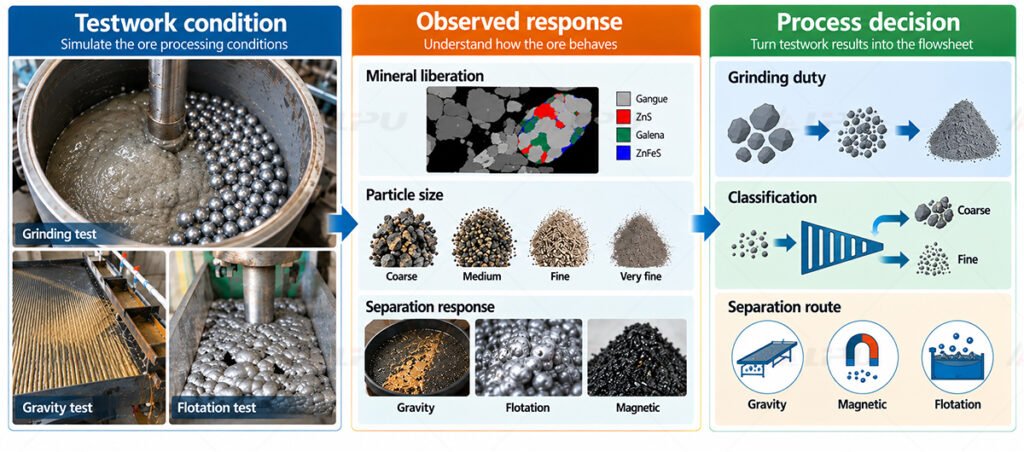
How Are Testwork Results Converted into Process Decisions?
Laboratory results become useful to plant design only when they can be translated into process decisions.
Turning testwork results into process decisions
Grinding tests provide a good example. Better separation after additional grinding does not automatically mean the entire feed should be ground finer.
Engineers need to determine which particles require further size reduction, whether classification can isolate them, and whether additional grinding creates excessive fines or other undesirable effects.
Separation testwork requires similar interpretation.
A positive gravity response may apply mainly to a particular size fraction or mineral association. Magnetic separation may be useful at one stage of a circuit, while another fraction responds differently. Flotation performance can also change as liberation, particle size, and feed characteristics change.
The key question is therefore not simply which laboratory test produced the strongest result.
Instead, engineers evaluate where that response can be used effectively within the complete circuit.
This is the main transition from metallurgical testwork to actual flowsheet development: test results become decisions about process sequence, stream routing, and treatment requirements.
How Do Grinding, Classification and Separation Work as a Circuit?
Grinding is closely connected to both classification and downstream separation.
Its purpose is not simply to reduce particle size. Grinding changes mineral exposure and determines the particle population presented to the next stage.
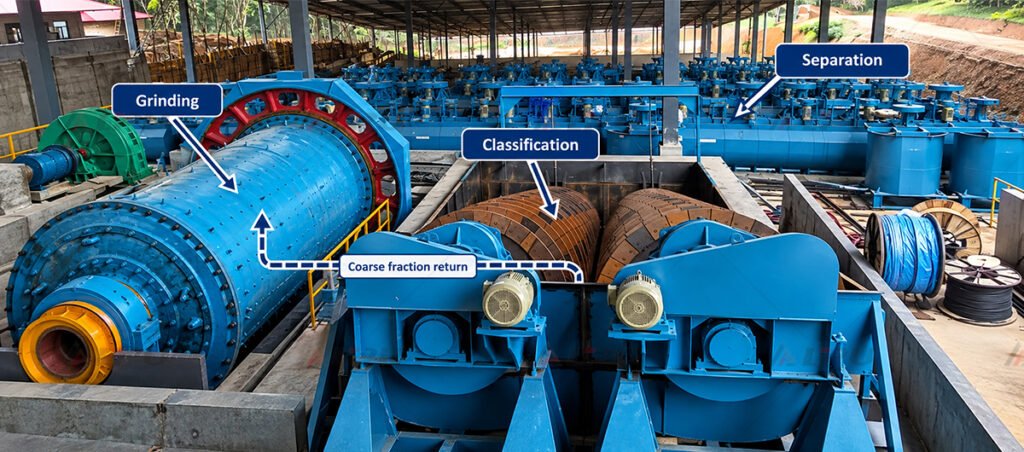
Classification controls which particles leave the grinding circuit and which require further size reduction. In a typical closed-circuit concept:
Grinding, classification and separation as one circuit
Grinding → Classification → Separation, while material that does not meet the required condition may return for further grinding.
The appropriate operating condition depends on mineral liberation and the requirements of downstream separation. Producing the finest possible material is therefore not the objective.
Instead, grinding and classification should prepare a suitable feed for the next process.
Circuit interaction also matters when evaluating equipment.
A ball mill can perform correctly as an individual machine while poor classification still limits the overall grinding circuit. Likewise, downstream separation equipment cannot fully compensate for unsuitable feed preparation.
The same principle applies to flotation equipment and magnetic separation. Their performance depends partly on the condition of the material produced by upstream stages.
Flowsheet development therefore focuses on the interfaces between operations, not only the performance of individual machines.
Why Do Intermediate Products and Recycle Streams Matter?
Mineral processing circuits are not always linear.
A separation stage may produce concentrate and tailings together with an intermediate stream that does not yet meet either final product or rejection criteria.
Middlings are a common example. They may contain partially liberated valuable minerals associated with gangue.
Sending such material directly to concentrate could reduce product quality. Discarding it with tailings could lose potentially recoverable valuable minerals. When testwork supports further treatment, the middlings may instead undergo additional liberation and another separation stage.
Recycle streams can also appear in grinding, classification, cleaning, scavenging, or staged separation circuits.
However, recirculation should always have a defined process purpose.
Returning material increases the load on another part of the circuit and can change particle-size distribution, residence time, and equipment duty. More recycle does not automatically mean better recovery or better plant performance.
The engineering question is therefore straightforward: what characteristic of this stream justifies further treatment?
Insufficient liberation, incomplete separation, or product-quality requirements may provide that justification. Without a clear metallurgical reason, additional loops can increase circuit complexity without solving the underlying processing problem.
How Is a Proposed Flowsheet Evaluated and Refined?
An initial flowsheet is a working hypothesis rather than a finished plant design.
Early testwork may identify a promising processing route, but engineers still need to examine how individual stages interact.
Typical questions include whether additional grinding provides useful liberation, whether classification improves downstream feed conditions, and whether an intermediate stream should be recycled or treated separately.
Engineers may also evaluate whether a cleaning stage produces a meaningful improvement, whether a process step is positioned correctly, and how changes in ore characteristics affect the proposed circuit.
As confidence develops, testing can progress from isolated laboratory observations toward more integrated circuit evaluation where appropriate.
This matters because changes in one stage can influence several others.
Different grinding conditions alter the feed entering classification. Classification changes the material presented to separation. Separation may create an intermediate stream that returns to another part of the circuit.
Flowsheet refinement is therefore about understanding these interactions and removing unnecessary complexity while preserving the stages that have a clear process function.
The result should be a stronger design basis for defining equipment duties.
When Should Equipment Selection Begin?
Equipment knowledge is useful throughout process development, but final equipment selection should follow a sufficiently defined flowsheet.
During early studies, engineers may already know that the process requires functions such as grinding, classification, flotation, magnetic separation, or dewatering. That does not yet define the final machine configuration.
Each process duty must first be understood.
Equipment selection follows flowsheet development
Important considerations can include feed characteristics, throughput requirements, required product condition, circulating streams, slurry conditions, separation objectives, and the flexibility needed to handle ore variability.
Once these duties are clearer, equipment can be matched to the circuit more reliably.
The ore provides the starting conditions. Testwork establishes process response. Flowsheet development defines how those responses should be connected. Equipment selection then provides the machines needed to perform those duties.
In other words, the equipment list should be an outcome of process development rather than the starting point of plant design.
Frequently Asked Questions
Can the same mineral processing flowsheet be used for two deposits of the same ore type?
Not necessarily. Deposits can differ in mineralogy, texture, liberation behavior, gangue composition, hardness, and metallurgical response. These differences may require changes to grinding, classification, separation, or intermediate treatment.
Does every successful laboratory test need to appear in the final flowsheet?
No. A test demonstrates a process response under specific conditions. A stage should be included only when it contributes meaningfully to the overall processing objective and works logically with the rest of the circuit.
Why are middlings sometimes reground?
Middlings may contain partially liberated valuable minerals. Additional grinding can sometimes improve liberation before another separation stage, but the decision should be supported by mineralogical and metallurgical evidence.
Can equipment be selected before the flowsheet is finalized?
Preliminary equipment types can be considered during process development. Detailed selection and sizing require clearer process duties, including feed conditions, throughput, circulating streams, product requirements, and downstream operating conditions.
When is a flowsheet ready for detailed equipment design?
A flowsheet can support detailed equipment design when its principal process route, material streams, separation stages, recycle logic, and major operating duties are supported by sufficient testwork and engineering evaluation. The required level of confidence depends on the project stage and complexity.
Conclusion
Mineral processing flowsheet development converts knowledge about an ore into a practical processing strategy.
Ore characterization establishes what the material contains and how its minerals occur. Liberation studies and metallurgical testwork reveal how the material changes during preparation and how it responds to different separation methods.
The flowsheet connects those findings into a circuit.
It determines where size reduction is required, how classification controls material movement, which separation stages are justified, and whether intermediate products need further treatment.
Equipment selection follows once these process duties are sufficiently understood.
A strong flowsheet is therefore not defined by the number of machines or stages it contains. Its value comes from how well the circuit reflects the characteristics and tested processing behavior of the ore.
This Cookie Privacy Policy statement explains how Zoneding Machine (hereinafter referred to as "we", "our", or "this website") uses cookies and similar technologies (collectively referred to as "cookies") to identify you when you visit our website lepuu.com. It explains what these technologies are, why we use them, and your rights to control our use of them.
Privacy Policy
Leave a Message
We will reply to you within 24 hours
Hello, I am Lipu Heavy Industry, what can we do for you please?


We will reply to you within 24 hours