A mineral separation strategy should begin with the properties of the ore, not with a preferred machine.
After crushing and grinding, valuable minerals still need a physical or physicochemical basis for separation from gangue. In some ores, density provides that basis. In others, magnetic susceptibility or mineral surface behavior creates the useful contrast.
The challenge is that these properties do not act independently. Mineral liberation, particle size, gangue associations and ore variability can determine whether a theoretically suitable separation method actually performs well.
For this reason, mineral processing engineers normally move from ore characterization and liberation to separation testwork, circuit development and finally equipment selection.
Understanding that sequence helps explain why two ores containing the same valuable mineral may require very different beneficiation circuits.
What Does a Mineral Separation Strategy Need to Achieve?
Mineral separation is not simply the stage where a concentrator, magnetic separator or flotation machine is installed.
The real objective is to create a controlled difference in behavior between valuable minerals and unwanted material. That difference must be large enough to produce useful separation under practical operating conditions.
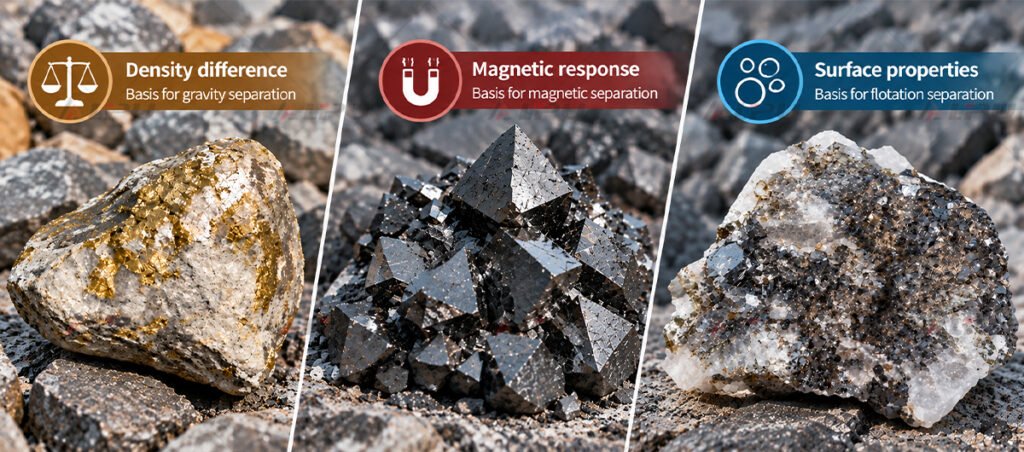
Three important mechanisms are commonly involved:
Mineral property
Separation principle
Typical process
Density difference
Particles respond differently to gravity and fluid motion
Gravity separation
Magnetic susceptibility
Minerals respond differently to a magnetic field
Magnetic separation
Surface properties
Minerals interact differently with water, reagents and air bubbles
Flotation
This table is only a starting point. It does not mean every dense mineral should use gravity concentration or every magnetic mineral should immediately enter a magnetic separator.
The mineral must first be sufficiently liberated. Particle size must also suit the separation mechanism, while associated gangue minerals can change the process response.
That is why ore characteristics should be evaluated before individual equipment is selected.
Which Ore Properties Control Separation Behavior?
Mineralogy identifies what minerals are present, but separation strategy depends on how those minerals occur and how differently they behave.
Several properties deserve particular attention:
Mineral association determines whether the valuable phase occurs as liberated particles or remains locked with gangue.
Liberation behavior indicates how much size reduction may be required before a useful property difference can be exploited.
Particle size affects the movement and response of particles in gravity, magnetic and flotation systems.
Density contrast can provide a basis for gravity concentration when valuable and gangue minerals respond differently under gravitational or centrifugal forces.
Magnetic susceptibility determines whether a magnetic field can create a useful difference in particle behavior.
Surface behavior becomes important when selective attachment to air bubbles can be created or enhanced during flotation.
Ore variability can change mineral associations, gangue proportions and liberation characteristics across different zones of the same deposit.
These properties are interconnected.
For example, a mineral may have a favorable density difference from the gangue, but that advantage may be difficult to exploit while the mineral remains locked inside composite particles.
Likewise, a magnetic mineral may respond strongly in a laboratory test but require different preparation when the feed contains excessive fines or complex intergrowths.
A separation strategy should therefore describe more than the nominal ore type. It should explain which mineral property is being exploited, at what process stage and under what feed conditions.
When Can Density Differences Be Used for Separation?
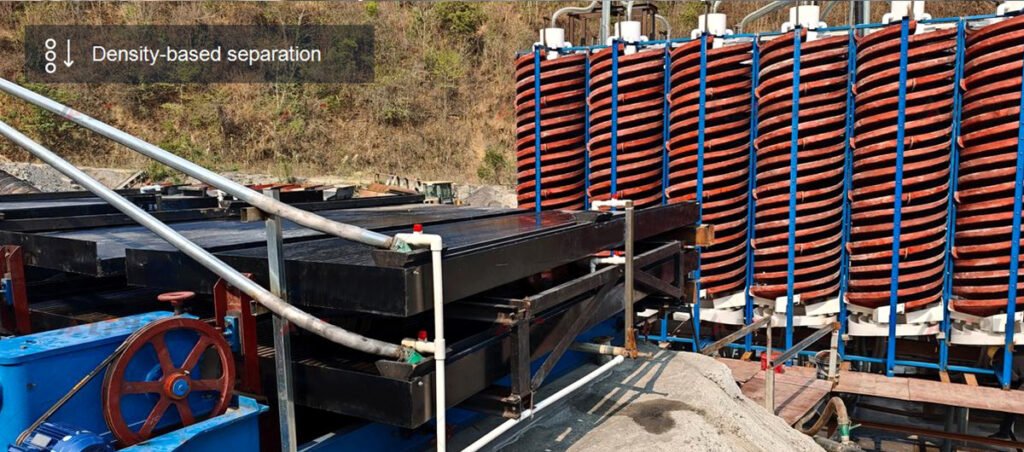
Gravity concentration exploits differences in particle behavior caused largely by density, particle size and fluid conditions.
Density differences can provide a basis for gravity separation
When sufficiently liberated valuable minerals are noticeably denser than the surrounding gangue, gravity separation may provide an effective concentration step.
The principle sounds simple, but mineral liberation remains essential.
A dense valuable mineral locked inside a lighter gangue particle does not behave like a fully liberated grain. Composite particles may report to middlings rather than forming a clean concentrate.
Particle size also changes gravity response. Coarse and fine particles do not settle or stratify in exactly the same way. Classification and feed preparation can therefore become important before gravity concentration.
Equipment such as a shaking table can be used to separate suitable mineral particles according to differences in their behavior on the deck.
Gravity concentration can serve different duties within a flowsheet.
Depending on the ore, it may be used for pre-concentration, recovery of liberated heavy minerals, concentrate cleaning or treatment of an intermediate stream.
The decision should therefore come from test response and circuit requirements rather than from the presence of a density difference alone.
When Does Magnetic Response Become the Main Separation Mechanism?
Some mineral systems provide a more useful contrast in magnetic susceptibility than in density or surface behavior.
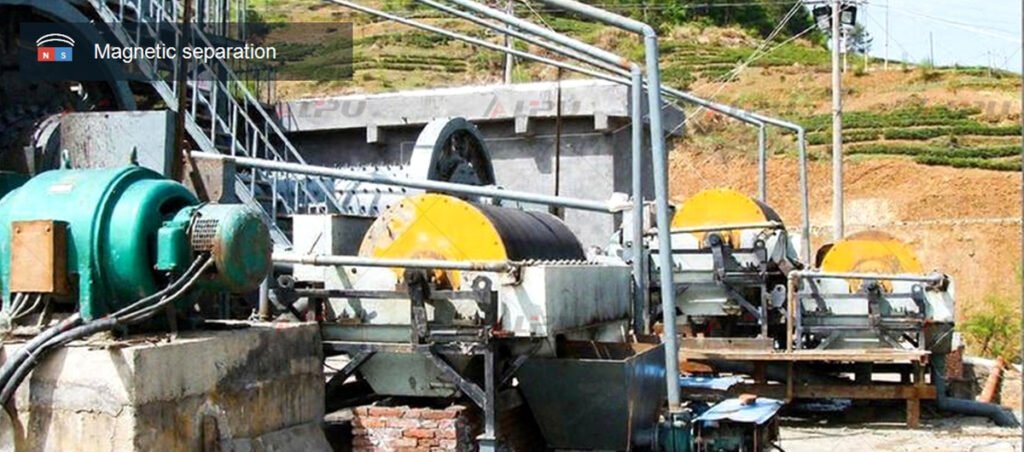
A magnetic field can then separate particles that respond differently to that field.
Magnetic response can define a selective separation route
The important engineering question is not simply whether the ore contains a magnetic mineral. Engineers also need to understand:
which mineral phases respond magnetically;
how strongly they respond;
whether those phases are sufficiently liberated;
the particle-size distribution entering separation;
whether wet or dry processing is more appropriate;
and what duty the magnetic stage must perform.
For example, a magnetic stage may be intended to recover a valuable magnetic mineral. In another circuit, its purpose may instead be to remove magnetic impurities before another separation process.
A magnetic separator should therefore be matched to the mineral response and process duty rather than selected from capacity alone.
Magnetic separation can also form only one part of a longer beneficiation route.
A magnetic product, non-magnetic product or intermediate stream may require further treatment when the first stage does not achieve the required selectivity.
This is another reason to evaluate magnetic separation as part of the complete circuit rather than as an isolated equipment decision.
When Are Surface Properties More Important Than Density or Magnetism?
Not every valuable mineral provides enough density or magnetic contrast for practical separation.
In these cases, differences in mineral surface behavior may offer a better route.
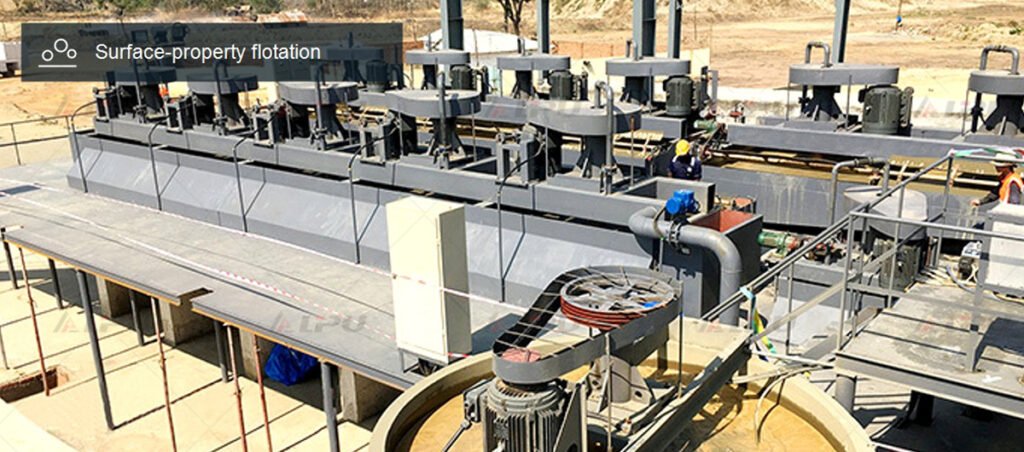
Flotation uses controlled surface chemistry to make selected particles more likely to attach to air bubbles. Those particles rise with the bubbles into a froth phase, while other material follows a different path through the circuit.
Flotation exploits differences in mineral surface behavior
This makes flotation especially dependent on what happens before the slurry reaches the flotation cells.
Grinding must expose enough of the target mineral surface. Classification should provide suitable feed conditions. Slurry chemistry and reagent conditions then influence whether the desired selectivity can be developed.
Consequently, finer grinding is not automatically better.
Insufficient grinding may leave valuable minerals locked. Excessive grinding can create unnecessary fines and change downstream separation behavior.
The appropriate target therefore depends on liberation and the requirements of the separation stage, as discussed in LIPU’s guide to determining the right grinding fineness.
A flotation machine provides the environment needed for slurry suspension, air dispersion and mineralized froth formation. However, the machine itself does not determine whether the ore is suitable for flotation.
Ore properties, liberation and metallurgical response remain fundamental.
Why Do Some Ores Need More Than One Separation Method?
Complex ores rarely behave as if every valuable particle has the same size, mineral association and physical properties.
One fraction may respond well to gravity concentration while another requires flotation. Magnetic separation may remove or recover a magnetic component before another stream continues to a different process.
The result can be a staged separation strategy rather than a single separation machine.
Intermediate products are particularly important.
A middlings stream may contain partially liberated valuable minerals. Sending it directly to concentrate could reduce product quality, while sending it directly to tailings could discard potentially recoverable material.
Further grinding or another separation stage may be more appropriate.
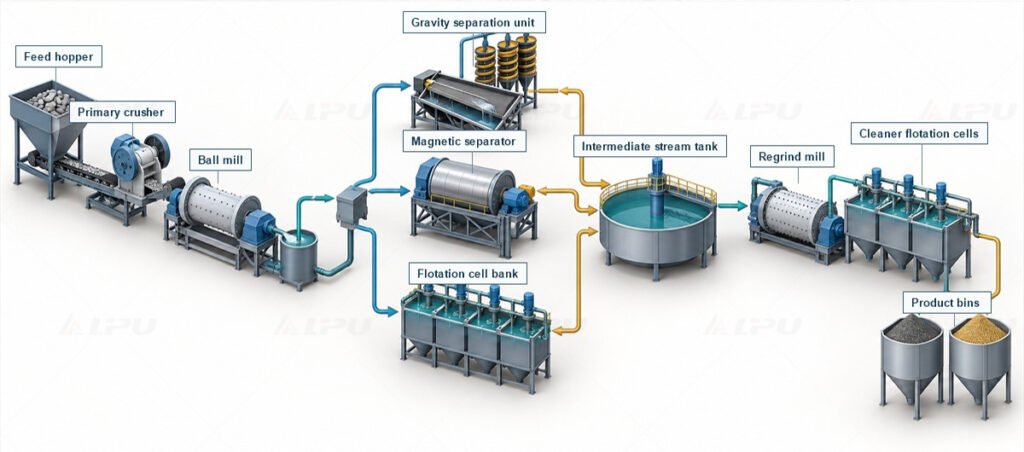
Combined processing should therefore not be interpreted as simply installing gravity, magnetic and flotation equipment in sequence. Each stage needs a defined process duty.
Complex ores may require coordinated separation stages
Depending on metallurgical test results, a circuit may include:
an early stage that removes easily separated material;
a main separation stage for the dominant valuable mineral;
treatment of middlings where additional liberation is justified;
cleaning stages where concentrate quality requires improvement;
scavenging where recoverable mineral remains in a downstream stream.
The actual combination depends on the ore.
This circuit-level view prevents a common mistake: evaluating every separator as an independent machine rather than as part of a connected mineral processing system.
How Do Liberation and Particle Size Change the Separation Strategy?
A mineral may possess a useful separation property and still respond poorly if it remains locked with gangue.
That makes liberation the connection between grinding and separation.
Consider a particle containing both valuable mineral and waste material. Its apparent density, magnetic response or exposed surface may differ significantly from that of a liberated valuable mineral grain.
Further grinding may improve separation if it releases those phases.
However, grinding should have a specific purpose. Once adequate liberation has been achieved, further size reduction can increase energy consumption and may create particles that behave differently in the downstream process.
The practical sequence is therefore not simply:
Grind as fine as possible → Choose a separator
A more useful engineering sequence is:
Determine liberation requirement → Establish suitable particle-size conditions → Test separation response → Define the circuit
Classification becomes important within this relationship because it helps control which particles proceed downstream and which may require additional grinding.
The optimum condition is ore-specific.
A target established for one deposit should not automatically be applied to another deposit simply because both contain the same valuable mineral.
Understanding mineral liberation is therefore essential before deciding how a separation stage should operate.
How Is the Separation Strategy Confirmed Before Equipment Selection?
Ore characterization can identify promising separation mechanisms, but metallurgical testwork is needed to determine how the material actually responds.
A useful test program should answer process questions rather than merely demonstrate that separation is possible.
Engineers may need to determine:
whether sufficient liberation has been achieved;
how different particle-size fractions respond;
whether useful separation selectivity can be established;
what happens to intermediate products;
whether regrinding changes the response;
and whether another separation stage improves the overall circuit.
Results from these tests can then be translated into process duties.
Only after those duties are understood should final equipment configuration begin.
For example, the process may establish the need for controlled gravity concentration of a classified fraction, wet magnetic recovery from a slurry stream, flotation followed by cleaning, or regrinding of an intermediate product.
In other cases, staged treatment using more than one separation mechanism may be justified.
Equipment selection then becomes much more specific.
Instead of asking only for a separator with sufficient throughput, the engineer can evaluate the machine against the required feed condition, separation duty, circuit position and product objective.
Ultimately, the separation strategy belongs inside the complete flowsheet. Grinding, classification, separation, intermediate streams and product handling must work as one circuit.
Frequently Asked Questions
Can one ore require gravity, magnetic separation and flotation?
Yes. A complex ore can contain several mineral phases that respond to different separation mechanisms. However, these methods should only be combined where testwork establishes a useful duty for each stage. They should not be added simply because several methods are technically available.
Does finer grinding always improve mineral separation?
No. Additional grinding can improve separation when valuable minerals remain insufficiently liberated, but unnecessary overgrinding may create excessive fines and increase energy demand. The grinding target should be linked to liberation and downstream separation response.
Can mineralogy alone determine the separation method?
No. Mineralogy provides essential information, but liberation, particle size, density differences, magnetic response, surface behavior and metallurgical test results also influence the final separation strategy.
Why can two ores containing the same valuable mineral need different circuits?
The mineral may occur with different gangue minerals, textures, grain sizes or associations. These differences can change liberation behavior and separation response even when the principal valuable mineral is the same.
When should separation equipment be selected?
Preliminary equipment options can be considered during process development, but final selection should follow confirmation of the process duty. Feed characteristics, testwork response, capacity, circuit position and required product all influence the appropriate equipment configuration.
From Ore Properties to a Practical Separation Circuit
A reliable mineral separation strategy is built around selectivity.
Density differences may support gravity concentration. Magnetic susceptibility can provide the basis for magnetic separation. Surface behavior may make flotation suitable. Complex ores can require several of these mechanisms at different stages.
None of them should be considered independently of mineral liberation, particle size and ore variability.
The engineering sequence can be summarized as:
Understand the ore → Establish liberation → Test separation response → Define the circuit → Select equipment
Following this sequence keeps equipment selection tied to the actual behavior of the ore.
More importantly, it helps engineers build a mineral processing circuit in which each stage has a defined purpose instead of assembling individual machines first and trying to connect them afterward.
For mineral processing projects involving grinding, classification, gravity concentration, magnetic separation or flotation, LIPU Heavy Industry can evaluate available ore information and process requirements before the final equipment configuration is determined.
This Cookie Privacy Policy statement explains how Zoneding Machine (hereinafter referred to as "we", "our", or "this website") uses cookies and similar technologies (collectively referred to as "cookies") to identify you when you visit our website lepuu.com. It explains what these technologies are, why we use them, and your rights to control our use of them.
Privacy Policy
Leave a Message
We will reply to you within 24 hours
Hello, I am Lipu Heavy Industry, what can we do for you please?


We will reply to you within 24 hours