Flotation performance begins before slurry enters the flotation cell.
The grinding and classification circuit determines the particle population delivered to flotation. Those particles can differ in size, liberation state, mineral association, shape and surface condition, even when the nominal grinding target appears similar.
This is why grinding should not be evaluated only by how fine the product becomes. Its real purpose is to prepare particles that the downstream separation process can treat effectively.
A useful engineering question is therefore not simply, “Is the ore fine enough?”
It is:
Has grinding and classification produced a suitable particle population for flotation?
Why Does Flotation Performance Begin Before the Flotation Cell?
A flotation machine separates particles according to differences in their surface behavior. However, the machine can only treat the particles supplied by the upstream circuit.
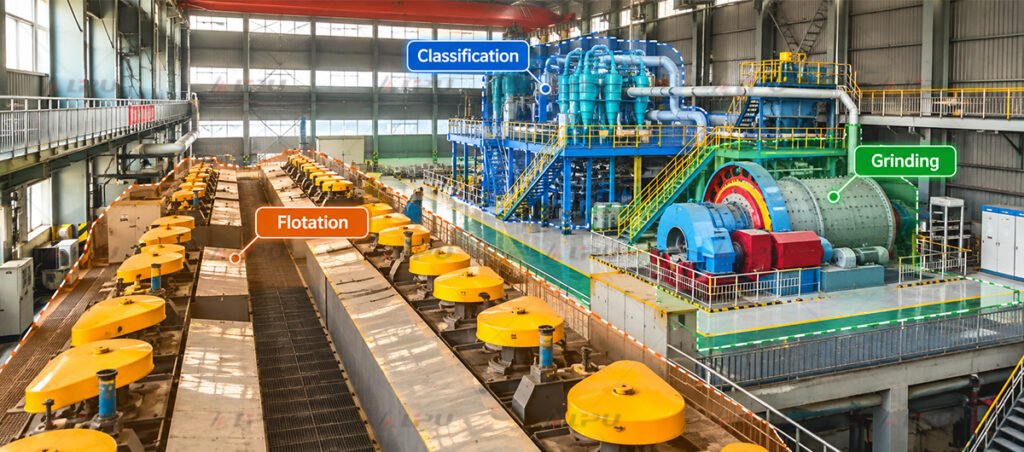
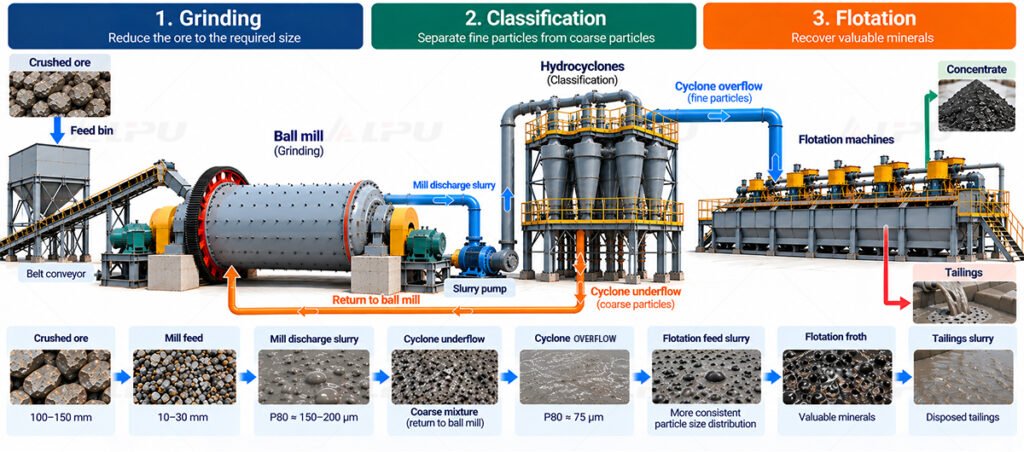
Before flotation begins, crushing, grinding and classification have already changed the ore substantially. A ball mill reduces particle size and promotes mineral liberation, while classification controls which particles move forward and which require additional grinding.
As a result, flotation feed may contain liberated valuable minerals, locked composite particles, gangue, fine particles and slimes in different proportions.
Changing this particle population can change flotation behavior even when the flotation equipment itself remains unchanged.
For this reason, poor flotation performance should not automatically be treated as a flotation-machine problem. The investigation may need to extend upstream to ore mineralogy, grinding conditions, liberation and classification.
Engineer Note: Flotation equipment cannot fully compensate for a grinding product that does not provide suitable liberation or particle conditions.
How Does Mineral Liberation Affect Flotation Feed?
Mineral liberation connects comminution with separation.
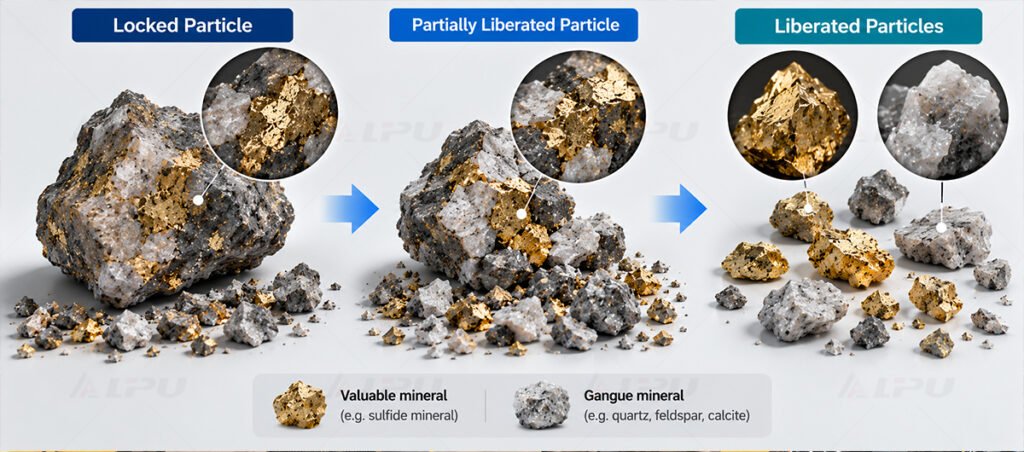
Valuable minerals often occur together with gangue inside the original ore. Grinding progressively breaks these mineral associations and creates particles with different degrees of liberation.
The objective is not to break every particle into the smallest possible size. Instead, grinding should develop enough useful liberation for the selected separation process.
Flotation feed can contain particles with very different liberation states
Locked particles can limit selective separation
A coarse particle may still contain both valuable mineral and gangue.
Such composite particles do not behave like completely liberated mineral grains. Their response depends on which minerals are exposed at the particle surface, how strongly they remain associated and how the flotation system interacts with that surface.
Consequently, insufficient liberation can restrict separation even when the overall particle size appears acceptable.
This is why mineral liberation should be examined together with particle size rather than inferred from fineness alone.
More liberation does not always justify more grinding
Additional grinding may expose more valuable mineral, but it also changes the rest of the particle population.
Material that was already sufficiently liberated may continue to break. The proportion of very fine particles may increase, while grinding energy and circulating duty can also rise.
The engineering target is therefore useful liberation, not maximum size reduction.
Why Does Particle Size Distribution Matter More Than One P80 Value?
P80 is useful for describing a grinding product, but it does not describe the complete particle population.
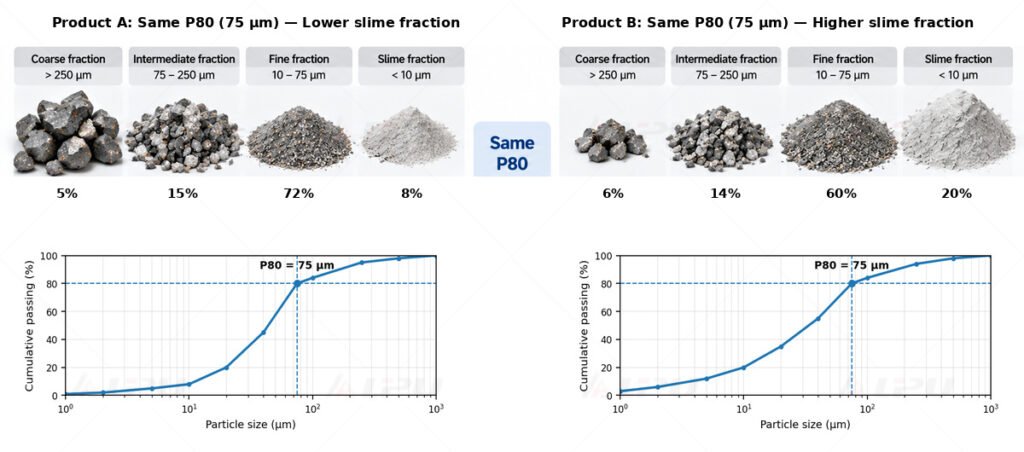
Two grinding products can have a similar P80 while containing different proportions of coarse particles, intermediate particles and fines. Their downstream behavior may therefore differ.
Similar P80 values can hide very different particle-size distributions
This distinction matters because flotation treats individual particles rather than a single average size value.
Coarse fractions may still contain composite particles
The coarse end of the distribution deserves attention when valuable minerals remain associated with gangue.
Sending these particles forward simply because the overall grind target has been reached can place additional separation difficulty on the flotation circuit.
Depending on mineral texture, some coarse particles may already be sufficiently liberated, while others may require further grinding. Mineralogical evidence and testwork are needed to distinguish between them.
Excessive fines can create a different flotation feed
At the opposite end of the distribution, unnecessary size reduction can increase the amount of very fine material.
Fine particles and slimes may influence pulp behavior, surface area, reagent interactions, entrainment and selectivity. The importance of these effects depends on the minerals, ore chemistry, grinding environment and flotation conditions.
Valuable minerals may remain insufficiently liberated
Controlled intermediate fraction
May provide suitable particles for flotation when liberation is adequate
Excessive fine particles
Can change flotation kinetics, surface interactions and entrainment behavior
High slime content
May affect selectivity, pulp behavior and reagent response
Broad or unstable size distribution
Can make flotation feed conditions more variable
These relationships are ore-specific. A particle size that works well for one mineral system should not automatically be transferred to another.
Can Grinding Conditions Affect More Than Particle Size?
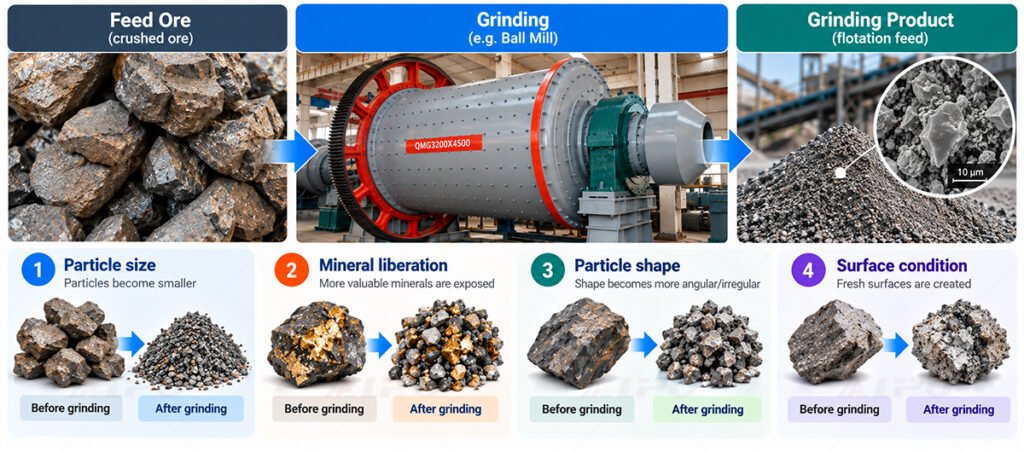
Grinding changes more than the dimensions of an ore particle.
Breakage exposes new mineral surfaces and can alter particle shape, surface roughness and the proportion of different mineral phases exposed to the slurry. The grinding environment may also influence the physicochemical condition of newly created surfaces.
Grinding changes several particle characteristics that can influence flotation
These effects matter because flotation depends on interactions at mineral surfaces.
However, no universal rule says that one grinding condition will always improve or reduce flotation performance. The response can depend on mineralogy, grinding media, water chemistry, ore chemistry, oxidation behavior and the reagent system used downstream.
For process development, this means grinding tests should not be evaluated only by the final size distribution.
Engineers may also need to ask:
Has useful mineral exposure improved?
Has additional grinding created unnecessary fines?
Are the particles entering flotation different in shape or surface condition?
Does the changed grinding condition actually improve separation response?
Is any improvement large enough to justify the additional grinding duty?
The last question is particularly important. A measurable change in laboratory grinding does not automatically justify a more complex or energy-intensive plant circuit.
Why Must Classification Be Stable Before Flotation?
Classification determines which portion of the grinding product leaves the circuit.
In a closed circuit, coarse material requiring further size reduction returns to grinding, while suitable material moves toward downstream separation. This makes the classifier an important control point between the mill and flotation plant.
When classification is unstable, flotation feed can also become unstable.
For example, an increased coarse fraction may introduce more insufficiently liberated particles. Excessive return of already suitable material can promote unnecessary regrinding and increase fines. Changes in water balance can further affect the slurry delivered downstream.
Stable classification helps deliver more consistent feed to flotation
The objective is not simply to keep the ball mill operating. Grinding and classification should jointly produce a reasonably stable feed condition for the next process.
Individual equipment capacity also needs to match this objective. A mill with sufficient nominal throughput does not guarantee a suitable flotation feed if classification becomes the circuit limitation.
How Should Grinding and Flotation Be Evaluated Together?
Grinding optimization should ultimately be judged by what happens downstream.
Suppose additional grinding produces a finer product. That result alone does not show whether the process has improved.
Engineers still need to determine whether useful liberation increased, whether the particle-size distribution remains suitable and whether flotation produces a meaningful improvement in separation.
The same principle applies when the grind is made coarser. Reduced grinding duty may be attractive, but the change is not beneficial if too many valuable minerals remain locked with gangue.
A test program can compare grinding conditions with liberation and flotation response rather than evaluating each stage independently.
Engineering question
What should be evaluated?
Is valuable mineral sufficiently liberated?
Mineralogy and liberation by size
Does the coarse fraction require more grinding?
Locked-particle characteristics and separation response
Is excessive fine material being produced?
Particle-size distribution and slime behavior
Is classification delivering a stable product?
Grinding-classification circuit performance
Does additional grinding improve flotation?
Comparative flotation testwork
Is concentrate quality improving?
Concentrate, middlings and tailings characteristics
Is regrinding justified?
Liberation and separation response of the specific intermediate stream
This approach also helps prevent unnecessary circuit complexity.
For example, a flotation middling may contain partially liberated valuable minerals. Regrinding that stream could be worth investigating because the additional grinding targets material with a specific liberation problem rather than grinding the entire plant feed finer.
Conversely, if additional size reduction produces little useful improvement in separation, further grinding may not be justified.
These decisions should eventually feed into mineral processing flowsheet development. Grinding, classification and flotation then become connected process duties rather than isolated machines.
Frequently Asked Questions
Does finer grinding always improve flotation?
No. Finer grinding may improve liberation when valuable minerals remain locked, but additional size reduction can also create unnecessary fines and change particle or slurry behavior. The appropriate grind should be established from mineralogy, liberation and flotation testwork.
How does mineral liberation affect flotation?
Liberation determines how much valuable mineral is exposed from gangue before separation. Poorly liberated composite particles may respond differently from liberated particles, which can limit selective flotation.
Why can excessive fines create flotation problems?
Very fine particles can behave differently from coarser particles because of their small mass, high surface area and interactions with water, reagents and other particles. Their actual effect depends on the ore and flotation system.
Can two grinding products with the same P80 behave differently in flotation?
Yes. P80 describes one point on the particle-size distribution. Two products with similar P80 values can still contain different proportions of coarse particles, intermediate material and fines, as well as different liberation characteristics.
Should grinding and flotation testwork be evaluated together?
Yes, particularly when establishing the grinding target for a flotation flowsheet. Comparing grinding condition, liberation, particle-size distribution and flotation response provides a stronger basis for process decisions than evaluating fineness alone.
From Grinding Product to Flotation Feed
A grinding circuit does more than produce fine ore. It prepares the particle population that the flotation circuit must separate.
Particle size is only part of that preparation.
Mineral liberation determines whether valuable minerals have been sufficiently exposed. Particle-size distribution shows how coarse material and fines are distributed across the product. Grinding conditions can influence particle shape and surface condition, while classification determines which particles leave the grinding circuit.
These characteristics eventually meet in the flotation feed.
For this reason, grinding and flotation should not be optimized as independent operations. The grinding target should reflect the condition required by downstream separation, while flotation results should provide feedback on whether the upstream preparation is actually suitable.
A stronger process-development sequence is therefore:
This circuit-based approach allows ball mill, classification and flotation duties to be defined around how the ore actually behaves rather than around isolated equipment specifications.
For a new mineral processing project, LIPU can evaluate available ore information, grinding requirements, classification needs and flotation test data to support equipment matching and process configuration.
This Cookie Privacy Policy statement explains how Zoneding Machine (hereinafter referred to as "we", "our", or "this website") uses cookies and similar technologies (collectively referred to as "cookies") to identify you when you visit our website lepuu.com. It explains what these technologies are, why we use them, and your rights to control our use of them.
Privacy Policy
Leave a Message
We will reply to you within 24 hours
Hello, I am Lipu Heavy Industry, what can we do for you please?


We will reply to you within 24 hours