Selecting a ball mill should not begin by matching plant throughput to the nearest capacity figure in a technical table.
Two plants may require the same hourly output but impose very different grinding duties on the mill. Ore grindability, feed condition, liberation requirement, classification and downstream separation can all change the amount of work required.
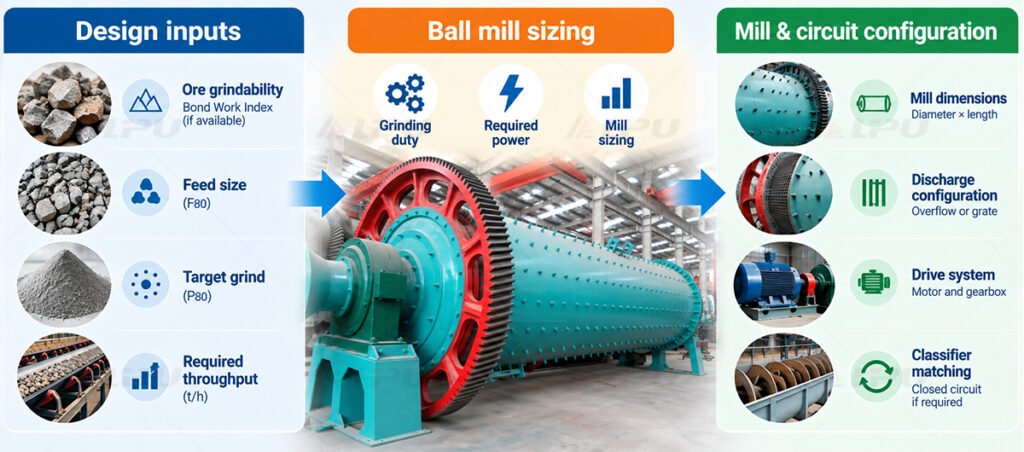
For this reason, ball mill selection should begin with the grinding duty, followed by mill size and configuration.
Why Can’t Ball Mill Size Be Selected from Capacity Alone?
Capacity tells us how much material a plant needs to process. It does not tell us how difficult that material will be to grind.
For example, two projects requiring similar fresh-feed throughput may differ in:
ore hardness and grindability;
feed particle size distribution;
required mineral liberation;
target grinding product;
classification arrangement;
downstream separation process.
These differences can produce very different grinding duties.
A mill handling an easily ground ore to a moderate product size does not perform the same duty as a mill treating a resistant ore that requires finer liberation.
That is why the capacity range of a ball mill should be treated as a preliminary reference rather than the only basis for equipment selection.
How Do Ore Properties Change the Required Grinding Duty?
Ore properties determine how the material responds inside the grinding circuit. However, they should not be reduced to simple rules such as “hard ore needs a larger mill.”
Several characteristics work together.
Grindability defines the grinding resistance
Hardness provides useful information, but grindability is more directly related to how an ore responds to size reduction under grinding conditions.
A more resistant ore may require greater grinding duty to reach the same product condition. This can influence mill sizing, power requirements and achievable throughput.
Abrasiveness introduces another consideration. It affects wear on liners, grinding media and other contact surfaces, so it also influences the practical mill configuration and maintenance strategy.
Important questions include:
How readily does the ore break?
How much size reduction is required?
How abrasive is the material?
Does ore behavior change between different feed zones?
These questions are more useful than classifying an ore only as hard or soft.
Mineral texture changes the liberation duty
Grinding is not performed simply to create fine particles. Its main purpose in mineral processing is often to expose valuable minerals sufficiently for the next separation stage.
Coarse mineral grains may become liberated after moderate grinding. Fine intergrowths can require additional size reduction before useful separation becomes possible.
This is why mineral liberation must be considered together with grindability.
Actual mill performance depends on the ore and required grinding duty
The relationship can be summarized simply:
Ore behavior defines how difficult grinding is, while mineral texture helps define how far grinding needs to proceed.
A detailed assessment of ore characteristics therefore provides a stronger basis for mill selection than capacity alone.
Why Must Feed Size and Grinding Target Be Considered Together?
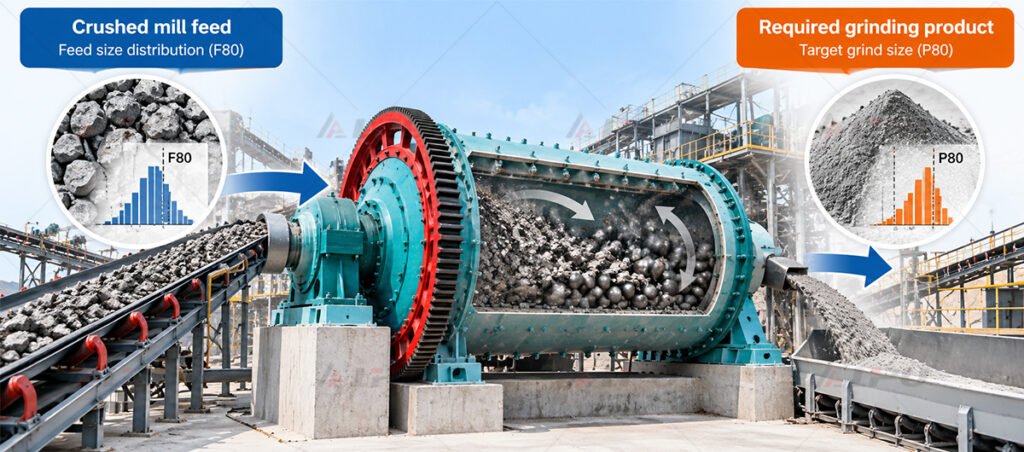
Feed size and grinding target represent the beginning and end of the mill’s size-reduction duty.
Looking at only one of them gives an incomplete picture.
Feed condition defines where grinding begins
Material entering a ball mill has normally passed through upstream crushing and, depending on the flowsheet, screening or intermediate storage.
The mill feed should be evaluated for:
particle size distribution;
presence of oversize material;
consistency of the crusher product;
changes in ore characteristics;
stability of the feed rate.
A coarser feed can transfer more size-reduction duty to the mill. Better upstream crushing may reduce part of that duty.
However, crushing as finely as possible is not automatically the correct solution. Additional crushing also requires equipment, power, wear parts and screening capacity.
The objective is to distribute size reduction appropriately between crushing and grinding.
Grinding target defines where grinding should stop
At the other end of the circuit, the required product should be determined by what the downstream process actually needs.
Insufficient grinding may leave valuable minerals locked with gangue. Excessive grinding can consume additional energy while generating fines that may provide little separation benefit.
Feed condition and grinding target define the size-reduction duty
Therefore, the target should not simply be:
“Make the ore as fine as possible.”
Instead, it should be:
“Produce the particle condition required for effective downstream separation.”
The appropriate target depends strongly on liberation behavior. Our guide to determining grinding fineness explains this relationship in more detail.
How Does Required Throughput Influence Ball Mill Size?
Once the grinding duty is understood, required throughput becomes a major sizing input.
A useful distinction must be made between fresh-feed throughput and the material handled internally by the grinding circuit.
In an open circuit, material generally passes through the grinding stage without external classification returning a coarse fraction.
A closed circuit behaves differently. Material that does not satisfy the classification requirement can return for additional grinding.
As a result, the mill may handle:
fresh feed entering the grinding section;
returned coarse material from classification;
variations caused by changing ore or operating conditions.
Two plants with similar fresh-feed capacity can therefore impose different internal duties on their mills.
Engineer Tip: Increasing nominal mill capacity does not automatically increase plant capacity. A bottleneck can also occur in feeding, classification, slurry handling or downstream separation.
This distinction is particularly important when evaluating a closed-circuit ball mill, because classification determines which material leaves and which material remains within the grinding duty.
How Do Wet, Dry, Overflow and Grate Configurations Affect Mill Design?
Ball mill selection does not end after determining the approximate mill size.
The equipment must also be configured for the process environment, material movement and downstream requirements.
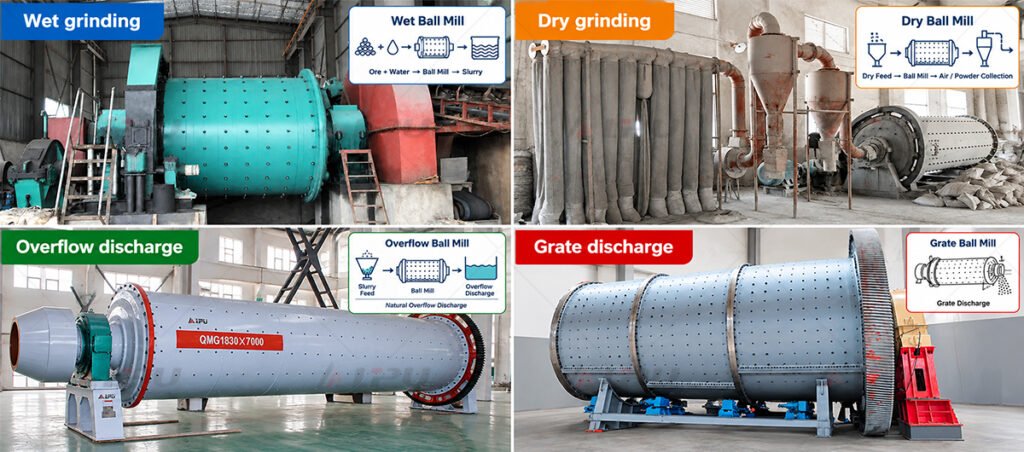
Mill configuration should match the required grinding process
Configuration decision
Main engineering question
Wet or dry grinding
In what condition should the material be ground and transferred downstream?
Overflow or grate discharge
How should ground material leave the mill?
Open or closed circuit
Is external classification and coarse return required?
Liner arrangement
What grinding and wear conditions must the mill withstand?
Grinding media
What breakage duty and particle range must be handled?
Drive configuration
What operating duty must the drive system transmit reliably?
No single configuration is universally better.
Wet grinding is widely used where downstream beneficiation operates with slurry. Dry grinding may be required when water addition is undesirable or the product must remain dry.
Overflow and grate discharge arrangements also control material discharge differently. Their selection should follow the grinding duty and circuit requirements rather than a fixed ore-name rule.
The same principle applies to liners, grinding media and drive configuration.
These components should support the required operating duty instead of being treated as independent options.
Why Must Ball Mill and Classification Capacity Be Matched?
In a closed circuit, grinding and classification perform different but connected jobs.
The mill reduces particle size. The classifier determines which material can leave the circuit and which material requires further grinding.
Grinding and classification capacity must be matched for stable circuit operation.
Poor matching can create several problems:
Classifier capacity is insufficient: material movement becomes restricted and excessive coarse return may increase internal duty.
Grinding duty is insufficient: classification cannot compensate for material that has not reached the required condition.
Circuit conditions are unstable: changes in feed, slurry conditions or ore behavior can affect both grinding and classification performance.
For this reason, the classifier should not be selected as an unrelated auxiliary machine.
A spiral classifier, for example, must be considered together with grinding capacity, overflow requirements, returned coarse material and slurry conditions.
The same circuit principle applies when another classification method is used.
Mill capacity + classification capacity + material return must work as one system.
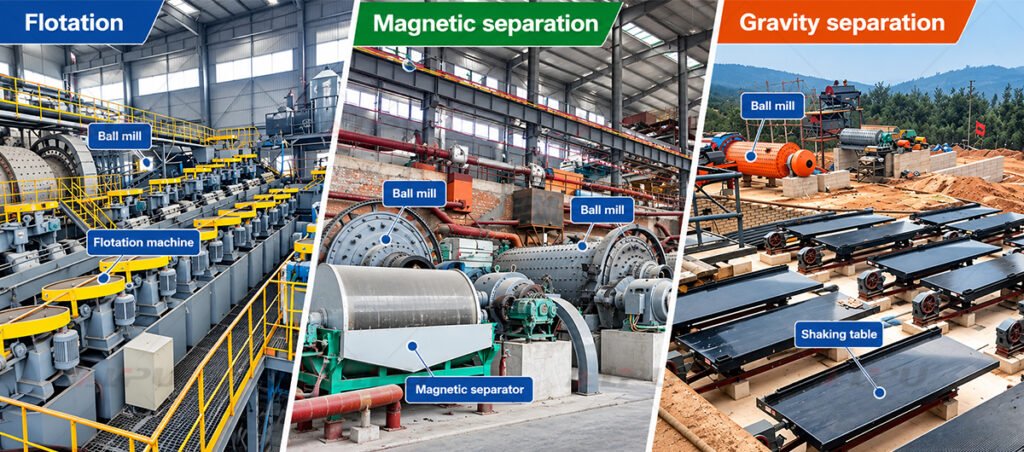
Downstream requirements also matter because the qualified product leaving classification becomes feed for the next separation stage.
Downstream process
What the grinding circuit must consider
Flotation
Sufficient liberation and a particle condition suitable for flotation
Magnetic separation
Liberation of magnetic minerals from associated gangue
Gravity concentration
Liberation together with a suitable particle-size range
Further processing
Product condition required by the next process stage
For example, a flotation machine cannot fully correct inadequate liberation created upstream. Likewise, a magnetic separator performs according to mineral magnetic response but still depends on adequate liberation.
Grinding and classification should therefore prepare the ore for separation rather than pursue fineness as an isolated objective.
What Project Data Is Needed Before Final Ball Mill Selection?
A preliminary recommendation can begin with basic project information. Final selection requires a clearer understanding of the ore, grinding duty and complete process.
The most useful inputs are:
Project data
Why it matters
Ore type and mineralogy
Defines the material and mineral associations being processed
Hardness or grindability
Helps establish resistance to grinding
Feed size distribution
Defines the starting condition of the grinding duty
Required throughput
Establishes the production requirement
Target grinding condition
Defines the required mill product
Liberation information
Connects grinding with mineral separation
Wet or dry requirement
Influences mill and auxiliary configuration
Circuit arrangement
Defines classification and return requirements
Downstream process
Establishes what product condition is useful
Site power conditions
Supports drive and electrical configuration
Existing equipment
Important for plant expansion or modification
Layout conditions
Influence installation and circuit arrangement
Not every project begins with complete testwork.
For an early inquiry, ore type, maximum feed size, required throughput, target product and downstream process can support preliminary discussion.
Complex beneficiation projects require stronger evidence before the final mill configuration is fixed. Mineralogy, liberation studies and metallurgical testwork can show whether additional grinding actually improves separation performance.
This distinction is important:
Preliminary model selection is not the same as final engineering selection.
Frequently Asked Questions
Can ball mill size be selected from throughput alone?
No. Throughput is an important input, but grinding duty also depends on ore characteristics, feed size, required product condition and circuit arrangement. Capacity figures are better used for preliminary screening than as the sole basis for final selection.
Does harder ore always require a larger ball mill?
Not necessarily. More resistant ore can increase grinding duty, but mill selection also depends on feed condition, throughput, target product, grindability and circuit configuration.
How does feed size affect ball mill selection?
Feed size influences how much size reduction must occur inside the mill. Coarser feed can transfer more duty to grinding, while finer upstream crushing changes the balance between the crushing and grinding sections.
Should the classifier be selected before or after the ball mill?
For a closed grinding circuit, the mill and classifier should be evaluated together. The mill provides size reduction, while classification controls product removal and coarse-material return.
What information should I provide for preliminary ball mill selection?
Provide the ore or material type, feed size, required capacity, target grinding condition, wet or dry requirement and downstream process. Ore analysis, mineralogy and available grinding or beneficiation test data are also useful.
Ball Mill Selection Starts with the Grinding Duty
The model number should be the result of the selection process, not its starting point.
A reliable selection begins by understanding the ore, defining the incoming feed and determining the product condition required by downstream separation. Throughput establishes the production requirement, while classification determines how material moves through a closed circuit.
Only then should mill size, grinding method, discharge arrangement, liners, media, drive and auxiliary equipment be finalized.
For mineral processing projects, LIPU can evaluate the ball mill together with grinding, classification and downstream separation requirements to develop a preliminary equipment configuration based on available project data.
This Cookie Privacy Policy statement explains how Zoneding Machine (hereinafter referred to as "we", "our", or "this website") uses cookies and similar technologies (collectively referred to as "cookies") to identify you when you visit our website lepuu.com. It explains what these technologies are, why we use them, and your rights to control our use of them.
Privacy Policy
Leave a Message
We will reply to you within 24 hours
Hello, I am Lipu Heavy Industry, what can we do for you please?

We will reply to you within 24 hours