A ball mill can reduce ore to a much finer size, but grinding alone does not determine when material is ready to leave the circuit. Mill discharge normally contains particles at different stages of size reduction and mineral liberation.
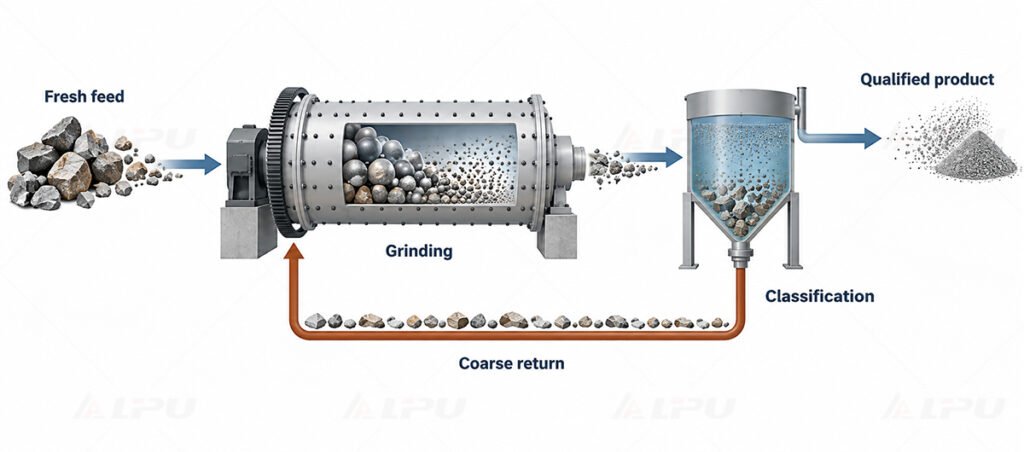
Classification provides the control needed to separate material that requires further grinding from material suitable for downstream processing. In a closed-circuit ball mill, this decision happens continuously as ore moves between grinding and classification.
The result is a more controlled grinding duty. Instead of treating the entire mill discharge as one product, the circuit keeps coarse material within the grinding stage while allowing suitable material to move forward.
What distinguishes a closed grinding circuit is what happens after material leaves the mill.
In an open arrangement, ground material proceeds to the next stage without a classifier sending part of the product back for additional size reduction. Closed-circuit grinding adds this return mechanism, allowing the grinding duty to respond continuously to the condition of the mill discharge.
Fresh ore enters the circuit while material that does not meet the classification requirement remains within it. Once particles reach the required condition, they can leave the grinding stage and continue toward mineral separation.
This arrangement means the ball mill cannot be evaluated only by its nominal throughput. Its actual operating duty is influenced by fresh feed, returned material, ore grindability, classification performance and the required final product.
Circuit performance therefore depends on balance. A mill may have enough mechanical capacity, yet the complete system can still perform poorly if classification cannot handle the discharge effectively or if too much unsuitable material moves downstream.
Why Is Classification Part of the Grinding Process?
Grinding reduces particle size, while classification determines how that size reduction is controlled within the circuit.
Ore leaving a mill contains a distribution of particle sizes rather than one uniform product. Some particles may already be suitable for the next processing stage, while others still require additional breakage.
Separating these streams prevents the complete mill discharge from being treated in the same way.
Grinding and classification operate as one connected circuit
Mineral liberation makes this relationship particularly important. Grinding should not aim to make every particle as fine as possible. Its purpose is to create a particle condition that allows valuable minerals to be separated effectively from gangue.
Classifier performance helps the circuit work around that target. Material requiring more size reduction remains within the grinding duty, while suitable material can leave before receiving unnecessary additional grinding.
Ore behavior must still be considered first. Two deposits containing similar valuable minerals may respond differently because hardness, mineral associations and liberation characteristics affect how readily particles break and separate. This is why ore characteristics should guide mineral processing equipment selection rather than relying on equipment capacity alone.
What Happens After Material Leaves the Ball Mill?
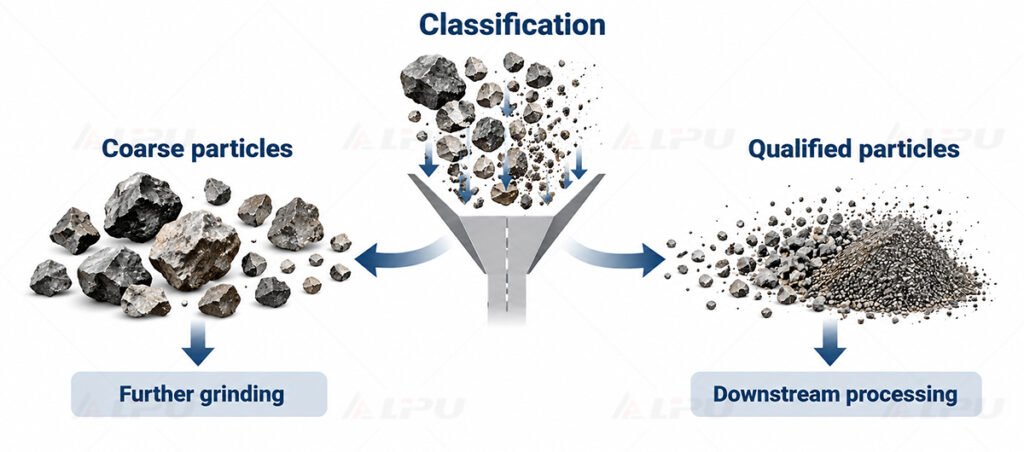
After grinding, classification prevents the entire mill discharge from being treated as a single finished product.
Material that does not meet the required classification condition remains within the grinding circuit. Suitable material is released for downstream processing, where it may enter flotation, magnetic separation, gravity concentration or another beneficiation stage.
The exact routing depends on the type of classifier.
Classification separates regrinding material from suitable downstream feed
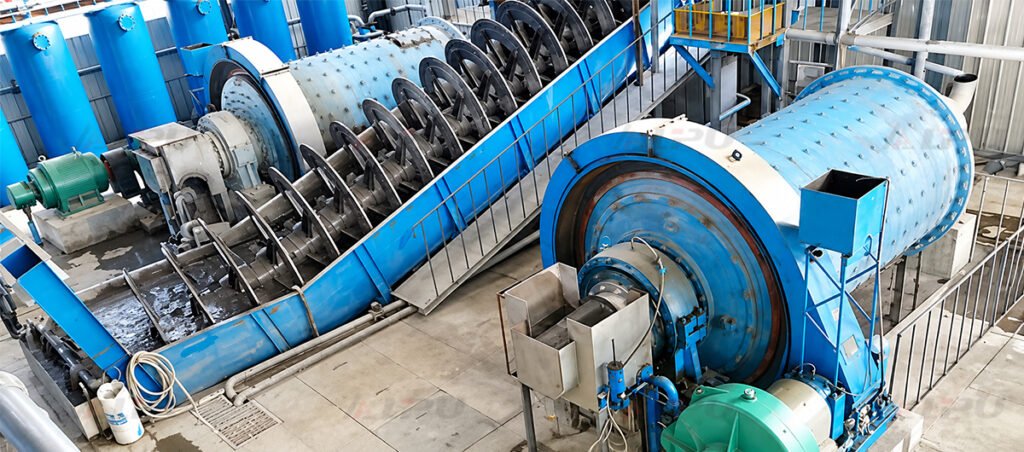
A spiral classifier relies mainly on differences in settling behavior. Fine particles remain suspended in the slurry and leave through the overflow, while coarser particles settle toward the bottom of the inclined tank. The rotating spiral then transports the settled material back toward the grinding stage.
Hydrocyclones perform the same general circuit duty through a different mechanism. Slurry is normally collected after grinding and pumped into the cyclone under pressure, where centrifugal action creates the classification effect.
Finer slurry leaves through the upper overflow. Coarser material exits from the lower underflow and is returned for additional grinding.
That distinction matters when designing the plant. A spiral classifier uses an inclined tank and mechanical spiral transport, whereas a hydrocyclone circuit requires suitable slurry handling, pumping and pressure conditions.
Neither should be treated as an interchangeable accessory selected after the ball mill. The classification method needs to fit the grinding duty and overall process arrangement.
How Does Classification Help Limit Unnecessary Grinding?
Once material has reached a condition suitable for downstream processing, additional size reduction may provide little process benefit.
Without effective classification, already fine particles can remain exposed to further grinding while coarser particles still need more work. This may increase the production of very fine material and make the grinding circuit harder to control.
Selective removal helps separate these duties.
However, particle size and mineral liberation are not the same thing. Industrial classifiers do not directly identify whether an individual valuable mineral grain has been fully liberated from gangue. Their separation behavior is influenced by factors such as particle size, density, slurry conditions and settling or centrifugal response.
For this reason, the classification target must be connected to the required liberation condition.
If valuable minerals remain locked at the selected grind, changing the classifier alone will not solve the problem. Conversely, pushing the circuit toward a much finer product does not automatically improve mineral recovery.
The correct target comes from understanding mineral liberation and how the downstream process responds to the ground product.
Flotation, gravity concentration and magnetic separation can also respond differently to particle-size distribution. Grinding and classification should therefore prepare the ore for the selected separation method rather than pursue fineness as an isolated objective.
What Does Circulating Load Tell Us About the Circuit?
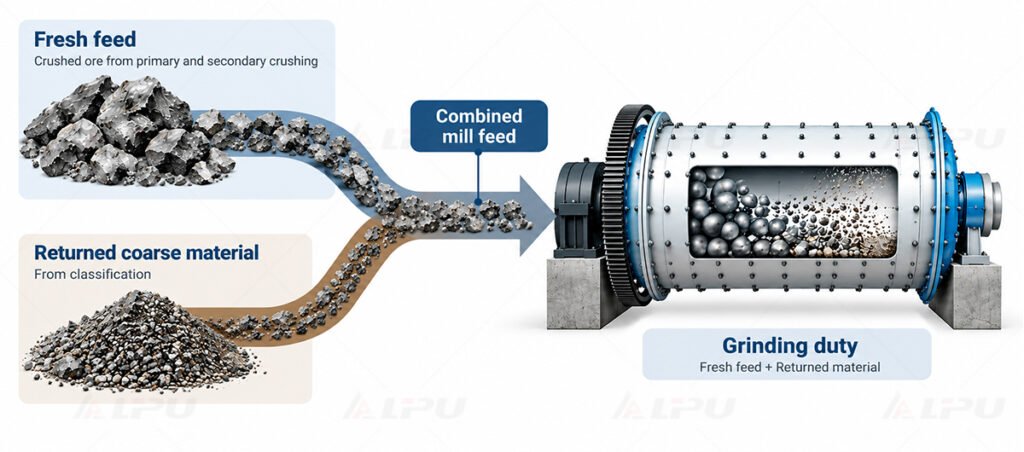
Returned coarse material creates an additional load inside a closed grinding circuit.
As a result, the tonnage handled by the ball mill is not limited to fresh ore entering the plant. Material rejected by classification also passes through the grinding stage again.
This internal movement is commonly described as circulating load.
Returned coarse material adds to the mill’s internal grinding duty
Circulating load is useful for understanding circuit behavior, but it should not be judged by a universal target.
A large return stream may indicate that substantial coarse material requires further grinding. It can also increase the duty imposed on the mill and classification system. By contrast, a small return stream does not automatically mean that the circuit is operating efficiently.
Poor classification may allow excessive coarse material to escape into the downstream product. Under that condition, return tonnage could appear relatively low even though the product is unsuitable.
Operating data therefore needs to be considered together. Mill feed stability, product particle-size distribution, classifier performance, slurry conditions and downstream results provide more useful information than circulating load alone.
Changes in ore characteristics can also shift the balance. Harder ore, a coarser feed or different liberation behavior may alter the amount of material requiring additional grinding even when the equipment configuration remains unchanged.
The aim is not to maximize or minimize circulation. It is to maintain a stable relationship between fresh feed, grinding capacity, classification and product removal.
How Should a Classifier Be Matched to the Ball Mill?
Classifier selection should start with the required process duty rather than a preference for a particular machine.
Several conditions influence the decision:
Circuit Consideration
Why It Matters
Ore characteristics
Affect grinding and particle behavior
Mill discharge condition
Defines the material entering classification
Required product condition
Establishes the classification objective
Grinding capacity
Influences classifier throughput requirements
Return material
Adds to the material handled within the circuit
Slurry properties
Affect wet classification behavior
Water balance
Influences slurry transport and classification
Plant arrangement
Affects equipment layout and material return
Downstream process
Defines the feed condition required after grinding
Spiral classifiers can be integrated closely with wet ball mills. Settled coarse material is mechanically transported by the spiral, making the equipment suitable for circuits where this type of return arrangement matches the process requirements.
Hydrocyclones are more compact and use centrifugal classification, but their operation depends on the surrounding slurry-handling system. Pumping conditions, feed characteristics and circuit arrangement become important parts of the design.
Capacity matching also requires more than checking fresh plant throughput.
Because returned material remains inside the circuit, classification equipment may need to handle considerably more material than the new ore entering the grinding section. The mill and classifier should therefore be evaluated as connected process equipment.
Downstream requirements provide another important reference point. A flotation circuit may require well-controlled grinding and classification before conditioning, while a magnetic separation circuit must receive material with sufficient liberation for differences in magnetic response to become useful.
For some gravity applications, particle-size control before equipment such as a shaking table can also affect separation stability.
The appropriate classifier is ultimately the one that supports the required grinding product and integrates properly with the rest of the flowsheet.
What Causes a Closed Grinding Circuit to Become Unstable?
A circuit that performs well under one operating condition may become less stable when feed characteristics change.
Ore hardness is one possible cause. Harder material can reduce the rate of size reduction and increase the amount of coarse material remaining in circulation. Changes in feed size or mineral texture can create similar effects.
Classifier conditions also matter. Variations in slurry density, water addition, feed rate or equipment condition may change the separation behavior and alter how much material returns to the mill.
Instability can appear in several ways:
fluctuating mill feed;
changing product particle-size distribution;
excessive coarse material in the classified product;
increasing material return;
unstable slurry conditions;
reduced downstream separation performance.
These symptoms should not be diagnosed independently.
For example, excessive coarse material in the final classified product might result from inadequate grinding, poor classification or a combination of both. Increasing grinding time without identifying the real cause may simply shift the problem elsewhere in the circuit.
Downstream performance can provide valuable feedback. When flotation, magnetic separation or gravity concentration begins receiving an unsuitable particle-size distribution, the cause may originate upstream in grinding or classification.
Stable operation therefore depends on monitoring the complete circuit rather than adjusting one machine in isolation.
How Is the Final Grinding and Classification Circuit Confirmed?
A reliable circuit begins with a clear definition of what the grinding section must achieve.
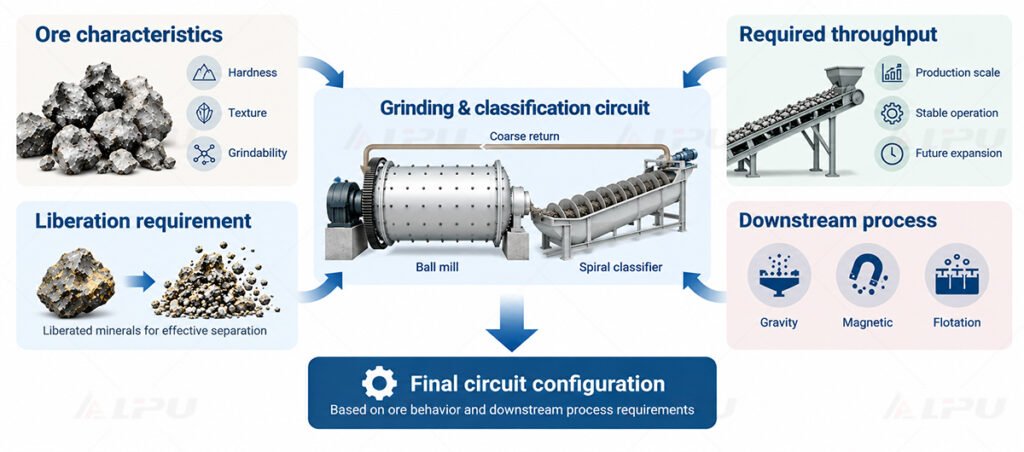
Ore characteristics provide the starting point. Hardness and feed size influence the size-reduction duty, while mineralogy and texture help determine how much grinding may be required to expose valuable minerals.
Liberation requirements then connect grinding to beneficiation.
Once the required product condition is understood, engineers can evaluate ball mill duty, classification method, return handling and downstream feed requirements as parts of the same system.
Circuit configuration should follow ore behavior and downstream process requirements
Preliminary circuit development normally benefits from information such as:
ore type and available mineralogical data;
maximum and typical feed size;
required plant throughput;
available grinding or beneficiation test results;
target product condition;
wet or dry processing requirements;
downstream separation method;
water availability;
existing equipment and site constraints.
Not every early-stage project will have complete testwork. Preliminary equipment discussions can begin with limited information, but complex beneficiation projects require stronger mineralogical and metallurgical evidence before the final flowsheet is confirmed.
This distinction is important because individual machine capacity does not equal circuit capacity.
A ball mill can have sufficient rated throughput while classification becomes the limiting stage. In another plant, the classifier may have enough capacity but the mill cannot provide the required grinding duty for a harder ore.
Good circuit design matches these stages around the behavior of the ore and the needs of the downstream process.
Frequently Asked Questions
Why is a classifier used with a ball mill?
A classifier controls which material remains within the grinding duty. Coarser material that does not meet the required condition receives additional grinding, while suitable material can proceed to downstream processing.
What happens to coarse particles in a closed grinding circuit?
They are returned for additional size reduction. The return method depends on the classification equipment. Spiral classifiers mechanically transport settled coarse material, while hydrocyclones discharge the coarser fraction through the lower underflow.
What is circulating load in a ball mill circuit?
Circulating load describes material returned from classification for further grinding. It adds to the material handled internally by the mill and should be evaluated together with classifier performance, product condition and overall circuit stability.
Can a spiral classifier form a closed circuit with a ball mill?
Yes. Spiral classifiers are commonly arranged with wet ball mills for closed-circuit grinding. Fine slurry leaves through the overflow, while settled coarse material is transported back toward the grinding stage.
Does every ball mill need to operate in closed circuit?
No. Open or closed grinding arrangements can be used depending on the process objective. The choice depends on factors such as ore characteristics, required product condition, classification needs and the downstream processing method.
From Grinding Equipment to Grinding Circuit Control
A closed-circuit ball mill is best understood as an integrated grinding and classification system rather than a mill with an auxiliary classifier attached.
Size reduction takes place inside the mill, but classification determines how material moves through the circuit. Suitable particles are released for downstream processing, while material requiring additional breakage remains within the grinding duty.
Stable performance depends on how well these functions are matched to ore behavior and mineral liberation.
Instead of selecting a ball mill only from a capacity table, circuit design should consider feed characteristics, grinding requirements, classification duty, material return and the needs of the following separation stage.
That broader approach turns grinding from an isolated machine operation into a controlled part of the complete mineral processing flowsheet.
This Cookie Privacy Policy statement explains how Zoneding Machine (hereinafter referred to as "we", "our", or "this website") uses cookies and similar technologies (collectively referred to as "cookies") to identify you when you visit our website lepuu.com. It explains what these technologies are, why we use them, and your rights to control our use of them.
Privacy Policy
Leave a Message
We will reply to you within 24 hours
Hello, I am Lipu Heavy Industry, what can we do for you please?


We will reply to you within 24 hours