Run-of-mine (ROM) ore rarely arrives at a mineral processing plant in a condition suitable for direct grinding. It may contain oversized rocks, fine particles, moisture, clay, and occasional foreign materials. Its particle-size distribution can also change as mining advances through different ore zones.
These variations affect crushing performance and the material delivered to the grinding circuit. Without adequate preparation, unstable feed conditions can increase equipment loading, cause blockages, and interrupt production.
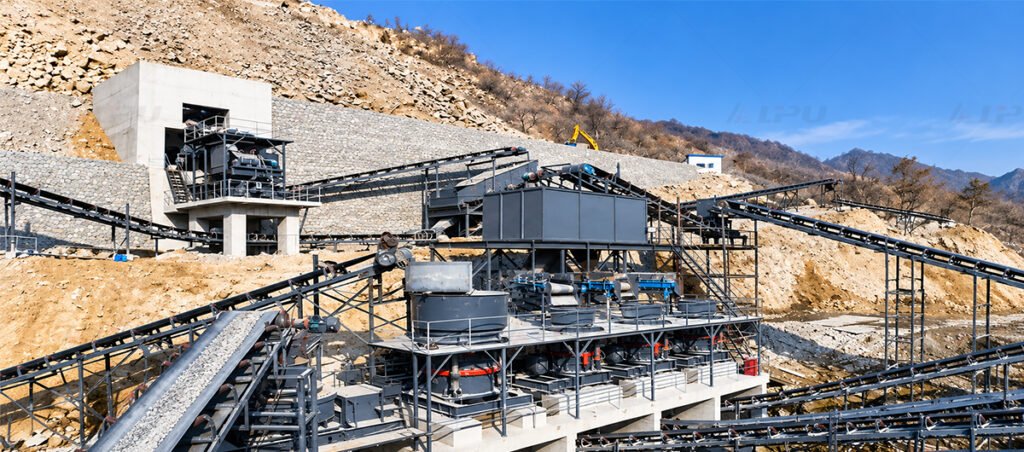
Effective run-of-mine ore preparation involves more than reducing large rocks. It combines controlled feeding, primary and secondary crushing, screening, material handling, and suitable storage before grinding.
The objective is to deliver a consistent mill feed that matches the selected grinding equipment and its operating duty.
Why Does Run-of-Mine Ore Need Preparation Before Grinding?
ROM ore is material delivered from the mine before processing. Its characteristics depend on the deposit, mining method, blasting conditions, and ore handling practices. Even within one deposit, the incoming material can vary considerably.
One production period may deliver competent rock containing a large proportion of coarse fragments. Another may contain fractured ore, excessive fines, or moisture-sensitive clay. These differences influence how material passes through crushers, screens, conveyors, and storage systems.
Poor ore preparation can create several operating problems:
Oversized rocks may exceed crusher or mill feed limits.
Irregular feed rates can cause unstable equipment loading.
Clay-rich material may interfere with screening and conveying.
Tramp metal can damage crushers and downstream machinery.
Excessive coarse material can increase grinding duty.
Poorly designed transfer points may cause blockages and spillage.
Consequently, a crushing plant should not be evaluated only by its ability to reduce the maximum rock size. The complete crushed-ore size distribution and its consistency are equally important.
For example, a ball mill requires feed that matches its selected size-reduction duty. Although the equipment can process a range of particle sizes within its design limits, grinding performance depends partly on the distribution and properties of the incoming material.
Stable preparation helps the grinding circuit operate closer to its intended conditions.
What Should Be Checked When ROM Ore Enters the Plant?
Ore preparation begins at the receiving hopper rather than at the crusher discharge. Before establishing equipment settings, engineers should understand the material arriving from the mine. Representative sampling and operating observations provide the foundation for reliable circuit design.
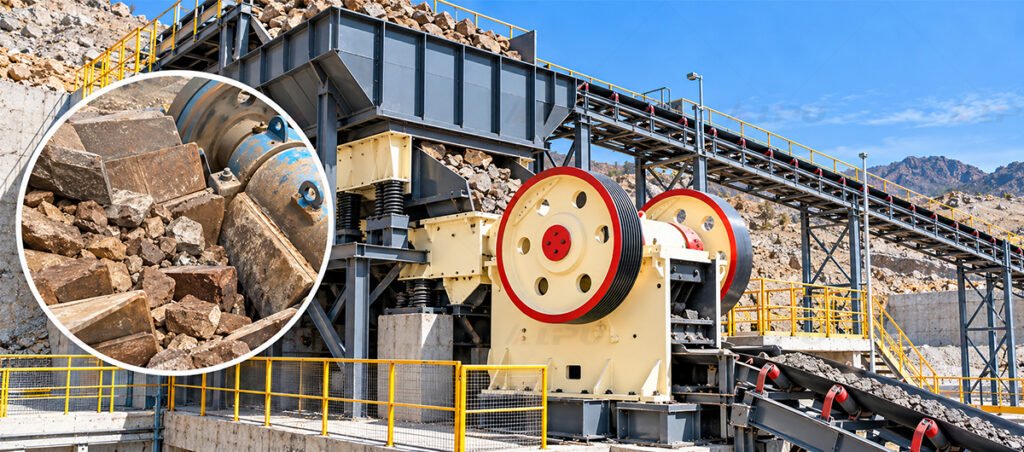
Controlled ore receiving helps maintain stable loading at the primary crusher
Maximum lump size and feed distribution
Maximum rock size determines whether the receiving hopper, feeder, and primary crusher can accept the material. However, the largest lump does not describe the entire feed. A mixture dominated by coarse rocks behaves differently from material containing substantial fines, affecting equipment loading and the required crushing duty.
Moisture, clay, and material handling behavior
Moisture and clay influence how ore moves through the plant. Dry, free-flowing rock may pass through feeders and screens with relatively little difficulty. In contrast, sticky material can accumulate inside chutes, adhere to screen surfaces, and reduce screening effectiveness.
Where these conditions are significant, the plant may require suitable screening surfaces, modified feeder arrangements, or improved chute geometry. Washing or wet screening should not be introduced automatically because water availability, downstream processing requirements, and ore characteristics must first be considered.
Foreign materials and abnormal feed
Mining and transportation can introduce steel fragments, worn components, and other unwanted objects. Such materials may damage crushing equipment if they enter the crushing chamber.
Depending on the application, protection measures may include metal detectors, magnetic removal of suitable ferrous materials, inspection points, and procedures for isolating tramp material. These controls should be considered during receiving-system design rather than only after equipment damage occurs.
How Do Feeding and Primary Crushing Prepare the Ore?
After ROM ore has been characterized, the next requirement is controlled delivery into the primary crusher. A receiving hopper provides temporary material storage, while a vibrating feeder regulates the flow of ore into the crushing chamber.
This control is important because haulage vehicles and crushers do not necessarily operate at the same instantaneous rate. A properly selected feeder helps reduce sudden surges and maintain a more consistent supply.
Some primary feeding systems include grizzly bars that allow smaller material to bypass the primary crusher. This arrangement can reduce unnecessary crushing when the undersize is already suitable for the following processing stage.
However, the grizzly opening must match the incoming ore distribution and downstream requirements. Sticky clay may reduce separation effectiveness, while bypassed material may still require screening before reaching fine ore storage.
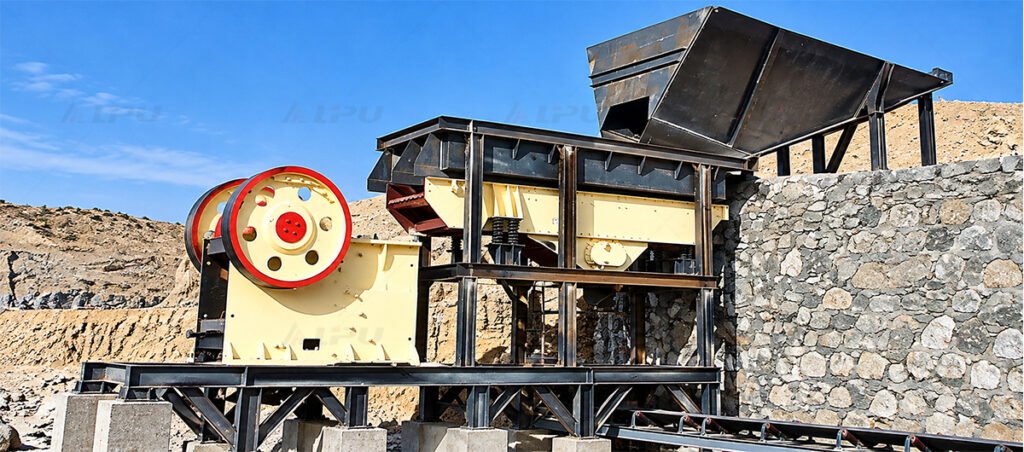
A jaw crusher is commonly used for primary reduction of hard-rock ROM ore. Its main function is to convert large, irregular fragments into material that subsequent equipment can handle.
Primary crushing reduces oversized ROM fragments for subsequent processing
Nevertheless, primary crusher discharge is not necessarily suitable for direct grinding. Its size distribution must match the next crusher’s feed requirements and the intended crushing circuit.
For smaller plants, a fine jaw crusher may provide secondary reduction. Larger hard-rock operations may require a different arrangement based on ore hardness, feed size, and throughput. The correct configuration should follow the actual reduction duty rather than the nominal capacity of one machine.
How Should Secondary Crushing and Screening Control Mill Feed?
After primary crushing, the material may still contain particles that are too large for the selected grinding equipment. Secondary or tertiary crushing provides additional reduction, while screening determines which material can proceed toward fine ore storage.
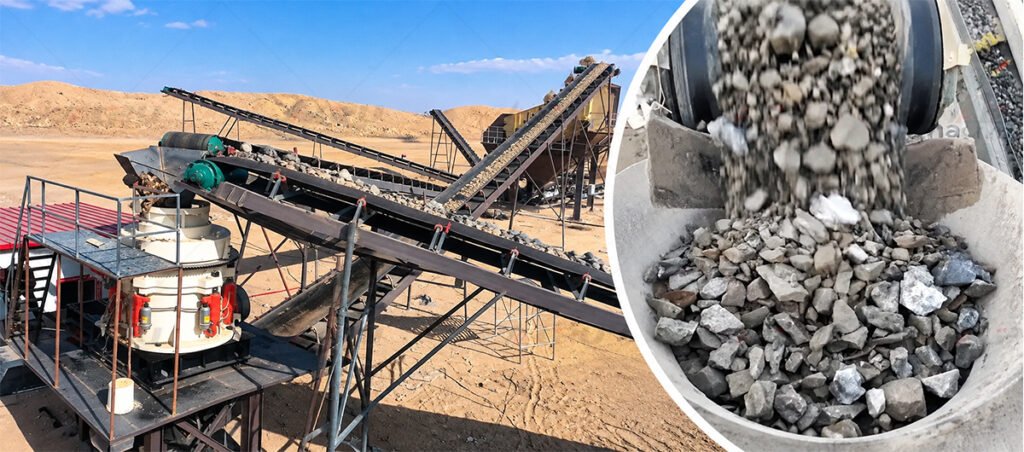
Secondary crushing reduces ore size before downstream screening and grinding
For hard and abrasive ores, a multi-cylinder hydraulic cone crusher may be selected for secondary or fine crushing. Other crusher configurations may also be appropriate depending on ore properties and the required duty.
The objective is not to install the maximum number of crushing stages. It is to achieve the required mill-feed distribution at the specified throughput.
Screening and closed-circuit crushing
A vibrating screen separates crushed material according to the selected screen openings. Material meeting the required size specification can move toward fine ore storage, while oversized particles may return to an appropriate crusher for additional reduction.
This arrangement creates a closed crushing circuit when recirculation is required. However, poor screening may allow excessive coarse material into the mill-feed stream or return acceptable undersize for unnecessary crushing.
Therefore, crusher settings and screen performance should be evaluated together. The selected screen capacity, separation efficiency, and circulating load must support the required production rate.
Why the complete particle-size distribution matters
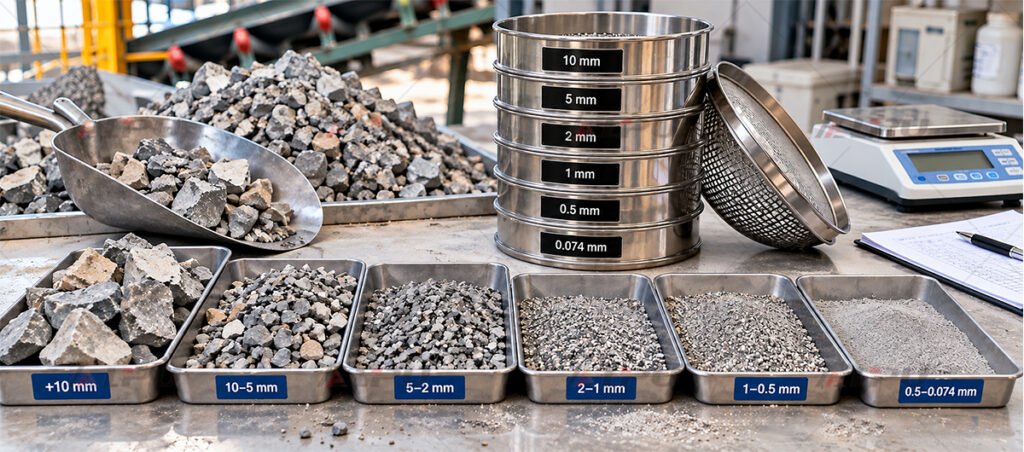
A mill-feed specification should not be defined only by its largest acceptable particle. Two crushing circuits may produce material with similar maximum sizes but different proportions of coarse, intermediate, and fine particles.
These differences influence the grinding duty. A feed dominated by particles near the upper size limit may require different grinding conditions than material containing more intermediate and fine particles.
Mill-feed characteristic
Engineering significance
Maximum particle size
Must remain within the selected mill’s feed limit
Coarse fraction
Influences the size-reduction duty required during grinding
Intermediate fraction
Contributes to the overall grinding feed distribution
Fine fraction
May influence material handling and subsequent grinding behavior
Moisture and clay
Affect storage, conveying, screening, and feeding
Feed-rate variation
Changes instantaneous grinding circuit loading
A finer crushing product is not automatically the best result. Additional crushing may increase equipment requirements, wear, maintenance, and circuit complexity. The preferred product should reflect the combined crushing and grinding requirements.
Reference Ball Mill Feed Sizes for Preliminary Design
The required mill-feed size depends on the selected ball mill, ore characteristics, and grinding duty. As model-specific references, the following values are listed in LIPU’s published ball mill technical parameters.
These figures represent published feed-size limits for the listed equipment models. They are not universal optimum crushing targets.
The final crushing product should be established by evaluating the complete feed-size distribution, ore grindability, required grinding fineness, and circuit performance.
Engineering note: Maximum allowable feed size and optimum economic feed size are different design considerations. A crushing circuit should satisfy the equipment limit while balancing additional crushing requirements against downstream grinding performance.
Why Are Fine Ore Storage and Controlled Mill Feeding Important?
Crushing and grinding are connected processes, but their operating patterns may differ. A crushing plant can experience interruptions caused by truck delivery, crusher maintenance, screen adjustments, or temporary blockages. Meanwhile, the grinding circuit generally benefits from a reasonably consistent feed supply.
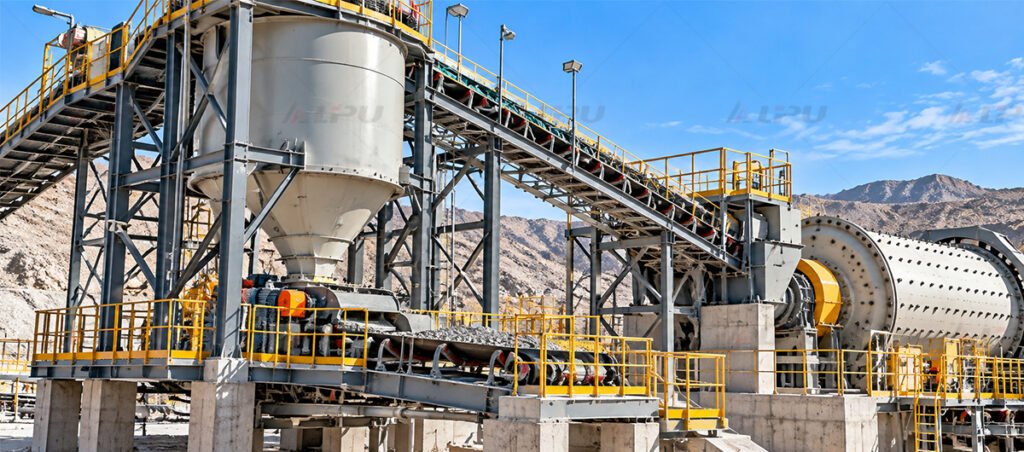
Fine ore storage helps reduce the immediate effect of short-term crushing interruptions. Depending on plant layout and operating requirements, this storage may take the form of a bin, silo, stockpile, or another suitable buffer arrangement.
Storage capacity should reflect the operating schedule, expected interruptions, material characteristics, and available plant space. However, capacity alone cannot guarantee stable feeding.
A properly designed storage system must also provide reliable material discharge. Poor flow behavior can cause bridging, ratholing, or irregular withdrawal, particularly when the ore contains moisture, clay, or a broad particle-size distribution.
Feeder selection and hopper geometry should therefore match the material’s flow properties. A belt conveyor can transfer crushed ore between equipment and storage locations, while feed-rate measurement and control can help maintain a stable supply to the mill.
Fine ore storage helps maintain continuous feeding between crushing and grinding
Ore segregation within storage may also influence the material withdrawn over time. The storage design and operating method should minimize undesirable segregation where it affects downstream performance.
The objective is consistent grinding duty, not simply maintaining a full storage bin.
How Can Engineers Confirm That the Ore Is Ready for Grinding?
Mill-feed preparation should be evaluated against measurable requirements. The necessary information depends on the ore, grinding equipment, production target, and downstream mineral processing method.
A useful assessment includes material characteristics, equipment limits, and actual operating performance.
Is the material consistent with the selected mill duty?
Appropriate comminution testwork
Moisture and clay
Will the material feed and discharge reliably?
Material testing and operating observations
Foreign material
Are damaging objects adequately controlled?
Inspection and protection-system checks
Feed rate
Can the required throughput be maintained?
Belt scales and operating records
Storage performance
Can the system deliver material consistently?
Bin-level and feeder-performance monitoring
Crushing circuit stability
Is oversized material being controlled?
Screen sampling and circulating-load evaluation
These checks help determine whether the crushing section is delivering suitable material to the grinding system. A satisfactory result cannot be defined by one universal feed-size number because different ores, mills, and grinding targets require different preparation conditions.
Crusher product testing provides important information, but the final assessment should also consider how the grinding circuit responds. Changes in mill-feed distribution may influence throughput, power draw, circulating load, or grinding product size.
For example, reducing the coarse fraction may improve grinding performance in a particular circuit. In another situation, the additional crushing equipment and operating requirements may outweigh the benefit.
These effects should be evaluated using operating measurements and appropriate testwork rather than assumed from crusher settings alone.
What Operating Problems Indicate Poor ROM Ore Preparation?
A crushing circuit can appear productive while still delivering unsuitable material to the grinding section. Engineers should investigate operating patterns across the complete material-handling system rather than treating each problem separately.
For example, repeated screen blockages may indicate a moisture or clay-handling issue. Unstable fine ore bin discharge may suggest material-flow problems rather than insufficient crusher capacity. Frequent mill-feed interruptions can also originate from upstream conveying or storage limitations.
Several symptoms deserve attention:
Oversized material repeatedly appears in the mill-feed stream.
Feed rates fluctuate despite stable production targets.
Crushers or transfer chutes experience frequent blockages.
Excessive recirculation develops within the crushing section.
Fine ore storage discharges irregularly.
Grinding performance changes unexpectedly after ore-source changes.
These symptoms do not identify a single cause by themselves. The appropriate response is to trace the material through receiving, feeding, crushing, screening, conveying, and storage.
Representative sampling and plant operating records can help identify where feed conditions change. Correcting an upstream cause is often more effective than repeatedly adjusting grinding equipment to compensate for unstable feed.
Optimize Your Ore Preparation Circuit With LIPU
A properly configured crushing, screening, and feeding system helps deliver consistent mill feed and supports stable downstream grinding performance.
LIPU Heavy Industry provides crushing, feeding, conveying, grinding, and related mineral processing equipment for project-specific plant configurations.
For example, a hard rock gold processing plant may require coordinated primary crushing, secondary crushing, screening, fine ore storage, and ball mill feeding before mineral recovery.
Share your project requirements with LIPU:
Ore type and mineral characteristics
Maximum ROM feed size
Required plant capacity (TPH)
Target crushed-ore or mill-feed size
Ore hardness and abrasiveness, if known
Moisture and clay conditions
Available testwork and site information
Our engineering team can review the available information and help develop a preliminary equipment configuration, crushing circuit arrangement, and sizing proposal.
Request Crushing Circuit Sizing & Flowsheet
Contact LIPU with your ore data and project requirements to discuss a suitable crushing and grinding preparation solution.
Frequently Asked Questions
What is run-of-mine ore preparation?
Run-of-mine ore preparation includes receiving, controlled feeding, crushing, screening, foreign-material control, and suitable storage before grinding or another downstream process. The objective is to deliver material with acceptable particle-size and handling characteristics.
Does ROM ore always require three-stage crushing before grinding?
No. The required number of crushing stages depends on incoming ore size, material characteristics, selected grinding equipment, and target mill-feed distribution. Some plants use fewer stages, while others require additional reduction and screening.
What particle size should be fed into a ball mill?
The acceptable feed size depends on the selected mill and its operating duty. As examples, LIPU lists feed sizes below 20 mm for its Φ900 × 1800 ball mill and below 25 mm for its Φ1200 × 2400 model. These are model-specific published limits, not universal optimum feed sizes.
Why is screening important before grinding?
Screening helps control oversized material and directs particles requiring additional crushing back to the appropriate equipment. Effective screening supports a more consistent mill-feed distribution and helps reduce unnecessary crusher recirculation.
Can fine ore storage improve grinding stability?
Yes. Suitable storage and controlled withdrawal can reduce the immediate effect of short crushing interruptions and feed-rate fluctuations. However, storage geometry, material flow, segregation, and feeder control must be properly considered.
From Run-of-Mine Ore to Consistent Mill Feed
Effective ore preparation establishes the operating conditions required by the grinding circuit. Primary crushing reduces large ROM fragments, while subsequent crushing and screening control the particle-size distribution.
Feeding, conveying, and fine ore storage help maintain continuity between the crushing and grinding sections. The final preparation requirements should be determined from actual ore characteristics, grinding equipment specifications, and plant operating conditions.
The most useful crushing product is not necessarily the finest one. It is the material that allows the downstream grinding circuit to perform its intended duty consistently.
For mineral processing projects, LIPU can assist with equipment matching and preliminary circuit configuration according to the complete processing requirements.
This Cookie Privacy Policy statement explains how Zoneding Machine (hereinafter referred to as "we", "our", or "this website") uses cookies and similar technologies (collectively referred to as "cookies") to identify you when you visit our website lepuu.com. It explains what these technologies are, why we use them, and your rights to control our use of them.
Privacy Policy
Leave a Message
We will reply to you within 24 hours
Hello, I am Lipu Heavy Industry, what can we do for you please?


We will reply to you within 24 hours