A crushing and grinding circuit should not be designed by selecting a crusher first and a mill second. The real task is to determine how size reduction should be distributed across the circuit so that the ore reaches the required liberation condition efficiently and consistently.
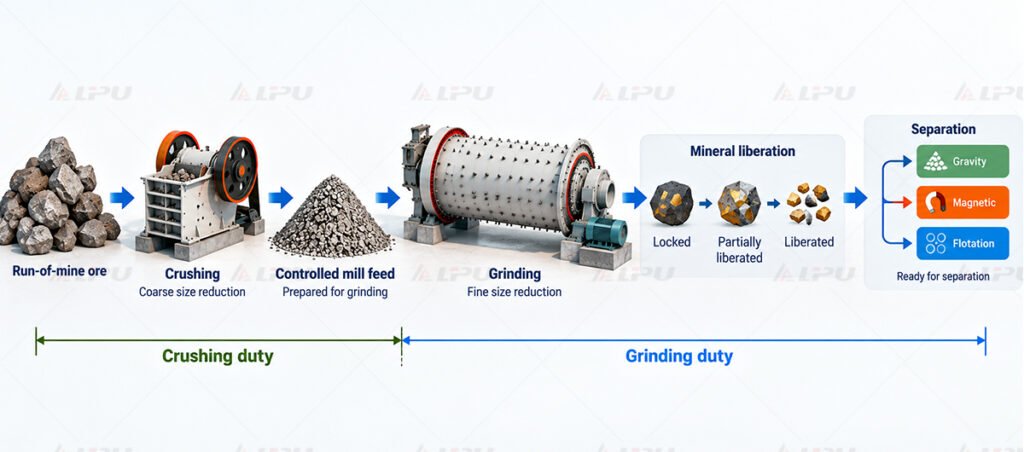
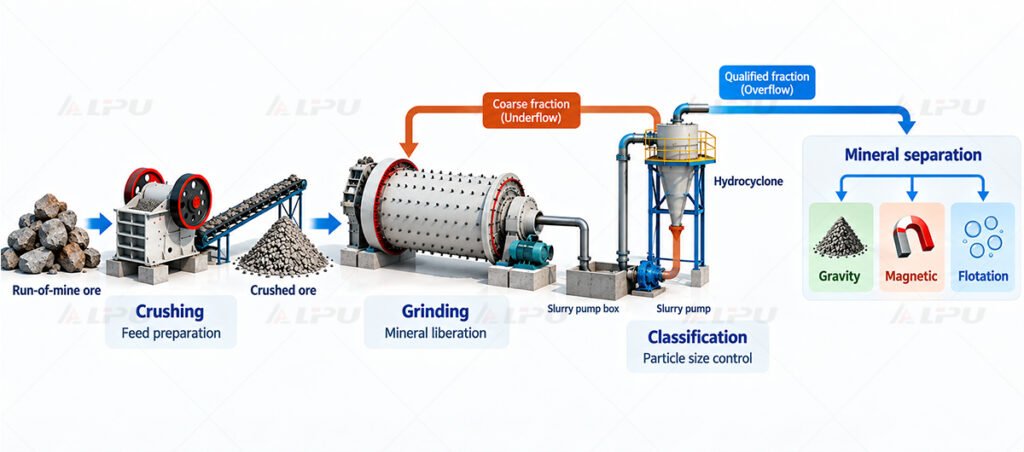
Crushing handles the coarser stages of size reduction. Grinding continues the process until valuable minerals are sufficiently liberated for gravity separation, magnetic separation, flotation, or another downstream process.
Therefore, the design question is not simply how small a crusher can make the ore or how fine a mill can grind it. A better question is: Where should crushing end, where should grinding begin, and what particle condition does the downstream separation process actually require?
The answer depends on ore characteristics, feed size, hardness, liberation behavior, throughput, classification performance, and the selected separation strategy.
1. What Should a Crushing and Grinding Circuit Achieve?
The purpose of comminution is not to produce the smallest possible particles. It is to prepare the ore for effective downstream processing.
Primary crushing accepts relatively coarse run-of-mine material. Secondary or tertiary crushing further reduces the ore and controls the feed entering the grinding section. Grinding then provides the finer size reduction needed for mineral liberation.
Classification becomes important once grinding begins because particles leaving the mill do not all have the same size or liberation condition.
Each stage should prepare material for the next one.
This means the crushing circuit cannot be designed only around crusher capacity. Likewise, the grinding circuit should not be designed only around mill capacity.
For example, a jaw crusher may provide sufficient primary crushing capacity, but its product still needs to match the downstream secondary crushing and grinding duties. A ball mill may also have sufficient nominal capacity, yet its actual duty depends on feed size, ore hardness, target fineness, and classification conditions.
A practical circuit therefore focuses on process continuity rather than maximizing the performance of one individual machine.
2. Where Should Crushing End and Grinding Begin?
There is no universal transfer size at which crushing should always stop and grinding should begin.
The appropriate boundary depends on how the ore responds to size reduction and how the selected grinding equipment performs with the resulting feed.
Factor
Why It Matters
Maximum feed size
Determines the primary crushing requirement
Ore hardness
Influences crushing and grinding duty
Abrasiveness
Affects crusher, liner and grinding-media wear
Ore competency
Influences how larger particles break
Moisture and clay
Can affect feeding, screening and crushing stability
Crusher product distribution
Determines the material presented to the mill
Liberation behavior
Determines how much further grinding is required
Plant throughput
Influences equipment sizing and circuit loading
Downstream separation
Helps determine the required final particle condition
The objective is usually to provide the grinding section with a controlled and suitable feed rather than forcing either crushing or grinding to perform unnecessary work.
Sending excessively coarse material to the mill increases the reduction duty that must be completed during grinding. However, adding more crushing stages simply to obtain the finest possible crusher product is not automatically a better solution.
Additional crushing may require more crushers, screens, conveyors, transfer points, foundations, wear parts, and control equipment. The correct balance therefore needs to be determined for the actual ore and plant conditions.
3. How Should the Crushing Section Prepare Ore for Grinding?
The crushing section should deliver a stable feed that the grinding circuit can process effectively.
For many hard-rock mineral processing plants, this may involve primary crushing followed by secondary crushing and screening. The exact arrangement changes according to run-of-mine feed size, ore competency, required capacity, crusher product distribution, and mill-feed requirements.
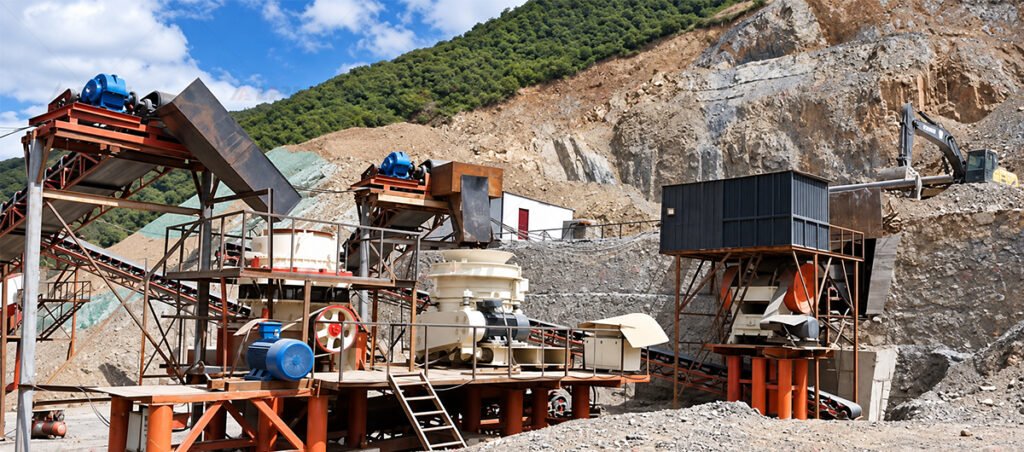
The crushing section should provide stable and suitable mill feed
A jaw crusher is commonly considered for primary reduction because it can accept relatively large material. Hard and abrasive ores may then require further compression crushing before grinding. A multi-cylinder hydraulic cone crusher is one possible option when additional hard-rock reduction is required.
However, equipment type should follow the process requirement rather than determine it.
Screening is also important because it determines which particles require additional crushing and which can move forward.
Poor control at this stage can create an unstable mill feed. Large variations in particle size may change the duty placed on the grinding circuit and make downstream operation less consistent.
When evaluating the crushing section, engineers should consider several practical questions:
Is the feed size distribution reasonably stable?
Does the crusher product suit the selected grinding equipment?
Is screening controlling oversized material effectively?
Can the crushing section maintain the required plant throughput?
Will changes in ore hardness significantly affect the product?
Is there sufficient surge or buffer capacity between crushing and grinding?
The last point is easily overlooked. Crushing and grinding equipment do not necessarily operate under identical conditions at every moment. Suitable intermediate storage and controlled feeding can reduce the effect of short-term fluctuations and provide a more consistent feed to the mill.
4. How Does Mineral Liberation Determine the Grinding Duty?
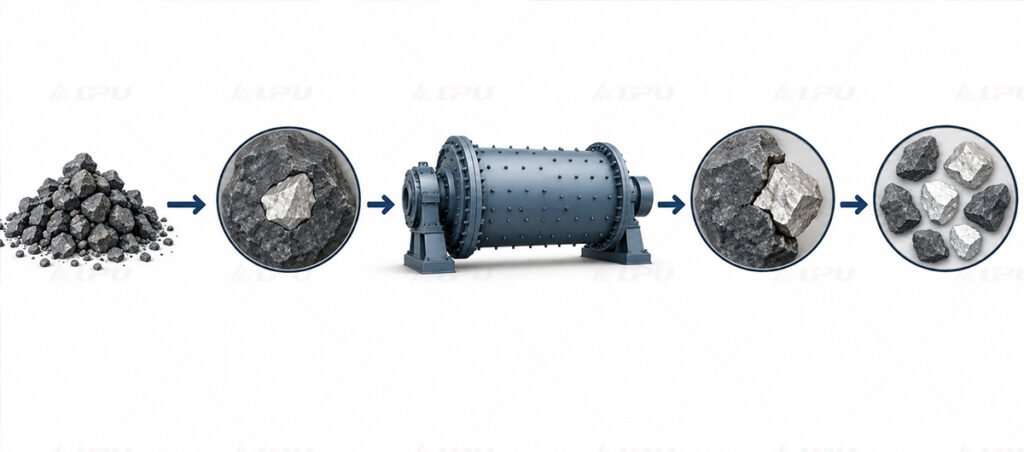
Crushing reduces rock size, but valuable minerals may still remain locked together with gangue after the crushing stages.
Grinding continues size reduction until enough of those mineral associations are broken for the selected separation process to work effectively.
Grinding continues until sufficient mineral liberation is achieved
This is why grinding should be designed around mineral liberation, not simply around producing fine powder.
Consider two ores containing the same valuable mineral. One may contain relatively coarse mineral grains that become sufficiently liberated after moderate grinding. Another may contain much finer intergrowths and require more intensive size reduction.
Using the same grinding target for both ores would ignore their mineralogical differences.
Insufficient grinding can leave valuable minerals locked with gangue. These composite particles may respond poorly during downstream separation.
Excessive grinding creates a different problem. Material that is already sufficiently liberated continues to receive grinding duty, while unnecessary fine particles may be produced.
The target should therefore be sufficient liberation for the selected separation process, rather than maximum fineness.
Together, liberation and grinding-fineness studies help establish what the grinding section actually needs to achieve.
5. Why Must Grinding and Classification Be Designed Together?
A mill alone does not guarantee controlled grinding.
Particles leaving a grinding machine normally contain a distribution of sizes. Some may already be suitable for downstream processing, while others still require additional size reduction.
Classification separates these streams.
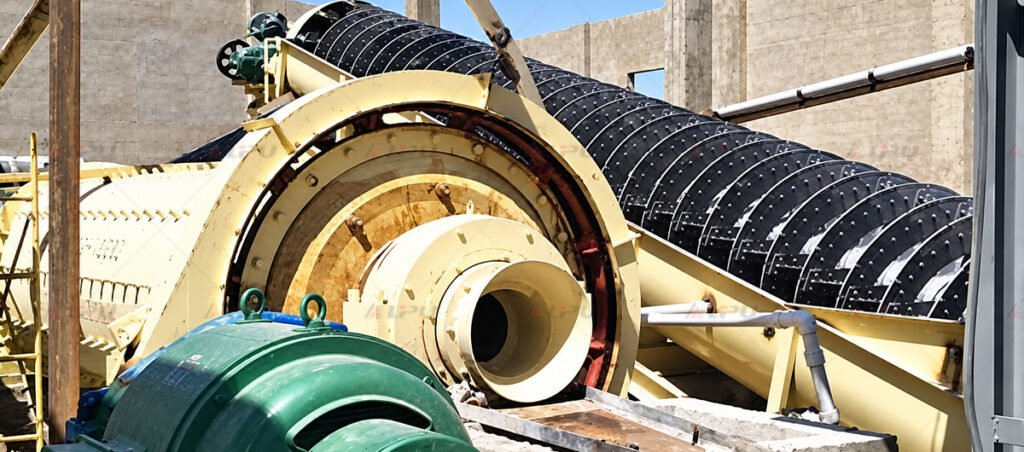
In a closed grinding circuit, qualified material can move forward while the coarse fraction returns for further grinding. A spiral classifier is one type of equipment that can work with a ball mill in suitable wet-grinding applications.
Classification controls which particles leave or return to grinding
This makes classification part of the grinding strategy rather than a separate accessory.
If coarse material moves downstream too early, mineral liberation may be inadequate. Conversely, returning material that has already reached the required condition can result in unnecessary additional grinding.
The classifier also influences the circulating material within a closed circuit. The mill and classifier should therefore be considered together when evaluating circuit capacity and operating stability.
Important design questions include:
What particle condition should move to separation?
How will coarse particles be returned for further grinding?
Is the classifier suitable for the selected grinding process?
Can the mill and classification stage handle the required circulating material?
Will downstream separation receive a reasonably controlled feed?
The objective is a stable grinding-classification circuit, not simply a mill operating at maximum throughput.
6. How Does Downstream Separation Affect Circuit Design?
Crushing and grinding should never be designed without considering what happens after them.
The required feed condition for gravity concentration may differ from the condition needed for flotation or magnetic separation. Particle size, liberation, mineral associations, and other physical properties influence how successfully the downstream process can separate valuable minerals from gangue.
For gravity separation, usable density differences must be combined with sufficient liberation. Producing unnecessary fines can also change how material responds to gravity-based separation equipment.
Magnetic separation depends on differences in magnetic response, but the magnetic mineral still needs to be sufficiently exposed from associated gangue for effective separation.
Flotation relies primarily on differences in mineral surface behavior. Grinding and classification therefore need to prepare particles so that the target minerals are sufficiently liberated for selective flotation response.
The relationship works in both directions:
Ore properties influence the separation strategy, while the separation strategy helps define the required grinding duty.
Size reduction should prepare ore for the selected separation process
This is why a crushing and grinding circuit should be developed as part of the complete mineral processing flowsheet.
Changing the downstream process can change the required liberation condition. That change may affect grinding fineness, classification, mill loading, and even how the upstream crushing section should prepare the feed.
A circuit that works for one ore should therefore not automatically be copied to another deposit simply because both contain the same valuable mineral.
7. How Is the Final Crushing and Grinding Circuit Confirmed?
Preliminary circuit design can begin with basic project information, but the final configuration should be supported by increasingly detailed ore and test data.
Useful starting information includes:
ore type and mineral composition;
maximum run-of-mine feed size;
required processing capacity;
ore hardness and abrasiveness;
available particle-size data;
target valuable minerals;
mineral liberation information;
downstream separation method;
water availability;
site and power conditions;
metallurgical and comminution test results, when available.
The design process should progressively connect these inputs rather than treat them independently.
Ore characterization establishes what material must be processed. Crushing evaluation determines how the coarse material can be reduced and controlled. Grinding assessment then defines the finer size-reduction duty.
Liberation analysis helps establish whether valuable minerals are sufficiently exposed, while metallurgical testwork shows how the prepared material responds to the proposed separation process.
Only after these relationships are understood should the equipment configuration be finalized.
The final circuit may be relatively simple or may contain several crushing, screening, grinding, and classification stages. Complexity should come from process requirements rather than from adding equipment without a clearly defined duty.
A practical design sequence is:
Understand the ore → Define the size-reduction duty → Establish the liberation requirement → Confirm downstream separation requirements → Divide crushing and grinding duties → Select and match equipment
The result should be a circuit in which every stage has a defined purpose.
Frequently Asked Questions
Should ore be crushed as fine as possible before grinding?
Not necessarily. A finer crusher product can reduce part of the size-reduction duty placed on the grinding section, but additional crushing stages also increase circuit complexity and equipment requirements. The appropriate crushing endpoint depends on ore characteristics, mill-feed requirements, throughput, and the overall process.
Why does ball mill feed size matter?
Feed size affects the reduction duty performed inside the mill. Material that is significantly coarser than the intended feed condition can change grinding performance and circuit loading. The upstream crushing section and ball mill should therefore be matched rather than designed independently.
Can crushing alone achieve mineral liberation?
Some mineral particles may become liberated during crushing, particularly where mineral grains are relatively coarse. However, many beneficiation ores require further grinding before sufficient liberation is achieved. The actual requirement should be determined from mineralogy, liberation behavior, and separation test results.
Why is classification included in the grinding circuit?
Classification separates material that has reached the required particle condition from coarser particles that need further grinding. In a closed circuit, this helps control the feed moving to downstream mineral separation while returning unsuitable coarse material for additional size reduction.
Can the same crushing and grinding circuit be used for different ores?
The same equipment types may be suitable for several ores, but the complete circuit should not automatically be copied from one project to another. Hardness, abrasiveness, mineral texture, liberation behavior, throughput, and downstream separation requirements can all change the required configuration.
From Ore Size Reduction to an Integrated Processing Circuit
A well-designed crushing and grinding circuit does more than reduce particle size. It creates the conditions required for mineral liberation and stable downstream separation.
The crushing section should prepare a controlled feed for grinding. Grinding should provide sufficient liberation without being treated simply as a race toward finer particle size. Classification then controls which material can leave the grinding circuit and which material requires further treatment.
Most importantly, these stages should be evaluated as parts of one mineral processing system.
For this reason, crushing and grinding circuit design should begin with the ore and the required separation result. Equipment selection comes afterward.
When ore characteristics, liberation behavior, throughput, classification, and downstream separation are considered together, the circuit can be designed around the actual processing duty rather than around a predetermined list of machines.
This Cookie Privacy Policy statement explains how Zoneding Machine (hereinafter referred to as "we", "our", or "this website") uses cookies and similar technologies (collectively referred to as "cookies") to identify you when you visit our website lepuu.com. It explains what these technologies are, why we use them, and your rights to control our use of them.
Privacy Policy
Leave a Message
We will reply to you within 24 hours
Hello, I am Lipu Heavy Industry, what can we do for you please?


We will reply to you within 24 hours