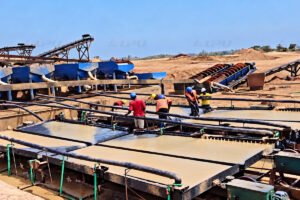
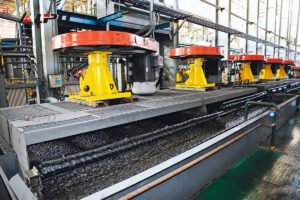
Tantalum niobium processing combines ore preparation, mineral recovery and concentrate upgrading. Alluvial, hard-rock and pyrochlore-bearing ores require different routes, selected through testwork to meet buyer specifications.
Send your ore analysis and target capacity to discuss a suitable flowsheet.
Identify the Minerals Before Selecting the Route
The first question is not which machine to install. It is how tantalum and niobium occur in the feed.
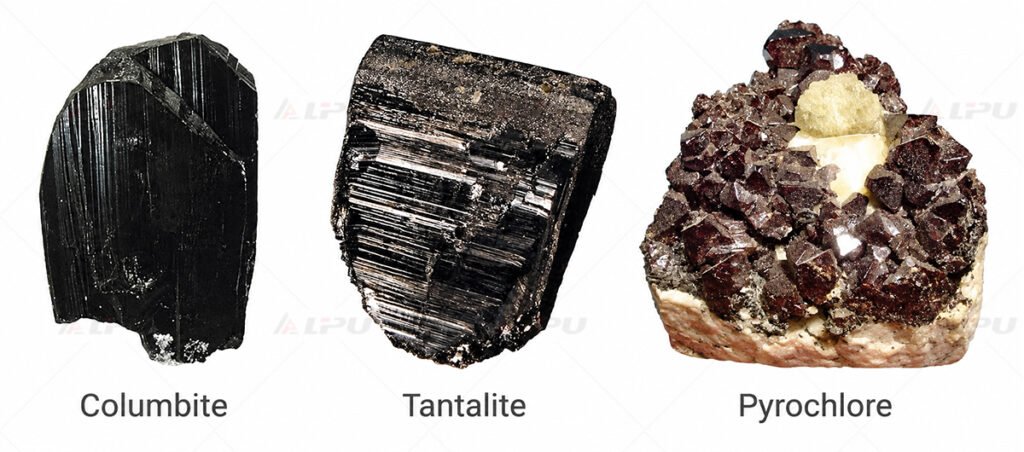
Columbite–tantalite minerals, commonly associated with the term coltan, differ from pyrochlore-bearing niobium ores. Associated cassiterite, iron minerals, sulfides and other heavy minerals can also influence the recovery and cleaning stages.
Different mineral types require different processing routes
A useful investigation combines chemical analysis with mineralogical examination and size-by-size testing. It should establish:
Which minerals contain tantalum and niobium.
Whether those minerals are liberated or locked with gangue.
How valuable minerals are distributed across particle sizes.
How much clay and fine material the feed contains.
Which associated minerals may be recovered or rejected.
Which constituents could affect concentrate acceptance.
Representative sampling is essential. Samples should reflect the expected mining zones and feed variability, rather than only unusually rich material.
Ore Type
Main Processing Question
Route to Evaluate
Alluvial or weathered columbite–tantalite
Are the valuable minerals liberated, and how difficult is clay removal?
Washing, screening and gravity recovery by size
Hard-rock columbite–tantalite
What degree of crushing and grinding releases the valuable minerals?
Staged size reduction, classification and gravity recovery
Mixed tin–tantalum–niobium material
Can valuable heavy minerals be recovered together and then separated?
Bulk gravity concentration followed by selective cleaning
Pyrochlore-bearing niobium ore
Which separation method suits the mineral associations?
A dedicated testwork-based route that may include flotation
These routes are starting points for testing, not interchangeable plant designs.
Alluvial Ore: Wash, Classify and Recover by Size
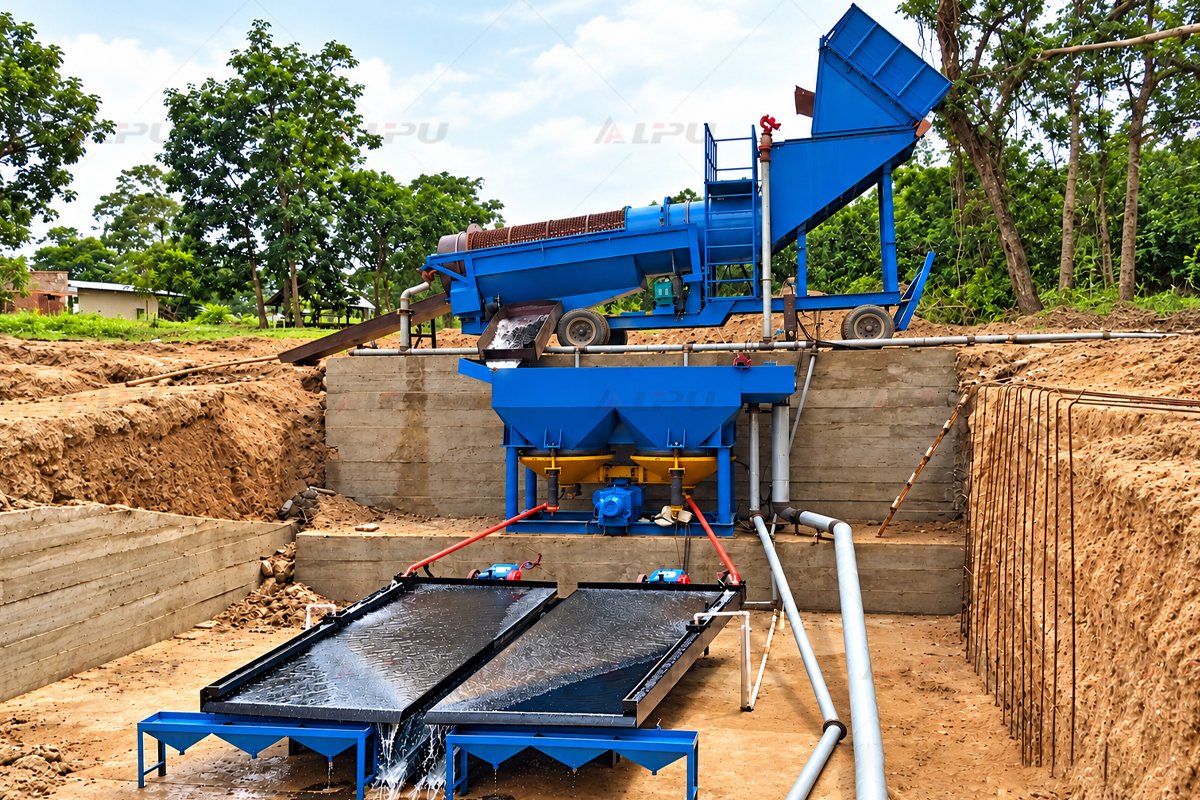
Alluvial processing often begins with releasing heavy minerals from clay and dividing the feed into suitable size fractions.
A grizzly can remove large material before the wet circuit. Where clay binds particles together, a scrubber may be needed ahead of screening. Cleaner, free-flowing feed may require a simpler washing arrangement.
The washed material is then screened and directed to recovery equipment suited to each fraction.
Typical route to evaluate:
Raw feed → Washing and screening → Gravity recovery by size → Concentrate cleaning → Dewatering
Oversize should be examined before disposal. It may contain barren rock, mineralized fragments or incompletely washed material. Its treatment should follow sampling and testing.
Match Gravity Equipment to the Classified Feed
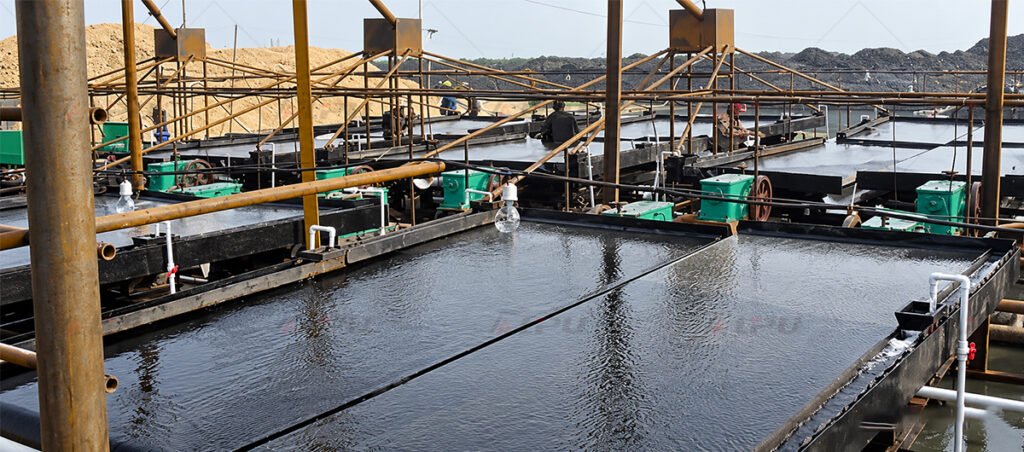
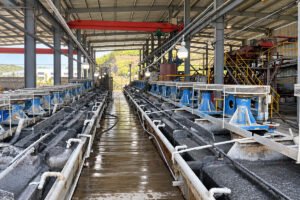
Washing and classification prepare feed for gravity recovery
Jigs may be evaluated for suitable coarser fractions. Shaking tables can be tested for finer classified material and concentrate cleaning. Centrifugal concentrators may warrant investigation where fine valuable minerals are not recovered effectively by conventional gravity equipment.
Equipment selection should account for feed size, liberation, solids concentration and the behavior of associated heavy minerals.
A wide particle-size range can make separation harder to control. Dividing the feed into narrower fractions may improve performance, but the benefit must justify the additional screens, pumps and operating duties.
For material containing recoverable cassiterite, the tin ore processing solution provides related examples of washing, classification and gravity recovery. The cleaning stages must still be selected for the actual tin–tantalum–niobium mineral assemblage.
Hard-Rock Ore: Liberate Minerals Without Excessive Grinding
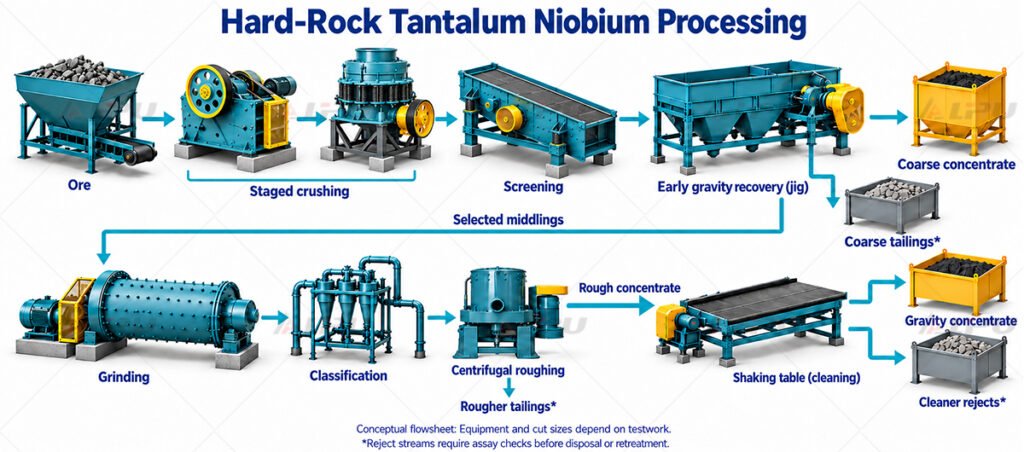
Hard-rock tantalum niobium ore requires sufficient size reduction to release valuable minerals from the host rock.
A jaw crusher may provide primary size reduction, followed by a cone crusher where ore characteristics and the required product size justify secondary crushing. Screening controls which material advances and which returns for further treatment.
Where testwork supports early gravity recovery, liberated heavy minerals can be removed before additional grinding.
Typical route to evaluate:
Ore → Staged crushing → Classification and early gravity recovery → Selected streams to grinding → Fine recovery → Concentrate cleaning
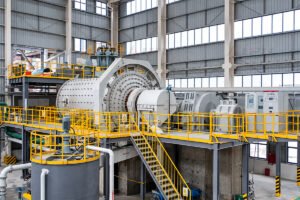
Staged liberation with early recovery of suitable heavy minerals
A ball mill may be used to grind selected material that requires further liberation. Its configuration and grinding target should follow liberation and recovery testing.
Grinding every stream to the same fine size can increase energy consumption and create material that is more difficult to recover. The circuit should therefore balance mineral liberation with the need to limit unnecessary fines.
Regrind Selected Middlings
A middlings product should be examined before it is recycled.
If valuable minerals remain locked with gangue, additional grinding may improve liberation. If they are already liberated, changes to classification or separation conditions may be more useful.
Selective regrinding should therefore be based on mineralogical evidence rather than applied to every intermediate stream.
Fine Material Needs a Defined Recovery Strategy
Fine material should be sampled and evaluated before being classified as waste.
Desliming can improve downstream separation, but the removed fraction may contain valuable minerals. Measure both the mass distribution and the tantalum and niobium distribution before selecting a cut size.
Fine-material testing should answer several questions:
How much of the valuable mineral is liberated?
Which size fractions respond to gravity recovery?
Does centrifugal concentration offer a useful recovery stage?
Would selected middlings benefit from further liberation?
Does flotation warrant investigation?
Assess the complete circuit rather than an isolated stage. A high recovery during concentrate cleaning does not establish a high recovery from the original ore.
A study of Abu Dabbab ore demonstrated a route combining centrifugal concentration and magnetic upgrading. Its results illustrate a possible approach, but the operating conditions and performance belong to that specific material.
Upgrade the Heavy-Mineral Concentrate Selectively
Gravity separation may produce a mixed heavy-mineral concentrate rather than a finished product.
The cleaning circuit must address the actual mineral assemblage. Material containing columbite–tantalite, cassiterite and iron-bearing minerals requires a different strategy from a concentrate with fewer associated minerals.
Gravity Cleaning
Shaking tables or other suitable gravity equipment may be evaluated to remove remaining light gangue and produce cleaner heavy-mineral fractions.
Stable feed rate, controlled water flow and appropriate sizing are part of the separation duty. A cleaner should be assessed using representative rougher concentrate.
Magnetic Separation
Magnetic testing should establish the response of both valuable and unwanted minerals.
The appropriate equipment, magnetic conditions and number of stages depend on those results. A single separator should not be assumed to produce all required products in one pass.
Cleaner stages, scavenging or middlings retreatment may be necessary.
Electrostatic Separation
Electrostatic separation may be considered where differences in electrical response provide a useful separation.
Its evaluation must include feed sizing, moisture and surface condition. Dry-feed preparation is part of the process duty, not a separate afterthought.
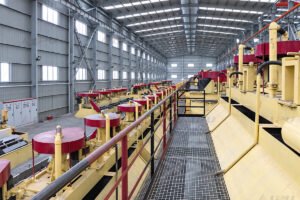
Flotation
Flotation should have a defined purpose within the flowsheet.
Depending on the ore, it may be investigated for valuable-mineral recovery or the removal of particular associated minerals. It should not be described as a routine step used only to remove quartz.
Where testing demonstrates a useful flotation response, the flotation machine should be selected together with the conditioning, reagent addition and concentrate-cleaning requirements.
Pyrochlore-Bearing Niobium Ore Requires a Separate Flowsheet
A columbite–tantalite gravity plant should not be used as the default design for pyrochlore-bearing niobium ore.
For this feed, investigate mineral associations, liberation, slime behavior and separation response independently.
The proposed route may include:
Crushing and grinding to the required liberation.
Classification and controlled slime management.
Conditioning and flotation where supported by testing.
Concentrate cleaning and any justified impurity-removal stages.
Dewatering and product handling.
The equipment package should follow a demonstrated process response. The presence of niobium alone is insufficient to justify a particular circuit.
Design Around the Concentrate the Buyer Will Accept
Confirm the intended product before finalizing the cleaning circuit.
The highest achievable concentrate grade is not automatically the best commercial outcome. Additional cleaning may reduce recovery, add operating costs or produce little improvement in payable value.
Request the buyer’s requirements for:
Ta₂O₅ and Nb₂O₅ content.
Payable components and the basis of settlement.
Moisture and particle size.
Restricted impurities and associated minerals.
Sampling and analytical procedures.
Packaging, origin and traceability documentation.
Uranium and thorium analysis where applicable.
A mixed concentrate may be valued differently from a separated product. Commercial acceptance should be confirmed with the intended buyer rather than inferred from combined tantalum and niobium content alone.
Mineral Concentration Is Different From Chemical Refining
Physical beneficiation produces mineral concentrates. It does not automatically separate tantalum and niobium into purified chemical products or metals.
Some uranium and thorium may also occur within the valuable mineral structure. Their removal should not be assumed from gravity or magnetic cleaning alone. Characterization should inform product handling and downstream processing decisions.
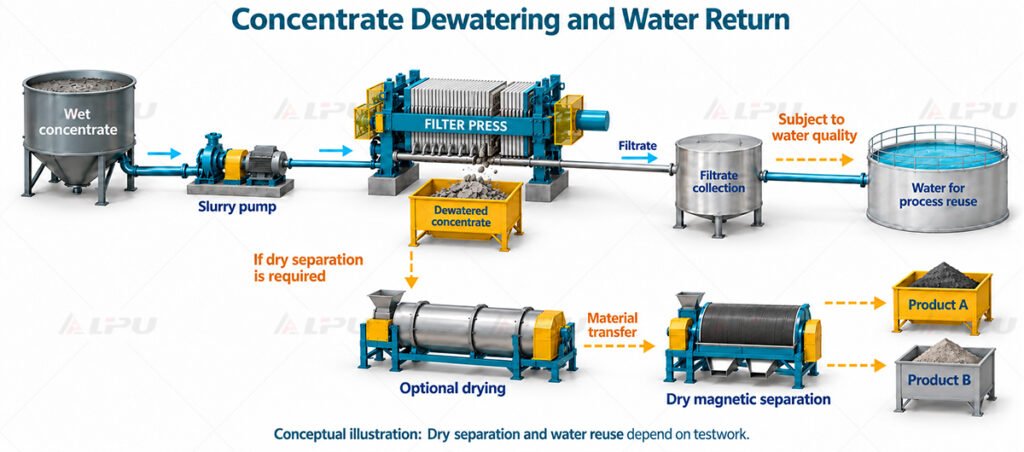
Dewatering, Dry Separation and Water Return
Water handling should be designed together with the recovery circuit.
Wet concentrate may require settling, thickening or filtration before storage and dispatch. The appropriate arrangement depends on the solids, required moisture and downstream processing stages.
If dry magnetic or electrostatic separation is proposed, establish the moisture and temperature conditions needed for stable feeding and separation.
A dryer should be included only where its duty is justified by the process, local conditions and production requirements.
Conceptual water arrangement:
Process slurry → Solids recovery and dewatering → Water collection → Clarification or treatment → Suitable process-water reuse
Concentrate dewatering and water return
Returned water may contain fine solids or dissolved constituents that affect washing and separation. Water reuse should therefore follow a water balance and an assessment of the required water quality.
Tailings, slimes and concentrate-cleaning rejects may have different characteristics. Evaluate them separately where those differences affect storage, water recovery or handling.
Select Equipment From Defined Process Duties
Equipment should be sized for the material reaching each stage, including circulating loads and expected feed variability.
Process Duty
Equipment to Evaluate
Information Needed for Selection
Feed regulation
Hopper, grizzly and feeder
Maximum lump size, moisture and feed variability
Clay disaggregation
Scrubber or washing equipment
Clay behavior and washing results
Size separation
Screens and classifiers
Required cuts and solids distribution
Size reduction
Crushers and grinding equipment
Competence, abrasiveness and liberation
Gravity recovery
Jigs, shaking tables and centrifugal concentrators
Size-by-size recovery response
Concentrate upgrading
Magnetic, electrostatic or flotation equipment
Mineral-specific separation results
Product dewatering
Thickener and filtration equipment
Settling behavior and filtration results
Dry-feed preparation
Dryer and controlled feeder, where needed
Moisture target and downstream duty
Water management
Sumps, pumps, clarification and storage
Water balance and reuse requirements
Raw-feed capacity alone is insufficient for selecting a plant.
Two ores treated at the same hourly tonnage may impose different loads because of clay, water demand, fine solids and circulating material. Capacity estimates should state the feed assumptions on which they depend.
Develop the Flowsheet Before Finalizing the Equipment List
A practical development program connects ore characterization with product requirements.
1. Characterize Representative Feed
Establish mineralogy, assays, particle-size distribution and the expected range of feed conditions.
2. Test the Main Recovery Route
Evaluate washing, liberation and separation options using representative material.
3. Investigate Concentrate Cleaning
Determine whether the rougher product can meet the buyer’s requirements and identify any additional treatment needed.
4. Check Water and Residue Behavior
Examine settling, filtration, water reuse and the characteristics of the proposed residue streams.
5. Prepare the Design Basis
Define equipment duties, operating assumptions, utility requirements and the outstanding work needed before detailed design.
A useful preliminary proposal should make these assumptions visible. Recovery and concentrate-quality targets should follow representative testing.
Information Needed for a Preliminary Plant Proposal
Provide as much of the following information as is available:
Deposit type and representative ore photographs.
Chemical assays and mineralogical reports.
Target raw-feed capacity and operating hours.
Feed size, clay content and moisture.
Existing washing or metallurgical test results.
Intended concentrate market and buyer specifications.
Water and power availability.
Site layout, access and elevation information.
Tailings storage and water-management arrangements.
Product packaging and transport requirements.
If some information is missing, identify it as an assumption or an investigation requirement rather than treating it as a confirmed design input.
Frequently Asked Questions
Can one plant process both alluvial and hard-rock tantalum ore?
Some equipment may serve both feeds, but their preparation and liberation requirements can differ substantially. A shared plant must account for those differences and the expected operating schedule.
Is a ball mill always required?
No. Liberated alluvial material may not require grinding. Hard-rock material may need grinding, but the duty should be established through liberation and recovery testing.
Can gravity separation produce a finished concentrate?
It may do so for suitable feed. Other material produces a mixed heavy-mineral concentrate that requires further cleaning.
Can magnetic separation completely separate tantalum from niobium?
It should not be assumed. Magnetic separation acts on mineral response and does not necessarily separate tantalum and niobium contained within the same mineral.
Should all slimes be discarded?
No. Sample and assay the fine fraction before deciding its treatment. Desliming may help the main circuit while also creating a valuable-mineral loss.
Is flotation only used to remove quartz?
No. Its role depends on the mineral assemblage and test results. It may be investigated for valuable-mineral recovery or the removal of selected associated minerals.
Can a plant be selected from the feed grade and hourly capacity alone?
No. Those figures do not establish liberation, clay behavior, separation response or concentrate quality. Representative characterization and testing are needed.
Can recovery and concentrate grade be guaranteed before testing?
A dependable target requires representative samples, defined feed conditions and a demonstrated circuit. Results from another deposit are insufficient.