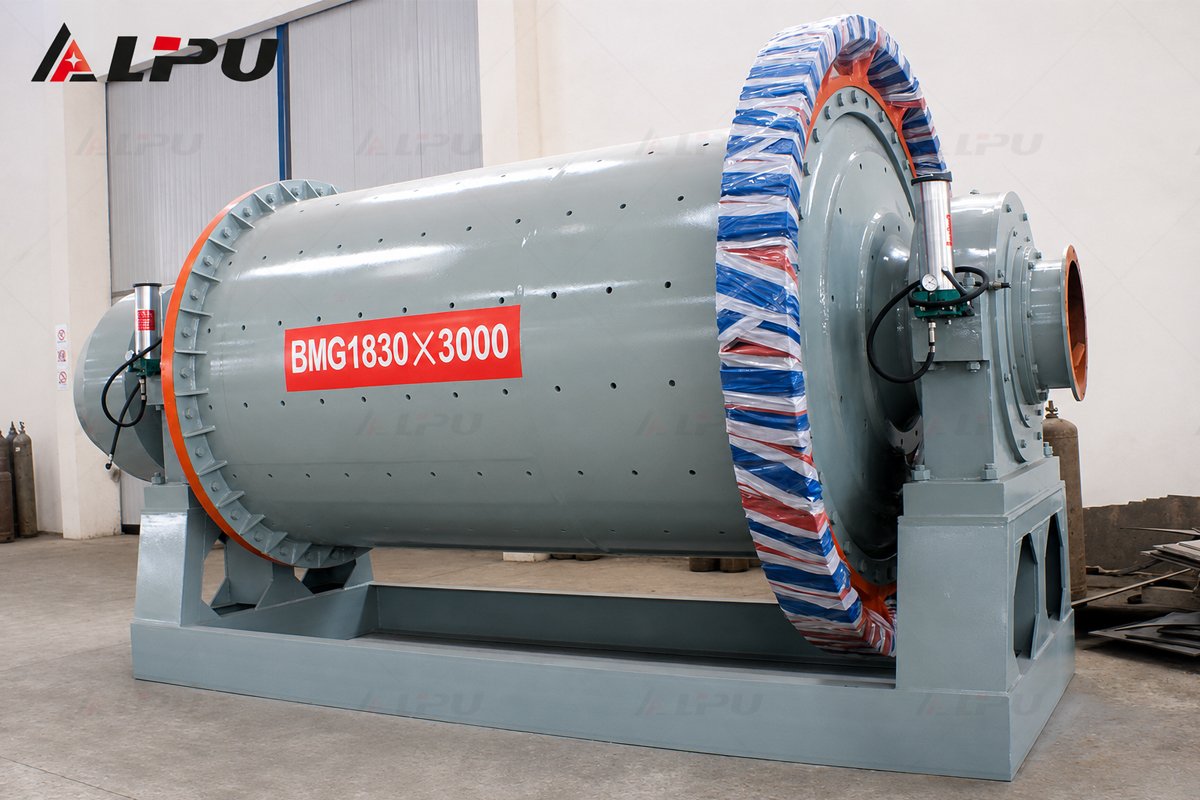
LIPU rod mills are grinding machines that use steel rods as the grinding media for coarse grinding and controlled particle-size reduction.
Compared with ball grinding, the long steel rods provide predominantly line contact with the material. This helps preferentially break larger particles while reducing excessive grinding of already-fine particles.
Rod mills are widely used in mineral processing plants, especially where a relatively uniform product, reduced overgrinding and controlled coarse grinding are important. They can also be used in manufactured sand and industrial mineral processing applications.
A rod mill is a cylindrical grinding machine filled with steel rods rather than steel balls.
As the cylinder rotates, the rods are lifted and then tumble or roll through the material. The rods contact the ore along their length, creating a grinding action that differs from the point-contact impact of ball media.
This characteristic makes rod mills particularly suitable for:
Coarse ore grinding
Open-circuit grinding
Preparation before gravity separation
Preparation before magnetic separation
Reducing overgrinding of valuable minerals
Manufactured sand production
Industrial mineral grinding
LIPU supplies MBS Series rod mills for different feed sizes, capacities and grinding requirements.
Wet and Dry Rod Mill Types
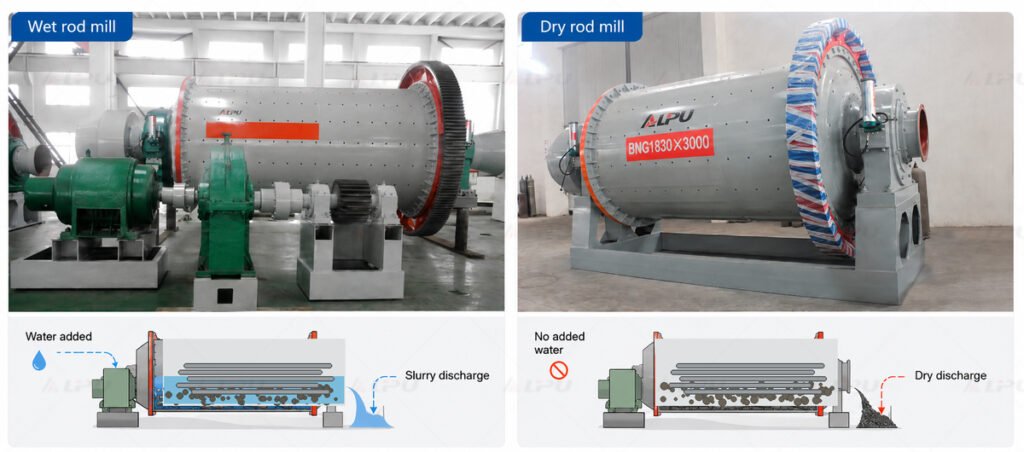
Rod mills can be configured for wet or dry grinding depending on the process.
Wet dry rod mill types corrected
Wet Rod Mill
Wet rod mills operate with water or process slurry inside the cylinder.
They are commonly used in mineral beneficiation plants because the ground product can be transferred directly to subsequent classification or separation equipment.
Typical applications include:
Gold ore
Iron ore
Copper ore
Tungsten and tin ore
Manganese ore
Other mineral beneficiation circuits
Wet grinding can also help control dust and improve material transportation through the grinding circuit.
Dry Rod Mill
Dry rod mills are used where water cannot be introduced into the process or where a dry product is required.
Typical applications can include:
Quartz
Feldspar
Limestone
Industrial minerals
Selected sand-making applications
The final choice between wet and dry grinding should consider the downstream process, moisture requirements and material characteristics.
Materials and Applications
Rod mills can process a range of ores and industrial materials.
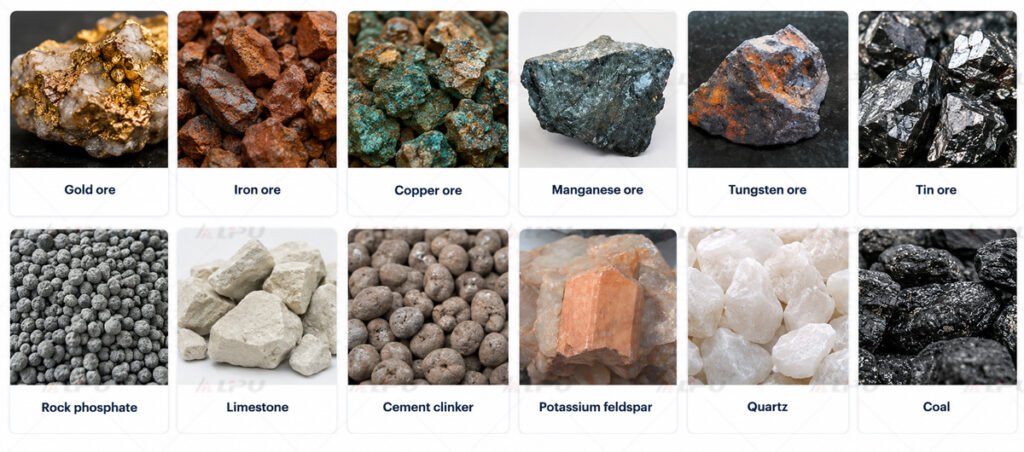
Typical ores and minerals suitable for rod mill grinding
Typical materials include:
Gold ore
Iron ore
Copper ore
Manganese ore
Tungsten ore
Tin ore
Rock phosphate
Limestone
Cement clinker
Potassium feldspar
Quartz
Coal
Other suitable mineral materials
Typical application areas include:
Mineral beneficiation plants
Gravity concentration circuits
Magnetic separation circuits
Coarse grinding before beneficiation
Manufactured sand production
Industrial mineral processing
In mineral processing plants, a rod mill may be used before a Spiral Classifier, Magnetic Separator or other downstream separation equipment.
Why Use Rod Grinding Instead of Ball Grinding?
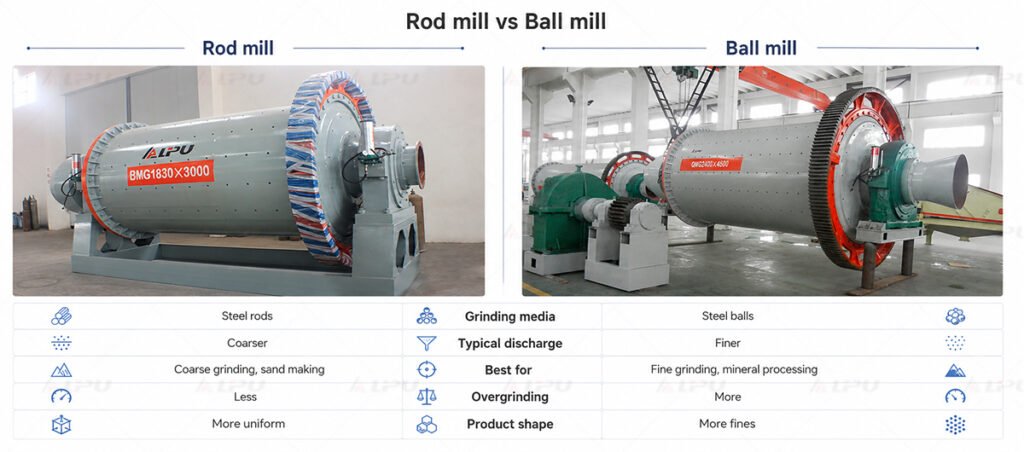
The main difference between a rod mill and a Ball Mill is the grinding media and the way the media contacts the material.
A rod mill uses long steel rods, while a ball mill uses steel balls or other spherical media.
Fine grinding before flotation or other beneficiation
A rod mill is therefore especially useful where the process requires selective reduction of coarse particles without producing excessive fines.
However, a ball mill is generally more suitable when a finer final product is required.
How Does a Rod Mill Work?
The motor drives the cylinder through the transmission system.
Steel rods are loaded into the rotating cylinder as the grinding media.
Working Principle of the Rod Mill
The grinding process follows several stages:
Material enters the cylinder through the feed end.
Cylinder rotation lifts the steel rods and ore particles.
The rods tumble, roll and slide through the material.
Larger particles are preferentially broken between the rods.
Material gradually moves toward the discharge end.
Ground material leaves the mill and enters the next process stage.
Because the rods remain in longitudinal contact with the material, coarse particles are more likely to be captured and ground while finer particles can pass through the spaces between the rods.
This produces the selective grinding characteristic associated with rod mills.
Main Components
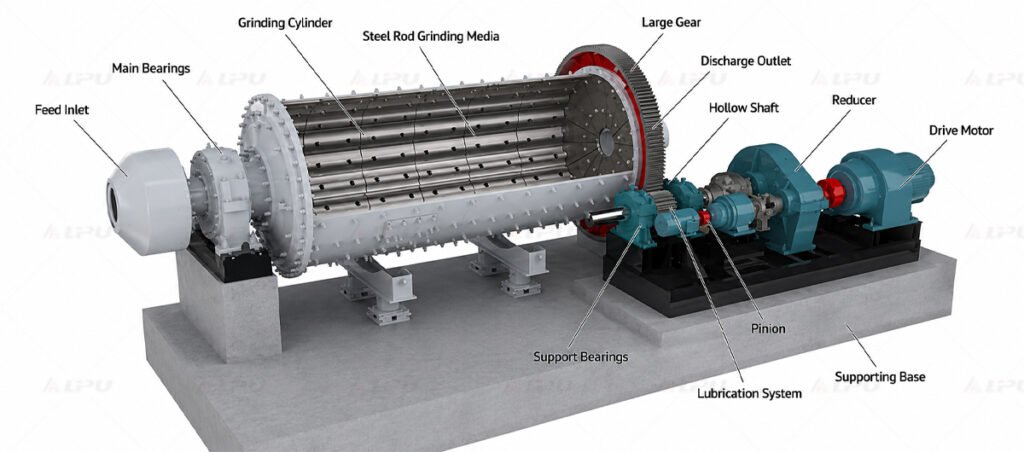
Main structural components of a rod mill
A typical LIPU rod mill includes:
Grinding cylinder
Steel rod grinding media
Feeding device
Discharge device
Hollow shaft
Main bearings
Large gear
Pinion
Reducer
Drive motor
Lubrication system
Supporting base
The cylinder, liners, transmission system and grinding media should be selected according to ore characteristics and required operating conditions.
Rod Mill for Coarse Grinding and Sand Making
Rod mills are not limited to conventional ore grinding.
Because they can produce a relatively controlled particle-size distribution with less excessive fines, they can also be used in some manufactured sand and aggregate-processing circuits.
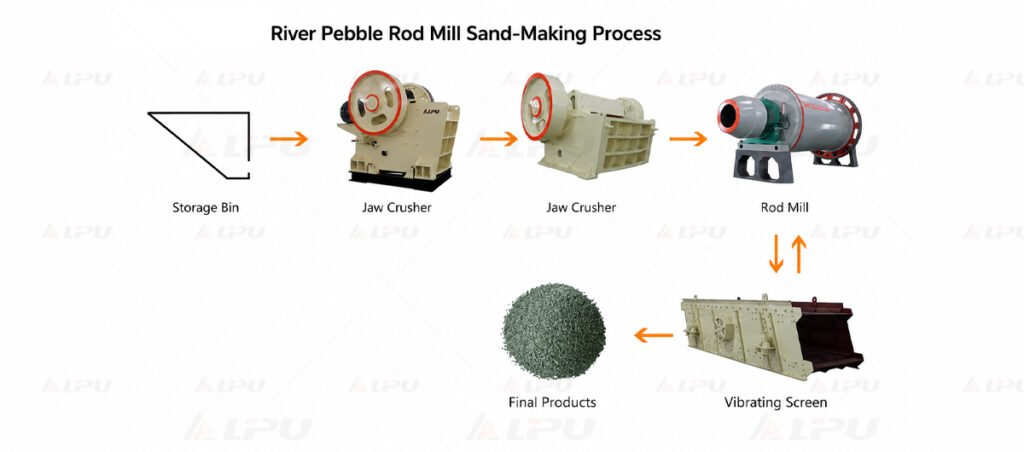
A typical rod mill sand-making process may include:
Raw Material → Crushing → Rod Mill → Screening → Finished Sand
Typical rod mill process for manufactured sand production
In this type of circuit, the upstream crusher reduces large feed material to a size suitable for the rod mill.
The rod mill then performs additional shaping and particle-size reduction.
Screening separates the finished product into the required size fractions, while oversized material can be returned for further processing.
This configuration may be suitable for:
Quartz sand
Limestone sand
Manufactured sand
Selected industrial mineral products
The final process should be configured according to feed hardness, abrasiveness and required product gradation.
Rod Mill Technical Parameters
MBS Series Rod Mill
Model
Cylinder Diameter (mm)
Cylinder Length (mm)
Shell Speed (r/min)
Feed Size (mm)
Discharge Size (mm)
Capacity (t/h)
Motor Power (kW)
Gross Weight (kg)
MBS0918
900
1800
36–38
≤25
0.833–0.147
0.62–3.2
18.5
5,500
MBS0924
900
2400
36
≤25
0.833–0.147
0.81–4.3
22
6,100
MBS1224
1200
2400
36
≤25
0.833–0.147
1.1–4.9
30
12,000
MBS1530
1500
3000
29.7
≤25
0.833–0.147
2.4–7.5
75
16,800
MBS1830
1830
3000
25.4
≤25
0.833–0.147
4.8–11.6
130
29,000
MBS2130
2100
3000
23.7
≤25
0.833–0.147
14–35
155
34,800
MBS2136
2100
3600
23.7
≤25
0.833–0.147
19–43
180
37,000
MBS2430
2400
3000
21
≤50
0.833–0.147
25–65
245
54,000
MBS2736
2700
3600
20.7
≤50
0.833–0.147
32–86
380
86,000
MBS2740
2700
4000
20.7
≤50
0.833–0.147
32–92
400
94,000
MBS3245
3200
4500
18
≤50
0.833–0.147
64–180
630
137,000
Actual capacity and product size depend on material hardness, feed gradation, grinding media loading, mill speed and operating conditions.
How to Select the Right Rod Mill
Rod mill selection should begin with the grinding objective rather than only the required production capacity.
Important information includes:
Material type
Material hardness
Maximum feed size
Required capacity
Target product size
Wet or dry grinding
Downstream beneficiation process
Required control of overgrinding
Abrasiveness
Installation conditions
For Mineral Beneficiation
If the rod mill is used before gravity or magnetic separation, product-size distribution and mineral liberation should be considered together.
Excessive grinding may produce fine particles that are more difficult to recover in some separation processes.
For Sand Making
For manufactured sand applications, the selection should consider:
Feed hardness
Feed size
Required sand gradation
Required fines content
Wear resistance
For Finer Grinding
If the required product is substantially finer than the practical range of rod grinding, a ball mill may be more suitable.
LIPU can evaluate the complete grinding circuit before selecting the final mill model.
Why Choose LIPU?
LIPU Heavy Industry provides grinding and mineral processing equipment for complete beneficiation and material-processing plants.
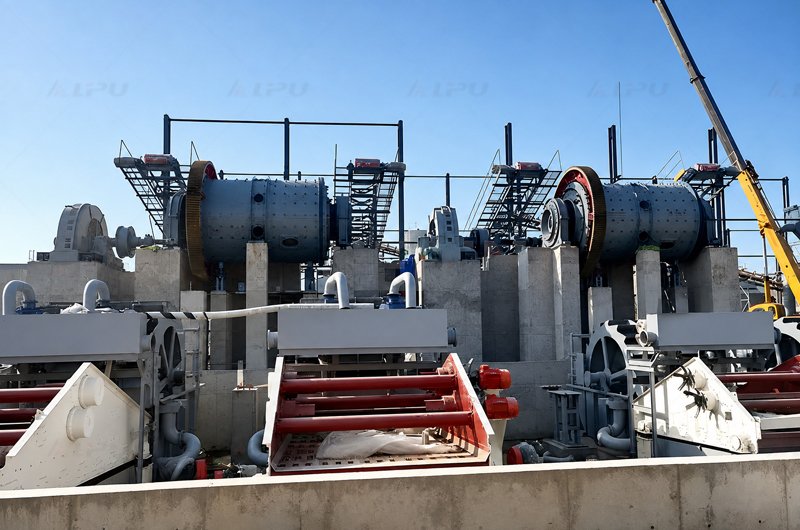
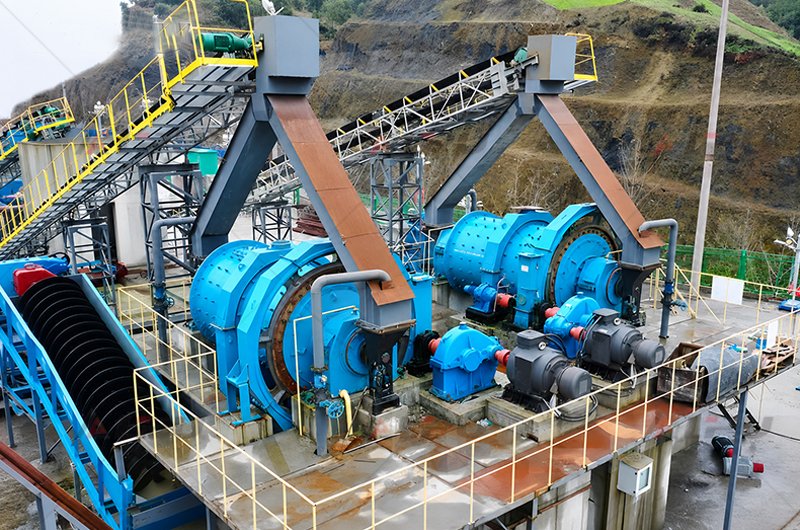
Rod mill for coarse grinding in a mineral beneficiation plant
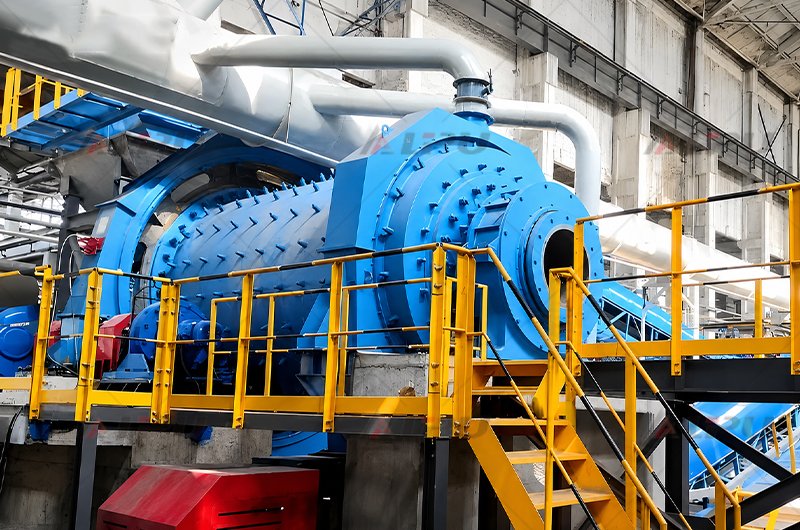
Rod mill for controlled coarse grinding before mineral separation
Rod mill in an industrial mineral processing circuit
For rod mill projects, LIPU can support:
Ore and material analysis
Rod mill model selection
Wet or dry grinding configuration
Grinding circuit design
Capacity matching
Grinding media selection
Equipment manufacturing
Factory testing
Installation guidance
Commissioning support
Spare and wear parts supply
Technical support
Rod mills can also be integrated with crushing, classification, gravity separation and magnetic separation equipment as part of a complete processing line.
Frequently Asked Questions
What is the main difference between a rod mill and a ball mill?
A rod mill uses steel rods as grinding media and is generally used for coarser grinding. A ball mill uses spherical grinding media and is typically more suitable for finer grinding.
Why does a rod mill produce less overgrinding?
The long steel rods create predominantly line contact with the material and preferentially grind larger particles. This helps reduce unnecessary grinding of particles that are already fine.
Can a rod mill be used for manufactured sand?
Yes. Rod mills can be used in selected manufactured sand circuits where controlled particle-size reduction and reduced excessive fines are required.
Can a rod mill operate wet or dry?
Yes. Rod mills can be configured for wet or dry grinding depending on the material and downstream process.
What information is needed to select a rod mill?
Provide the material, maximum feed size, required capacity, target product size, wet or dry process and downstream application. These factors determine the appropriate mill model and configuration.